Table of Contents
- It Is Not Too Late - Why Starting from Zero Is Fine
- Choosing a Dance Style That Fits You
- Finding the Right Beginner Classes
- Learning at Home - YouTube, Apps, and Online Platforms
- Building Your Sense of Rhythm
- Overcoming Self-Consciousness on the Dance Floor
- Physical Preparation - Flexibility, Strength, and Stamina
- Creating a Practice Routine That Sticks
- Social Dancing - Taking Your Skills Out in Public
- Key Takeaways
- Frequently Asked Questions
It Is Not Too Late - Why Starting from Zero Is Fine
Let us get the biggest mental hurdle out of the way first. You are not too old, too uncoordinated, too stiff, or too anything else to learn how to dance with no experience. This is not a polite platitude - it is a fact backed by the experiences of thousands of adult beginners who start dancing every year and find themselves performing, competing, or simply enjoying social dance floors within months.
Misty Copeland did not start ballet until she was 13 - ancient by ballet standards - and became the first African American principal dancer at American Ballet Theatre. Takahiro Ueno started popping at 16 and became one of the most respected street dancers in the world. These are extreme examples, but they illustrate a point: the idea that you must start dancing as a toddler to be any good is a myth.
What adults actually have as an advantage over children is cognitive understanding. You can learn concepts, analyze movement, and apply corrections more quickly than a seven-year-old. You understand musicality because you have been listening to music your entire life. Your body might be less flexible than it was at ten, but that is a solvable problem - not a permanent limitation.
The real barrier for most adults is not physical. It is psychological. The fear of looking stupid in front of other people keeps more potential dancers on the sidelines than any physical limitation ever could. We will address that fear directly later in this guide. For now, know this: every single person in a beginner dance class started exactly where you are.
Choosing a Dance Style That Fits You
The question of how to dance with no experience starts with choosing what kind of dance appeals to you. Do not overthink this - go with your gut. You can always explore other styles later. Here is an honest breakdown of popular styles and what they demand from beginners:
Hip-hop: High energy, groove-based, and the most popular class style for adults. You will learn isolations (moving one body part independently), basic grooves, and choreography set to current music. Physically demanding but extremely fun. Great for people who want to dance to the music they already listen to.
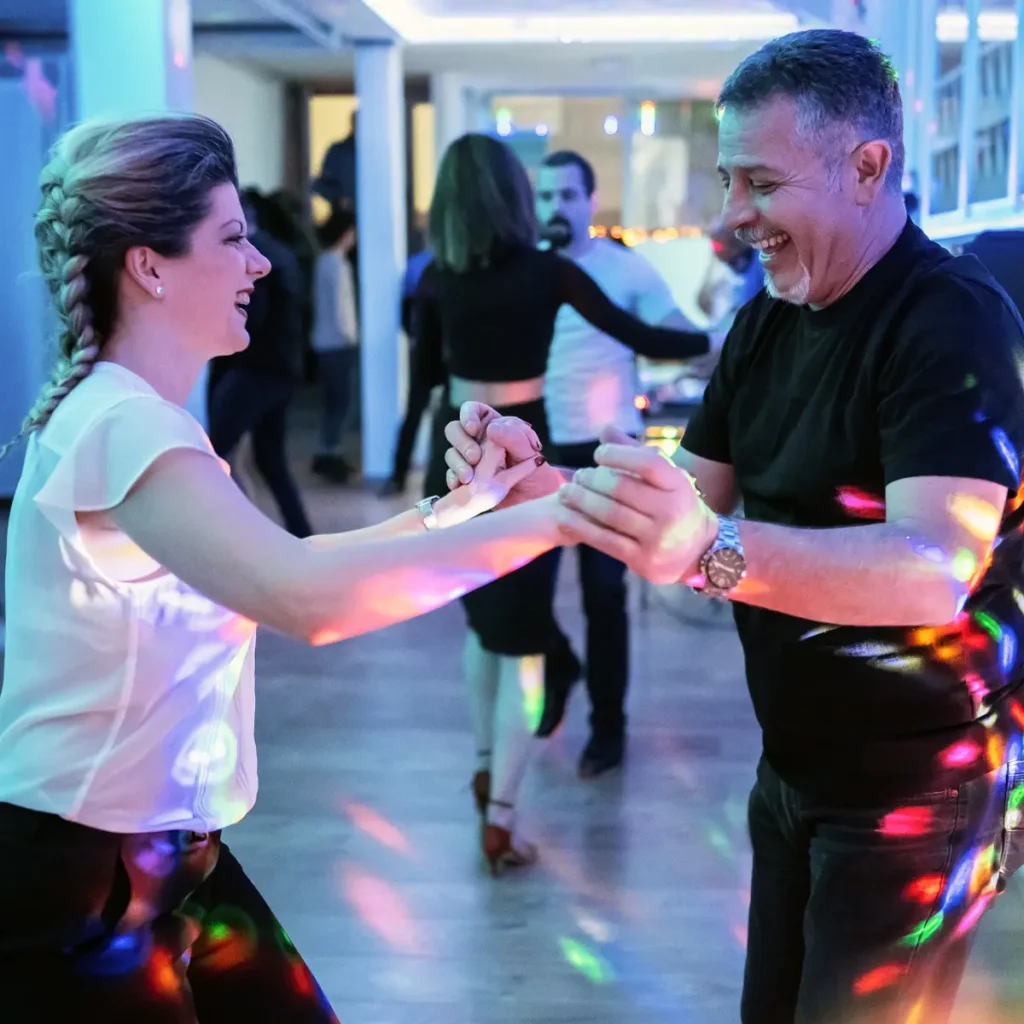
Salsa and bachata: Partner dances with a strong social component. You will learn patterns, lead/follow dynamics, and musicality. Most cities have active salsa and bachata scenes with weekly social dances where beginners are welcomed. This is the fastest path from “I cannot dance” to “I am dancing with a partner at a real event.”
Contemporary/modern: Expressive, floor-based, and emotionally driven. Requires more flexibility than hip-hop but does not demand the rigid technique of ballet. Good for people who want dance as a form of personal expression. Expect floorwork, improvisation exercises, and movement that connects to your emotions.
Ballet: The foundation of Western dance technique. Adult beginner ballet classes are widely available and focus on posture, alignment, basic positions, and simple combinations at the barre. Progress is slower than in other styles, but ballet training improves every other dance style you might pursue later.
Swing (Lindy Hop, East Coast, West Coast): Fun, social, and rooted in jazz music. Swing dancing has an incredibly welcoming community and regular social events in most cities. You will be dancing with partners from your very first class.
Breaking: Athletic, creative, and deeply rooted in hip-hop culture. Breaking includes toprock (standing moves), footwork (floor-based steps), power moves (spins and acrobatics), and freezes (held positions). Physically demanding but endlessly creative. Now an Olympic sport as of Paris 2024.
Dancehall and Afrobeats: High-energy styles rooted in Caribbean and African music traditions. These styles emphasize body movement, rhythm, and enjoyment over rigid technique. Growing rapidly in popularity, with classes available in most major cities.
Finding the Right Beginner Classes
The quality of your first dance class will significantly impact whether you continue or quit. A bad first experience can set you back months. Here is how to find the right class:
Search for “absolute beginner” or “intro” level classes. Many studios label their easiest class as “beginner” when it is actually attended by people who have been dancing for a year or more. Look for classes specifically described as “no experience needed” or “Level 0.” Studios like Millennium Dance Complex (LA), Broadway Dance Center (NYC), and Pineapple Dance Studios (London) clearly label their levels.
Check Google and Yelp reviews. Read reviews specifically from beginners. Comments like “I had never danced before and felt welcomed” are exactly what you want to see. Avoid studios where reviews mention a cliquey or intimidating atmosphere.
Try a drop-in class first. Most studios offer single-class drop-in rates ($15-25) before committing to a package or membership. Take 2-3 different classes at different studios before choosing where to train regularly. The instructor’s teaching style matters enormously - some teachers break things down patiently for beginners while others blast through choreography at high speed.
Community centers and rec departments are underrated. City recreation departments often offer dance classes at a fraction of studio prices ($5-10 per class). The instruction may be less intense, but the atmosphere tends to be relaxed and welcoming for true beginners. YMCA locations frequently offer dance fitness and beginner classes as well.
Learning at Home - YouTube, Apps, and Online Platforms
If attending in-person classes feels too intimidating or is not practical, learning how to dance with no experience at home is absolutely viable. The online dance education space has exploded, and some of the best instruction available is free or very affordable.
YouTube channels worth following: STEEZY (hip-hop choreography tutorials with clear breakdowns), MihranTV (beginner-friendly hip-hop and party dance moves), Passion4Dancing (salsa, bachata, and ballroom basics), and Kathryn Morgan (adult beginner ballet). These channels provide structured, follow-along lessons that you can pause, rewind, and repeat at your own pace.
STEEZY Studio ($19.99/month): The most comprehensive online dance learning platform. STEEZY offers structured programs for absolute beginners in hip-hop, popping, house, choreography, and more. Each program builds progressively over multiple classes, and the video player lets you slow down or mirror the instruction. Over 1,500 classes are available.
CLI Studios ($9.99/month): Focuses on contemporary, jazz, ballet, and hip-hop. Taught by professional choreographers and dancers, with classes organized by difficulty. Great for people interested in studio dance styles.
Free resources: TikTok and Instagram Reels are surprisingly useful for learning isolated moves and short combinations. Search for dance tutorial content in your preferred style. The format forces creators to be concise and clear, which often makes for effective micro-lessons.
The one limitation of home learning is the absence of real-time feedback. You cannot know if your posture is wrong or your timing is off unless you film yourself and critically review the footage. Set up your phone to record your practice sessions and compare your movement to the instructor’s. This self-correction habit will accelerate your progress dramatically.
Building Your Sense of Rhythm
“I have no rhythm” is the most common thing non-dancers say, and it is almost never true. Rhythm is not a talent you are born with or without - it is a skill you develop. If you can clap along to a song, you have rhythm. You just need to train your body to express it.
Start by listening actively to music. Put on a song you like and focus on the beat - the steady pulse that makes you want to nod your head or tap your foot. That pulse is usually the kick drum and snare drum. The snare typically hits on beats 2 and 4 of every measure. Try clapping on those beats while listening. This exercise alone will improve your musicality more than you expect.
Practice counting music. Most popular music (pop, hip-hop, R&B, rock) is in 4/4 time, meaning you count “1, 2, 3, 4” repeatedly. Dance choreography is usually taught in sets of 8 counts: “1, 2, 3, 4, 5, 6, 7, 8.” Practice counting along to songs until you can identify where each 8-count begins without losing your place.
Move to music daily. This does not need to be formal practice. Just put on music while cooking, cleaning, or getting ready and let your body respond. Bounce, sway, nod your head - anything that connects your movement to the rhythm. The more time your body spends moving to music, the more natural it becomes.
Use a metronome app. Apps like Pro Metronome (free) let you set a specific tempo and practice simple movements in time. Start slow (60 BPM) and work up. Step side to side on the beat. March in place. Do simple arm movements. The goal is building the neural connection between hearing a beat and responding physically.