Understanding how music royalties work is essential for any songwriter, artist, or producer who wants to earn a living from their music. The royalty system can seem overwhelming at first - it involves multiple types of payments, several different organizations, and a web of legal and contractual relationships. But at its core, the concept is straightforward: whenever your music is used, someone owes you money.
The music industry generated over $28 billion in global recorded music revenue in 2023, according to the IFPI. A significant portion of that money flows to creators through various royalty streams. The challenge is not that the money does not exist - it is that the system for collecting and distributing it is fragmented across multiple organizations, platforms, and territories. Artists who understand how royalties work are able to set up proper collection mechanisms and capture every dollar they are owed. Those who do not often leave substantial money on the table.
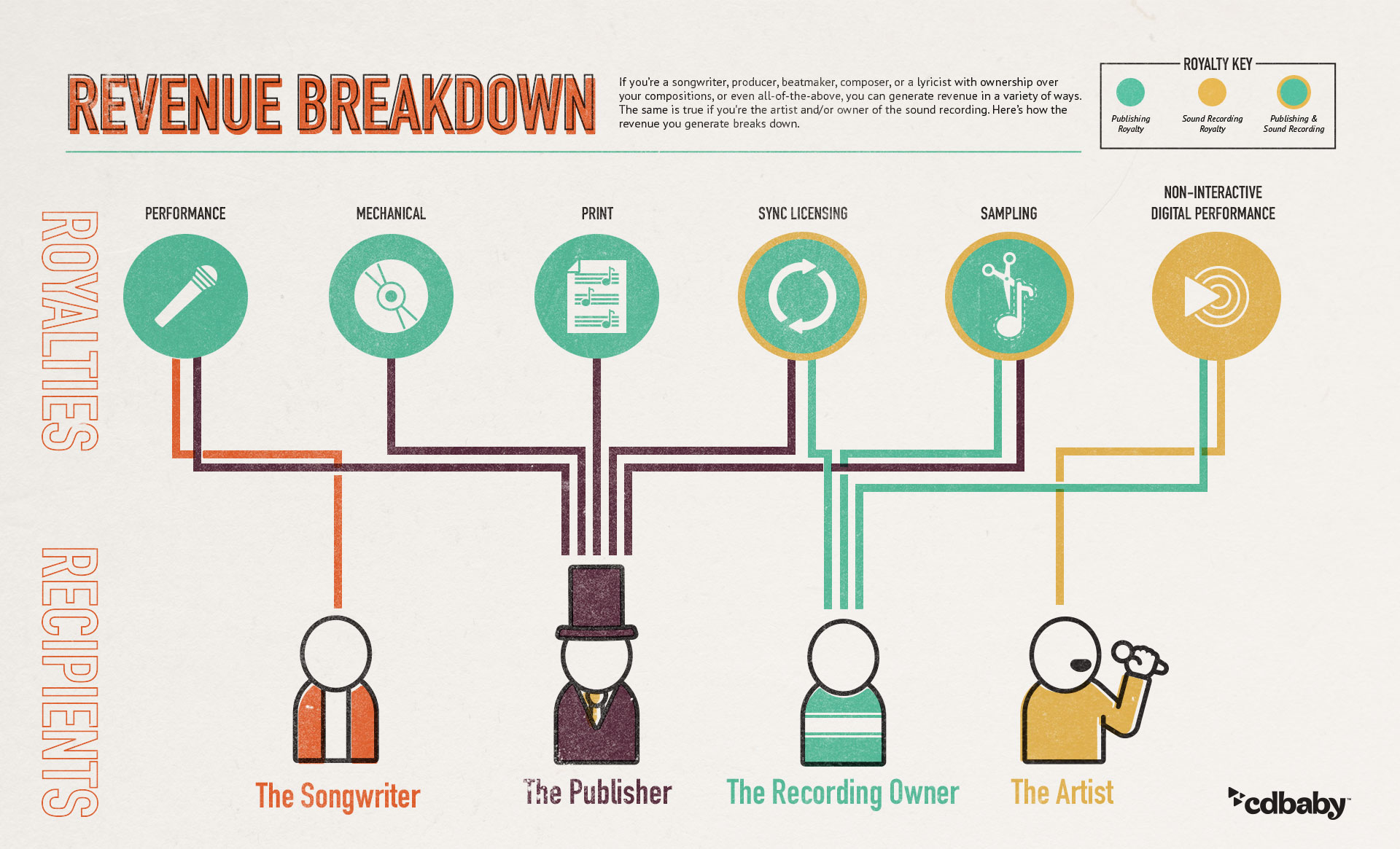
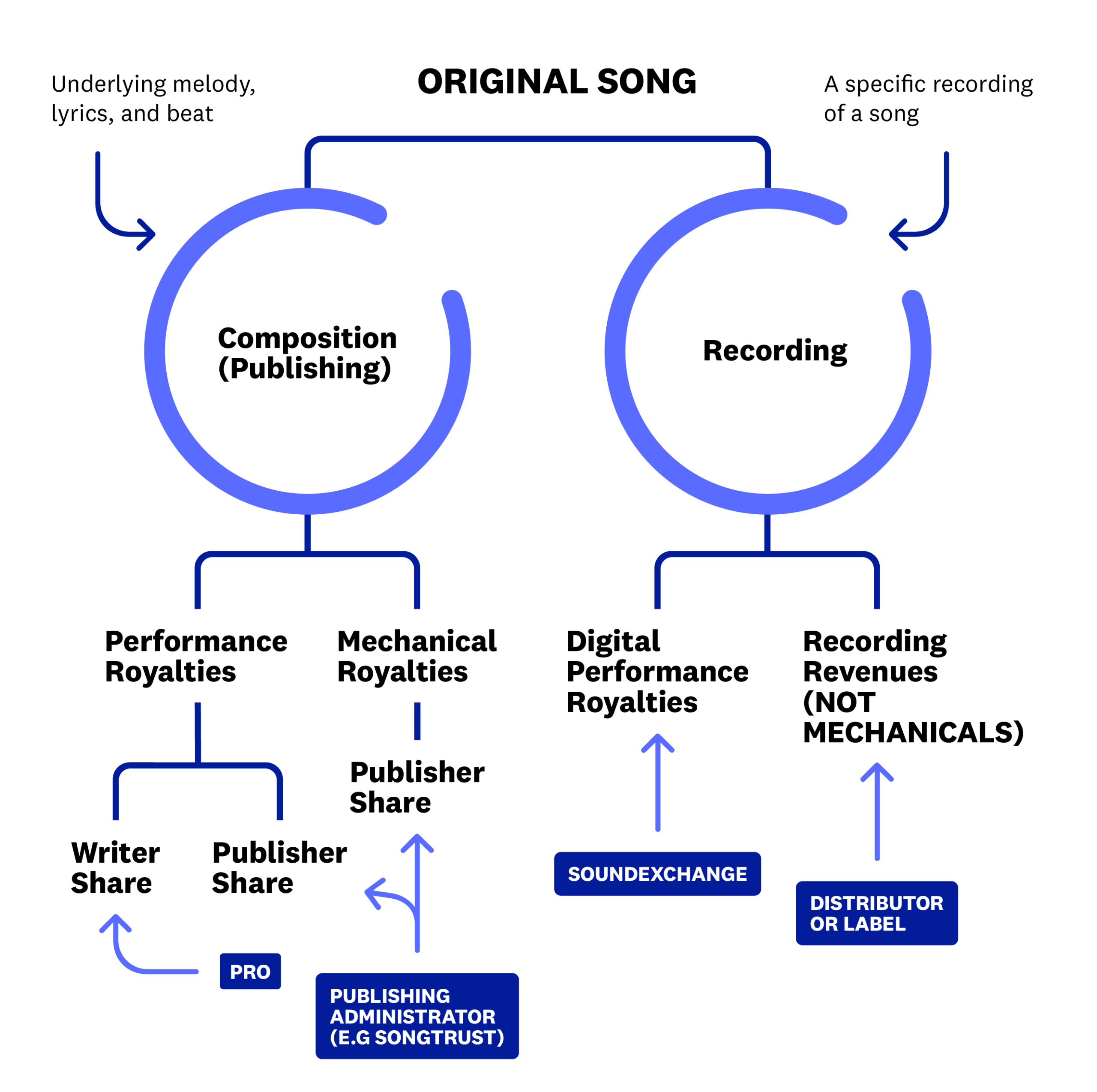
Every song actually generates two separate sets of rights - and therefore two separate streams of royalties. The composition (the underlying song - melody, lyrics, and musical structure) generates one set of royalties, while the sound recording (the specific recorded version of that song) generates another. This distinction is fundamental to understanding how music royalties work, and it is where most of the confusion begins. A songwriter who writes a hit song earns royalties on the composition every time anyone records or plays that song, while the recording artist and their label earn royalties on their specific recording of it.
Mechanical Royalties Explained
Mechanical royalties are payments made to songwriters and publishers whenever a copy of their composition is reproduced. The term dates back to the early 1900s when music was reproduced mechanically on piano rolls and phonograph records. Today, mechanical royalties apply to physical sales (CDs, vinyl), digital downloads, and - crucially - streaming.
The Statutory Rate
In the United States, mechanical royalty rates for physical and digital sales are set by the Copyright Royalty Board (CRB). The current statutory rate is 12 cents per song for tracks five minutes or shorter, or 2.31 cents per minute for longer tracks. This means that if your song appears on a CD that sells 10,000 copies, you earn $1,200 in mechanical royalties (10,000 x $0.12). For digital downloads on platforms like iTunes or Amazon Music, the same rate applies per download.
Streaming Mechanicals
Streaming mechanicals are calculated differently and are significantly more complex. Rather than a fixed per-unit rate, streaming mechanical royalties are determined through a formula that considers the service’s total revenue, the number of plays, and other factors. The Mechanical Licensing Collective (MLC), established by the Music Modernization Act of 2018, now handles the collection and distribution of streaming mechanical royalties in the US. If you are a songwriter, registering with the MLC is absolutely essential - before its creation, billions of dollars in streaming mechanical royalties went uncollected because there was no centralized system to match songs with their writers.
Image: Ari’s Take
Who Collects Mechanical Royalties?
Mechanical royalties are collected by several different entities depending on the context. For physical sales and downloads, the Harry Fox Agency (HFA) has historically been the primary mechanical rights organization in the US. For streaming, the MLC now handles collection from digital service providers like Spotify, Apple Music, and Amazon Music. Music publishers also collect mechanical royalties on behalf of their signed songwriters. If you are an independent songwriter without a publisher, you need to register directly with the MLC and consider using a publishing administrator like Songtrust, TuneCore Publishing, or CD Baby Pro to collect mechanicals from other sources and international territories.
Performance Royalties and PROs
Performance royalties are generated whenever a song is performed publicly. “Public performance” is a broad legal term that includes radio airplay (terrestrial, satellite, and internet radio), live performances at venues, music played in restaurants, bars, retail stores, and other businesses, television broadcasts, streaming on interactive platforms like Spotify and Apple Music, and music used in podcasts and online video platforms. Performance royalties represent one of the largest income streams for songwriters, and they are collected by Performing Rights Organizations (PROs).
The Big Three PROs in the US
ASCAP (American Society of Composers, Authors, and Publishers) was founded in 1914 and represents over 900,000 members. It operates on a not-for-profit basis and distributes nearly $2 billion annually to its members. Joining ASCAP costs a one-time fee of $50. BMI (Broadcast Music, Inc.) was founded in 1939 and represents over 1.4 million songwriters, composers, and publishers. BMI is also not-for-profit and distributes approximately $1.5 billion per year. Joining BMI is free for songwriters. SESAC (originally the Society of European Stage Authors and Composers) is the smallest of the three and operates as a for-profit company. Unlike ASCAP and BMI, SESAC is invitation-only - you cannot simply sign up. SESAC tends to be more selective but offers more personalized service to its members.
How PROs Collect Money
PROs issue blanket licenses to businesses, venues, broadcasters, and digital platforms, granting them the right to play any song in the PRO’s catalog. These license fees are pooled and then distributed to members based on how often their songs are performed. PROs use a combination of digital tracking technology, radio monitoring services like BDS (Broadcast Data Systems), cue sheets from television and film, setlist reporting from live venues, and data from streaming platforms to determine how frequently each song is performed. The more your music is played, the larger your share of the distribution pool.
Choosing a PRO
You can only belong to one PRO at a time as a songwriter, so choose carefully. All three offer similar core services, but they differ in their distribution timing (ASCAP pays quarterly, BMI pays quarterly with a slight delay, SESAC pays monthly), their digital tools and reporting dashboards, their networking events and showcases, and their customer service responsiveness. Many industry professionals suggest researching all three, attending their showcases if possible, and talking to fellow songwriters about their experiences before committing. The good news is that you can switch PROs if you find your initial choice is not working for you, though there are contractual waiting periods involved.
Image: PRS for Music
Sync Licensing: Music in Film, TV, and Ads
Sync (synchronization) licensing occurs when music is paired with visual media - film, television, commercials, video games, trailers, and online content. Sync licenses are negotiated individually for each use, and they can be extremely lucrative. A single sync placement in a major television show or national commercial can earn a songwriter anywhere from $10,000 to $500,000 or more, depending on the prominence of the placement and the scope of the license.
How Sync Deals Work
When a music supervisor for a film or television show wants to use a song, they need to obtain two separate licenses: a sync license for the composition (negotiated with the songwriter or their publisher) and a master use license for the specific recording (negotiated with the recording artist or their label). Both licenses must be secured before the music can be used. For independent artists who own both their compositions and masters, this simplifies the process considerably and makes them attractive to music supervisors who want quick clearances.
Getting Your Music Placed
Breaking into sync licensing typically happens through several channels. Music publishers with active sync departments pitch their catalogs to music supervisors. Sync licensing agencies and libraries like Musicbed, Artlist, Epidemic Sound, and Marmoset represent independent artists and pitch their music for placements. Music supervisors also discover songs through personal listening, industry showcases, and recommendations. Building relationships with music supervisors - attending industry events like the Guild of Music Supervisors Awards, SXSW, or Sync Summit - can open doors. Having well-organized, properly tagged music with clean metadata makes it easier for supervisors to find and clear your songs quickly.
Sync Royalty Payments
A sync placement generates multiple revenue streams. The upfront sync fee and master use fee are one-time payments negotiated at the time of licensing. After the placement airs, performance royalties are generated every time the episode, film, or commercial is broadcast. These ongoing performance royalties can add up substantially for songs placed in shows that air in reruns or are streamed on platforms like Netflix and Hulu. A song placed in a popular Netflix series might continue generating performance royalty payments for years after the initial placement.
Streaming Royalties and Per-Stream Rates
Streaming now accounts for approximately 67% of all recorded music revenue globally, making it the dominant way most artists earn royalties. Understanding how streaming royalties work - and how much they actually pay - is critical for any modern musician.
How Streaming Payments Are Calculated
Streaming services do not pay a fixed “per-stream” rate, despite what you may have read. Instead, they use a “pro rata” model where the platform’s total royalty pool (a percentage of subscription and advertising revenue) is divided among all streams on the platform proportionally. Your payment per stream varies based on the listener’s country, whether they are on a free or paid tier, the total number of streams on the platform that month, and your contractual terms with your distributor or label.
Approximate Per-Stream Rates (2024-2025)
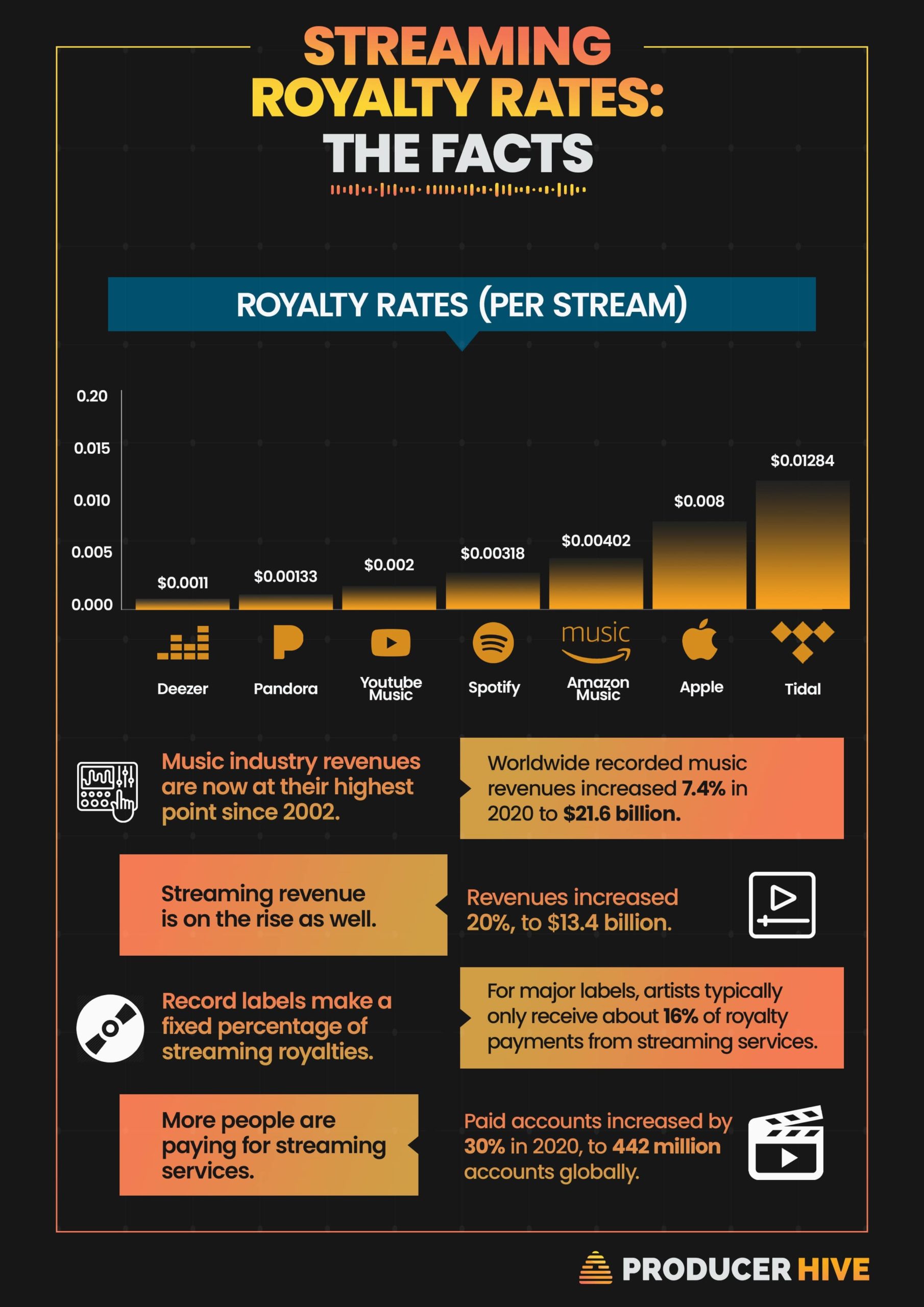
While rates fluctuate, these are typical ranges: Spotify pays approximately $0.003 to $0.005 per stream, Apple Music pays approximately $0.007 to $0.01 per stream, Amazon Music pays approximately $0.004 to $0.008 per stream, YouTube Music pays approximately $0.002 to $0.005 per stream, and Tidal pays approximately $0.008 to $0.013 per stream. These rates represent the total payout to all rights holders - what you personally receive depends on your agreements with your label, distributor, and publisher.
Ad SpaceIn-Article - 300x250
Advertisement
Image: Dreamstime
The Math of Streaming
Let us put these numbers in context. At Spotify’s average rate of roughly $0.004 per stream, you need 250,000 streams to earn $1,000 in recording royalties. To earn the equivalent of the US median income ($59,000) from Spotify alone, you would need approximately 14.75 million streams per year - or about 1.2 million streams per month. These numbers explain why most artists cannot survive on streaming revenue alone and need to diversify their income through live performance, merchandise, sync licensing, and other revenue streams.
Publishing Deals and How They Work
Music publishing is the business of managing and monetizing compositions. A publishing deal can significantly impact how your royalties are collected, managed, and - importantly - how they are split.
Types of Publishing Deals
Full publishing deals involve a publisher taking ownership of a percentage (often 50% or more) of your compositions in exchange for an advance payment and active song promotion, sync pitching, and administration. Co-publishing deals are the most common arrangement for established songwriters - the writer retains 50% ownership while the publisher takes 50%, but the writer earns 75% of total publishing income (their 50% share plus half of the publisher’s 50%). Administration deals leave ownership entirely with the songwriter while the publisher handles collection and administration for a fee of 10% to 25% of collected royalties. This is increasingly popular with independent artists who want to maintain control.
When to Sign a Publishing Deal
Not every songwriter needs a traditional publishing deal. If your primary goal is ensuring your royalties are collected properly, a publishing administrator (like Songtrust at $100/year plus 15% commission, or CD Baby Pro at a one-time fee per song) may be sufficient. A full publishing deal makes more sense when you are an active songwriter seeking co-writing opportunities and sync placements, when you want an advance to fund your creative process, or when you need an experienced team to actively pitch your songs to other artists and media opportunities. The key question is whether the publisher will add enough value to justify their share of your royalties.
How Royalties Are Collected and Distributed
The royalty collection ecosystem involves multiple organizations, and understanding which ones you need to register with is essential for capturing all your earnings.
The Collection Chain
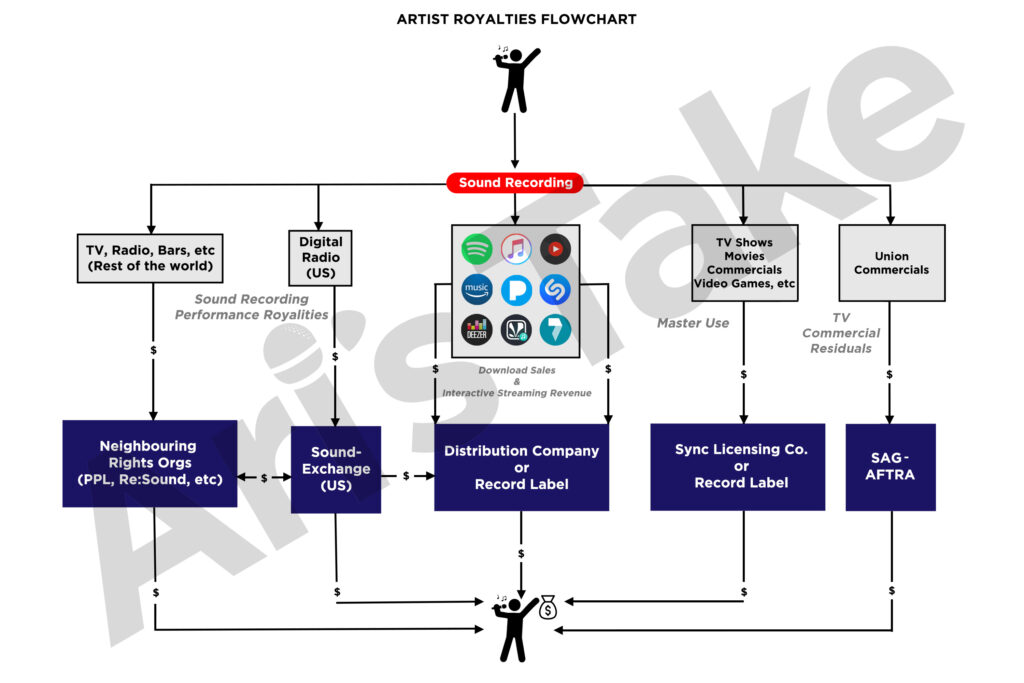
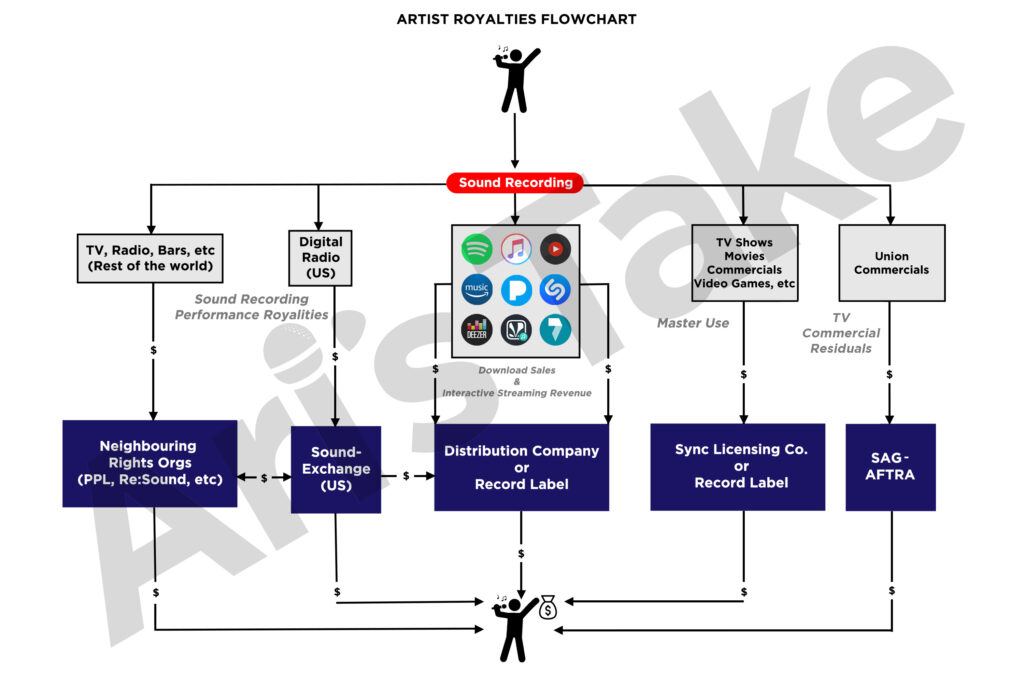
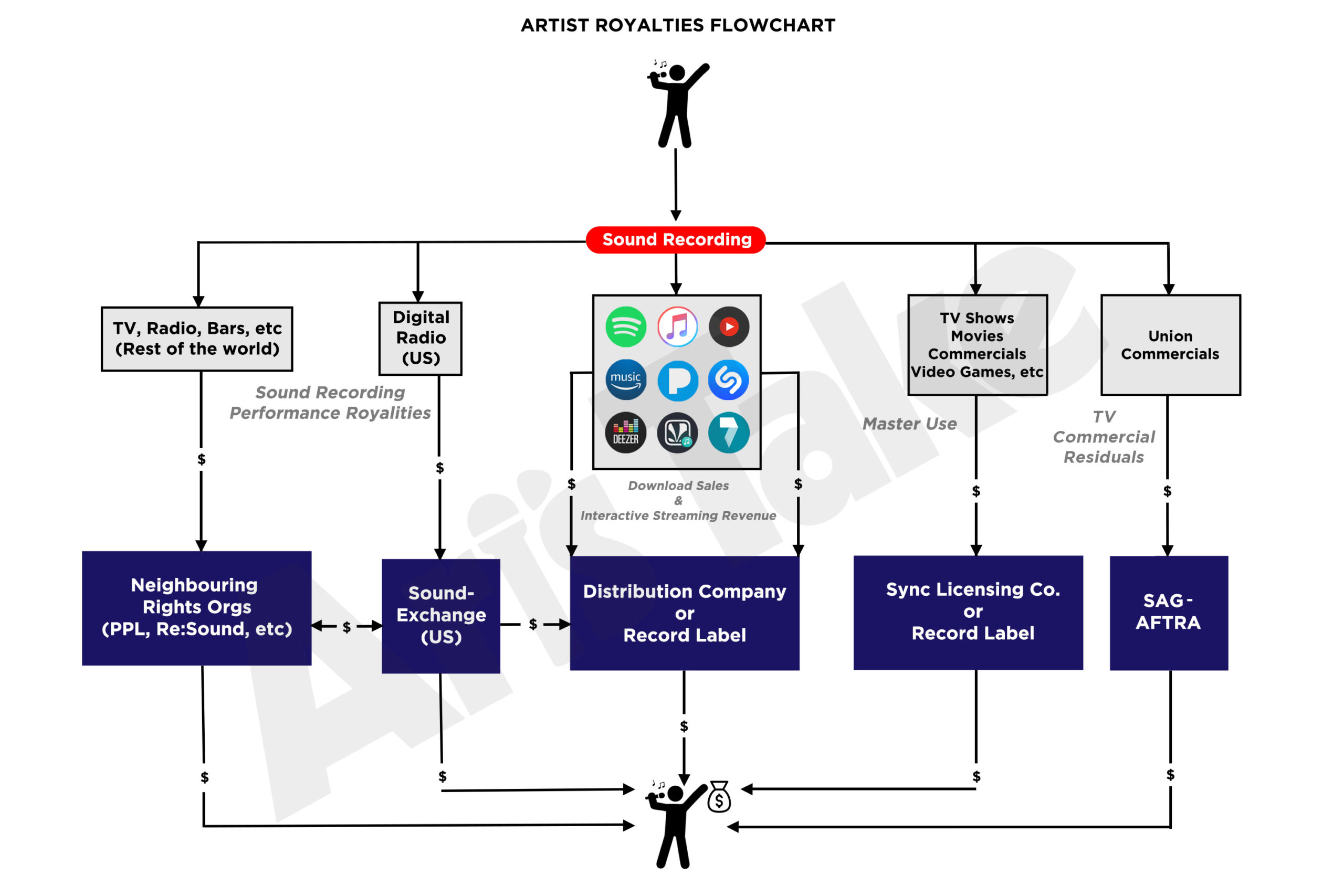
Here is a simplified overview of how royalties flow from listener to creator. When someone streams your song on Spotify, several things happen simultaneously. The streaming platform pays recording royalties to your distributor (DistroKid, TuneCore, etc.), who passes them to you (minus any fees). Spotify also pays mechanical royalties to the MLC, which distributes them to registered songwriters and publishers. Spotify pays performance royalties to your PRO (ASCAP, BMI, or SESAC) through their licensing agreements. If the stream is from a non-interactive source (like a Spotify radio station), additional performance royalties for the sound recording may be collected by SoundExchange. Each of these payment streams flows through a different organization on a different timeline - which is why many artists are confused about what they are owed and where to find it.
International Royalty Collection
Music royalties are territorial, meaning each country has its own collection societies and systems. If your music is played or streamed in Germany, those royalties are collected by German organizations (GEMA for performance rights, for example) and must be routed back to you through reciprocal agreements with your US-based PRO or publisher. This international collection process can take 12 to 24 months, and some royalties inevitably fall through the cracks. Using a publishing administrator with global reach helps ensure you are collecting from all territories where your music is played.
Real Payment Examples and What to Expect
Concrete examples help illustrate how music royalties work in practice and what different levels of success translate to financially.
Independent Artist with 100,000 Monthly Spotify Listeners
An independent artist averaging 100,000 monthly listeners on Spotify might generate approximately 300,000 to 500,000 streams per month. At $0.004 per stream, that translates to $1,200 to $2,000 per month in recording royalties through their distributor. Add mechanical royalties from the MLC ($100 to $200), performance royalties from their PRO ($50 to $150), and similar revenue from other platforms (Apple Music, Amazon, YouTube), and total monthly royalty income might reach $2,000 to $4,000. This is before any sync, merchandise, or live performance income.
Songwriter with a Song on a Hit TV Show
A songwriter who places a song in a popular television drama might receive a sync fee of $15,000 to $50,000 upfront (negotiated with the music supervisor). Each time the episode airs on network television, the songwriter earns performance royalties - approximately $1,500 to $3,000 per network airing, tracked through cue sheets submitted to their PRO. If the show is also streamed on a major platform, additional smaller performance royalty payments continue for months or years. A single well-placed sync can generate $30,000 to $100,000 or more in combined upfront and ongoing royalties.
Band with a Song on Popular Playlists
A band whose song gets placed on a major Spotify editorial playlist like “Today’s Top Hits” (which has over 30 million followers) can see streams jump from a few thousand per day to 100,000 or more per day. A two-week playlist placement generating 1.4 million streams would earn approximately $5,600 in recording royalties, plus mechanical and performance royalties. The residual effect of playlist placement - new followers, algorithmic recommendations, and playlist additions by independent curators - can sustain elevated streaming numbers for weeks or months afterward.
How to Register Your Music and Start Collecting
If you are creating music and want to ensure you collect every royalty you are owed, here are the essential registration steps.
Step-by-Step Registration Guide
First, join a PRO. Register as a songwriter with ASCAP ($50 one-time fee), BMI (free), or SESAC (by invitation). This ensures you collect performance royalties. Also register a publishing entity with your PRO - even if you self-publish, you need a publisher account to collect the publisher’s share of performance royalties. Second, register with the MLC (themlc.com) to collect streaming mechanical royalties. This is free and essential. Third, register with SoundExchange (free) to collect digital performance royalties for sound recordings from non-interactive streams like Pandora, SiriusXM, and internet radio. Fourth, choose a distributor (DistroKid, TuneCore, CD Baby) to get your recordings on streaming platforms and collect recording royalties. Fifth, consider a publishing administrator like Songtrust or CD Baby Pro to collect mechanical royalties from international territories and non-digital sources that the MLC does not cover.
Keep Your Metadata Clean
Proper metadata is the backbone of royalty collection. Every song you release should have accurate songwriter credits, publisher information, ISRC codes (for recordings), ISWC codes (for compositions), and your IPI/CAE number (assigned by your PRO). Incorrect or missing metadata is the number one reason royalties go uncollected. Double-check every field when registering songs with your PRO, the MLC, and your distributor. A single misspelled name or incorrect split percentage can result in lost revenue that is extremely difficult to recover after the fact.
Key Takeaways
Every song generates two separate rights - the composition and the sound recording - each producing its own royalty streams collected by different organizations.
Mechanical royalties (from reproductions and streaming) are collected by the MLC for streaming, and by publishers or administrators like HFA for physical and download sales.
Performance royalties are collected by PROs (ASCAP, BMI, SESAC) whenever your music is played publicly, broadcast, or streamed.
Sync licensing can be the most lucrative single royalty event - a major TV or film placement can generate $30,000 to $100,000 or more.
Streaming pays roughly $0.003 to $0.01 per stream depending on the platform - diversifying income sources is essential.
Register with a PRO, the MLC, SoundExchange, and a distributor at minimum to capture all your royalty streams.
Clean, accurate metadata is critical - incorrect information is the leading cause of uncollected royalties.
Frequently Asked Questions
How long does it take to receive royalty payments?
Royalty payment timelines vary by source. Distributors like DistroKid and TuneCore typically pay streaming royalties within two to three months of the streams occurring. PROs pay performance royalties quarterly, usually with a six to nine month delay from the date of the performance. Mechanical royalties from the MLC are distributed quarterly as well. Sync license fees are usually paid within 30 to 90 days of the contract being signed, while the ongoing performance royalties from sync placements follow standard PRO timelines. International royalties can take 12 to 24 months to arrive due to the chain of collection societies involved.
Can I collect royalties without a record label or publisher?
Yes, absolutely. Independent artists can collect all royalty types by registering with the right organizations. Use a distributor (DistroKid, TuneCore, CD Baby) to collect recording royalties from streaming and sales. Join a PRO to collect performance royalties. Register with the MLC for streaming mechanicals. Sign up with SoundExchange for digital sound recording performance royalties. And consider a publishing administrator to collect international royalties. You do not need a label or publisher to access any of these revenue streams - you just need to handle the registration and administration yourself or through affordable administrative services.
What percentage of streaming revenue goes to the artist?
It depends on your agreements. Streaming platforms typically pay out 65% to 75% of their revenue to rights holders. For independent artists using a distributor, you keep the vast majority - DistroKid charges a flat annual fee and passes through 100% of royalties, while TuneCore charges per release and also passes through 100%. CD Baby takes a 9% commission. Artists signed to major labels typically receive 15% to 25% of their label’s share after recoupment of advances. The songwriter’s share (performance and mechanical royalties from the composition) flows separately through PROs and the MLC regardless of your recording deal.
Do I need to copyright my songs to earn royalties?
In the United States, your music is technically copyrighted the moment you create it in a fixed, tangible form (such as a recording or written notation). However, formally registering your copyright with the US Copyright Office ($65 per online registration for a single work, or $85 for a group of unpublished works) provides important legal benefits: it establishes a public record of your ownership, it is required before you can file a copyright infringement lawsuit, and it allows you to seek statutory damages and attorney’s fees in litigation. While you can earn royalties without formal registration, registering your copyrights is strongly recommended as a protective measure.
Ad SpaceIn-Article - 300x250
Advertisement
Share
Get the recap
Loved this story? Get more like it.
Join readers who get our weekly entertainment recap - the stories worth your time, delivered every Friday.
No spam. Unsubscribe anytime. By signing up you agree to our Privacy Policy.