Why Netflix Keeps Canceling Hit Shows: The Streaming Economics Behind Surprise Cancellations
Nova Patricks··9 min read
Ad SpaceArticle Top - 728x90
Advertisement
Roughly two-thirds of Netflix scripted originals never make it past their third season. Industry trackers have catalogued the pattern for years, and it holds across genres, budgets and critical reputations. A show can pull strong reviews, a devoted fanbase and respectable viewing numbers, and still get the axe somewhere around the thirty-episode mark. To the viewer who just binged all three seasons in a weekend, the decision looks irrational, even cruel. To the people running the numbers inside Netflix, it is one of the most defensible calls in the building.
Understanding why means setting aside the question fans usually ask, which is whether a show was good. Netflix is not in the business of rewarding quality for its own sake. It is in the business of acquiring and retaining subscribers at the lowest sustainable cost per viewing hour. Once that framing clicks into place, the cancellations that feel arbitrary start to look like the output of a fairly simple, fairly cold spreadsheet. The streamer’s own pattern of renewals and endings tells the story, and the recent fate of one of its most reliable legal dramas is a useful place to start.
The Lincoln Lawyer and the trap of the word “canceled”
In May 2026, Netflix confirmed that “The Lincoln Lawyer,” its adaptation of Michael Connelly’s Mickey Haller novels starring Manuel Garcia-Rulfo, would end with its fifth season. Variety and Deadline both reported the news around May 13, and Netflix’s own Tudum site framed Season 5 as the planned conclusion, adapting Connelly’s novel “Resurrection Walk.” The show had actually been renewed for that fifth season back in January 2026, so this was not a hard cancellation in the GLOW or Mindhunter sense. It was a managed ending.
That nuance matters, because the trending search around the show has been some version of “Netflix cancels Lincoln Lawyer,” and the reality is more interesting than the panic. TechRadar noted that the series was wrapping up despite an increase in its viewing figures, with the final season already filming in Los Angeles. Here was a popular, profitable-looking legal drama being walked to a deliberate exit at exactly the point in its lifecycle where the math turns against it. Five seasons is, by streaming standards, a long and generous run. The fact that even a hit gets a defined finish line rather than an open-ended green light is the whole point. The Lincoln Lawyer did not fail. It simply reached the part of the curve where the cost of continuing starts to outrun the value of doing so.
The three-season wall
There is a reason so many Netflix shows stop at two or three seasons, and it is not coincidence. Reporting going back to a 2019 Deadline analysis laid out the mechanics: Netflix’s talent deals are built with escalating payments after each season. The bumps are modest after Season 1, larger after Season 2, and then they jump sharply after Season 3, sometimes from the hundreds of thousands into the millions per episode, especially on shows Netflix owns outright. CBR and others have since described the same structure as the engine behind the streamer’s “two-or-three-and-done” reputation.
Cast and crew know this too. By the time a show has proven itself over two seasons, the ensemble has leverage. Agents come to the table for the third or fourth renewal expecting raises that reflect the show’s success. Showrunners want bigger budgets to match rising ambitions. Every element that made the show good in the first place becomes more expensive to retain. The third season is therefore the moment where a series stops being a cheap bet and becomes a genuine financial commitment. For Netflix, that is precisely when the question changes from “is this working?” to “is this worth what it now costs?”
The cost curve of a hit
Picture the lifetime of a successful Netflix show as a curve. In the early seasons it is relatively inexpensive and its novelty drives sign-ups and buzz. New subscribers arrive to watch the thing everyone is talking about. But two forces work against the show as it ages. The first is the cost escalation already described. The second, subtler one is audience saturation. By the third season, most of the people who were ever going to start the show have already started it. A fresh season of an established series mostly serves viewers who are already subscribers, which means it does less to bring in new money even as it costs dramatically more to make.
Set those two lines against each other and the logic of the three-season wall becomes obvious. Costs rise steeply. The show’s ability to acquire new subscribers flattens. At some point the lines cross, and every additional season is paying premium prices to entertain people who were already paying anyway. A brand-new first season, by contrast, is cheaper to produce and carries the upside of attracting viewers who are not yet customers. CBR’s reporting captured the resulting strategy plainly: Netflix cancels older, pricier shows and replaces them with new first seasons specifically to keep its average content cost per hour down. The replacement is the strategy, not a side effect.
How Netflix actually measures a show
Broadcast television lived and died by overnight ratings, a single number measuring how many people watched live. Netflix runs on a richer and stranger dashboard, and the metric fans rarely think about is completion rate. The streamer obsesses over what percentage of people who start a show actually finish it, and over how many total hours a title generates relative to its cost. A series with a smaller audience that watches all the way through can rate higher internally than a flashier show that millions sample and abandon after two episodes.
Ad SpaceIn-Article - 300x250
Advertisement
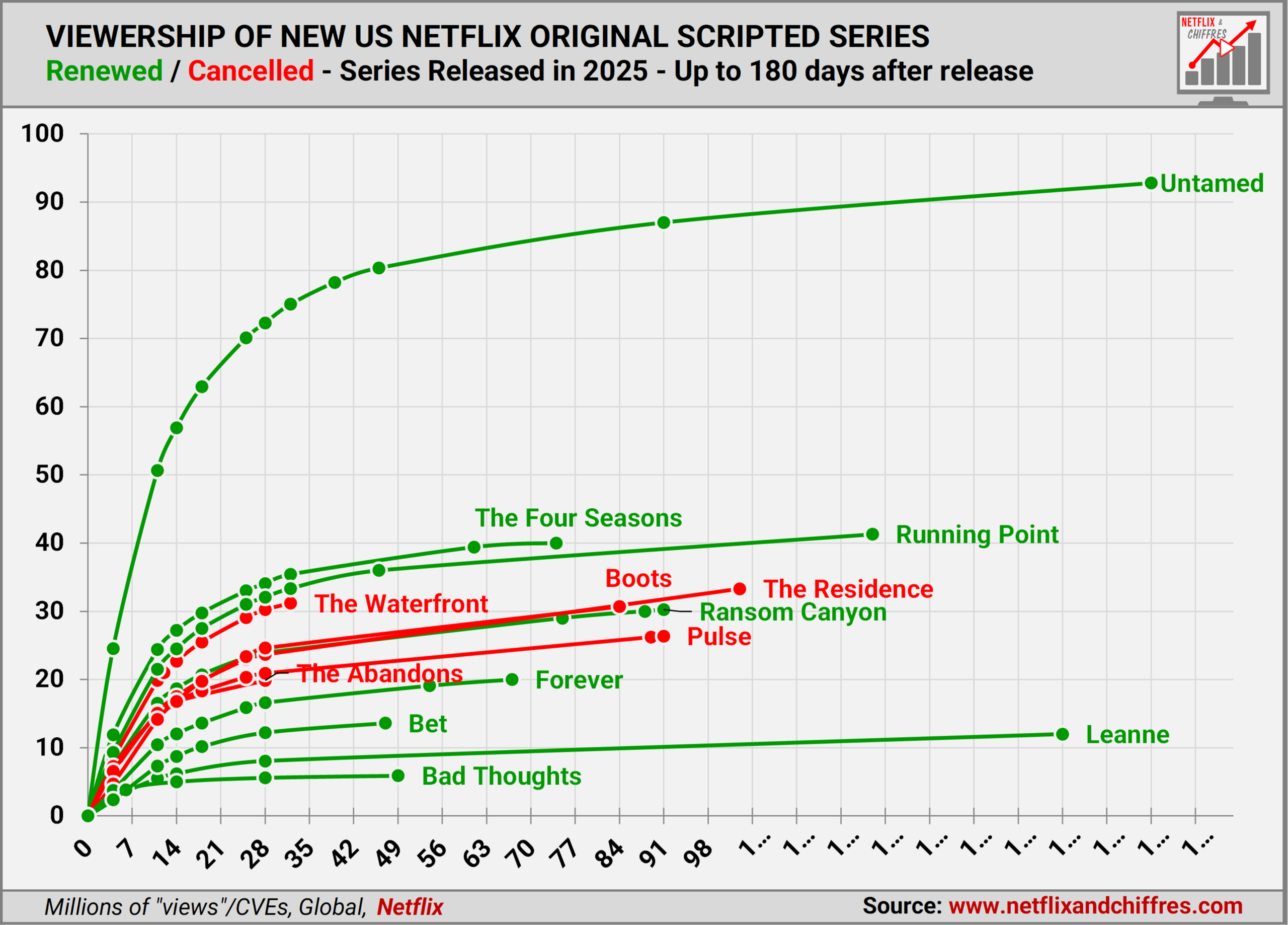
This is why audience size alone is a poor predictor of survival. A show can post big launch numbers and still be quietly judged a disappointment if viewers drift away mid-season, because the hours that justify a renewal never materialize. Conversely, a modest performer with fierce completion can punch above its raw viewership. The other figure that governs everything is efficiency: cost per viewing hour, or what Netflix is paying to generate an hour of watching. When a show’s per-episode price triples in its fourth season but its viewing hours hold flat or dip, that efficiency number collapses, and no amount of critical praise rescues it. Sense8, canceled after two seasons, and 1899, canceled after one, were both undone by exactly this collision of high production cost against viewing numbers that did not justify it.
The death of syndication math
To grasp how completely the rules have changed, it helps to remember what made the old system work. In traditional broadcast and cable, a hit show’s real fortune was made in the back end. A series that survived to around 100 episodes, usually four or five seasons, became eligible for lucrative syndication deals, sold into reruns on other networks and overseas markets for years. That back-end payday rewarded longevity. The longer a show ran, the more valuable its library became, so networks and studios had every incentive to keep beloved shows alive well past their creative peak.
Streaming demolished that incentive. As Variety and Backstage have both explained, Netflix typically buys out global rights to its originals and owns them outright, which means there is no external syndication market to chase and no per-airing residual windfall waiting at the 100-episode finish line. The show simply sits in Netflix’s own library whether it runs three seasons or eight. The financial reward for endurance that defined the broadcast era essentially evaporated. Under this model, an extra season is pure added cost with no syndication upside attached, which removes the single biggest reason the old industry kept long-running shows on life support. Reaching 100 episodes used to be a goal worth engineering toward. On Netflix, it is mostly just a bigger bill.
The shows that get to live, and why
Netflix does let some series run long, and the exceptions prove the rule rather than break it. Stranger Things, The Crown and Cobra Kai all earned multi-season runs, and what they share is not merely popularity but the specific kind of popularity that drives subscriber retention. These are tentpole properties that people keep their accounts open to watch, and that generate enough cultural gravity to pull in new sign-ups season after season rather than just servicing existing ones. When a show clears that bar, the escalating cost is worth paying, because the subscriber value it protects exceeds the price of the raises.
The clearest signal that a show belongs to this protected tier is the split-season release. As whats-on-Netflix has documented, the streamer increasingly reserves split seasons, dropping a season in two halves months apart, for its most valuable titles: Stranger Things, Bridgerton, Cobra Kai, The Witcher, Emily in Paris. The mechanic is deliberate. A viewer who wants both halves on release has to keep paying across two separate months, squeezing extra subscription revenue out of the same season. Netflix does not extend that treatment to shows it considers marginal. So when a series gets a split season, that is the company telling you, through its release calendar, that it views the title as a retention engine worth maximizing rather than a cost to contain.
What it means for viewers and creators
For viewers, the hard truth is that loving a show is not enough to save it, and never was on this platform. Petitions and hashtag campaigns occasionally generate noise, but they rarely move a decision that was made on a cost-per-hour basis. The shows that survive are the ones that keep accounts open, and a passionate but contained fanbase, however loud, may simply not register against the only metrics that count. This is why so many cancellations feel like betrayals: the audience is measuring affection while Netflix is measuring efficiency, and the two scales do not convert.
For creators, the lesson has reshaped how shows get built. Writers increasingly plan tighter arcs and plant exit points, because pitching an open-ended saga that needs seven seasons to pay off is a hard sell when the platform’s structural bias caps most series at three. The Lincoln Lawyer’s managed conclusion, a creative team given the runway to end on their own terms across five seasons, is arguably the better outcome available under these rules, and showrunners have started to treat a clean, planned ending as a win rather than a defeat. The era of the indefinitely renewable hit, sustained by syndication dreams, is over. What replaced it rewards shows that know where they are going and get there before the cost curve catches up.
How to read the tea leaves on your favorite show
There are signals worth watching if you want to guess a show’s odds. A series approaching its third season is entering the danger zone by default, because that is where the cost escalation bites hardest. Watch for whether Netflix promotes a new season aggressively, since marketing spend tends to follow the titles the company still believes can acquire subscribers. A split-season release is a strong positive sign, an indicator the show sits in the protected, retention-driving tier. Renewals announced quickly after a season drops suggest healthy completion numbers behind the scenes, while long silences often precede bad news.
None of these tells are guarantees, because the underlying data stays locked inside Netflix and the public never sees the completion rates or the cost-per-hour figures that actually decide things. What the pattern does offer is a more honest expectation. A great Netflix show is not a long-term relationship so much as a finite, often excellent, run with a shelf life set by economics rather than affection. Going in with that understanding takes some of the sting out of the inevitable, and makes a deliberate, well-earned ending like The Lincoln Lawyer’s look less like a loss and more like the rare case of a popular show getting to finish its own sentence.
Ad SpaceIn-Article - 300x250
Advertisement
Share
Get the recap
Loved this story? Get more like it.
Join readers who get our weekly entertainment recap - the stories worth your time, delivered every Friday.
No spam. Unsubscribe anytime. By signing up you agree to our Privacy Policy.