Why Audience Scores Matter More Than Critics for Netflix Films in 2026
Tristan Melo··10 min read
Ad SpaceArticle Top - 728x90
Advertisement
Sometime in late 2021, a heist comedy starring Dwayne Johnson, Ryan Reynolds and Gal Gadot landed on Netflix to a chorus of professional groans. Critics filed it under forgettable, calling it loud, weightless and over-budget. The Tomatometer settled at a brutal 37 percent. By the math that has governed Hollywood prestige for a century, “Red Notice” was a flop before most people had even pressed play.
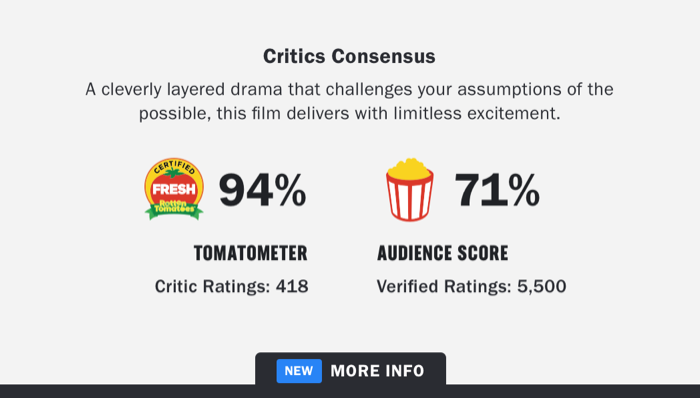
Then everyone pressed play. The film racked up 364 million hours of viewing in its first 28 days and went on to become, by Netflix’s own published count, the most-watched original movie in the platform’s history at 230.9 million views. Against that 37 percent critic score sits a 92 percent audience score. Two numbers, one film, two completely different verdicts. For Netflix, only one of those numbers mattered, and it was not the one the critics wrote.
That gap is no longer an oddity. It has become the operating logic of streaming. The reviews that once decided whether a movie lived or died now sit beside a second scoreboard that, for an algorithm-driven business, carries far more weight. Understanding why means looking at how the two scoring systems actually work, why a subscription business is built to ignore one of them, and what that shift means for Nollywood filmmakers trying to reach the world through a Los Angeles content engine.
The Film Critics Hated That Everyone Watched
“Red Notice” is the loudest example, but it is not alone. “Don’t Look Up”, the 2021 climate satire stuffed with Leonardo DiCaprio, Jennifer Lawrence and Meryl Streep, drew a divided 56 percent from critics who found it smug and overlong. Audiences disagreed, handing it a 74 percent audience score, and they kept watching: 359.8 million hours in 28 days, second only to “Red Notice” at the time. “The Gray Man”, the Russo brothers’ globe-trotting assassin thriller, earned a middling 45 percent from critics and a 90 percent audience score, with 245 million hours watched in its early weeks.
The pattern repeats often enough that it stops looking like coincidence. Netflix keeps commissioning expensive, star-stacked films that critics shrug at and subscribers devour. The studio is not failing to make films critics like. It is making something else on purpose, and the audience scoreboard is where you see the strategy working.
How the Two Score Systems Actually Work
To see why the gap matters, it helps to know what each number measures. The critic score, the Tomatometer on Rotten Tomatoes or the weighted Metascore on Metacritic, aggregates the verdicts of accredited professional reviewers. A film is “Fresh” on Rotten Tomatoes if at least 60 percent of those critics post a positive review. The judgment is qualitative and trained: critics weigh craft, originality, screenwriting, performance and a film’s place in cinema history. They are paid to hold films to the standard of the best films ever made.
The audience score measures something blunter and, in commercial terms, more useful: did regular people enjoy it. Rotten Tomatoes rebuilt this side of its house in August 2024, rebranding the audience rating as the Popcornmeter and tightening it against abuse. Verified scores now lean on ratings from users who can prove a ticket purchase through Fandango, the ticketing company that owns Rotten Tomatoes, with a “Verified Hot” badge for theatrical films that clear 90 percent. IMDb runs its own parallel system, a one-to-ten star average drawn from millions of registered users, which tends to track popular enthusiasm rather than critical consensus.
These are not two measurements of the same thing. The Tomatometer asks whether a film is good. The Popcornmeter and the IMDb average ask whether people are glad they watched it. Those questions usually rhyme, but on a Netflix slate they frequently come apart, and when they do, the business has already decided which answer it cares about.
Why Netflix’s Model Weights Audience Behaviour
A cinema sells you a ticket whether you love the film or walk out at the halfway mark. The transaction is complete the moment you sit down. That is why opening-weekend box office, and the reviews that shape it, mattered so much in the old model: a strong critical reception could fill seats before word of mouth caught up.
Netflix sells nothing per film. It sells a monthly subscription, and the only thing that protects that subscription is whether you keep finding things you want to watch. The metric that predicts renewal is not a review; it is engagement. How many accounts started the film, how many finished it, how long they stayed, and whether that satisfied viewing kept them on the platform for the next title the algorithm served up. By Netflix’s own accounting, roughly 80 percent of what subscribers watch comes from the recommendation system rather than active search, which means the engine is constantly testing what holds attention and feeding more of it back.
Completion rate is the quiet star of this system. A film that 20 million accounts start and 80 percent finish is, to Netflix, a triumph regardless of what any critic wrote, because it signals satisfied time spent and a reason to renew. The reporting metric the company adopted, total hours viewed, gets close to that same truth. “Bird Box”, the 2018 Sandra Bullock thriller that critics met with a lukewarm 66 percent, was watched by more than 45 million accounts in its first seven days, with each of those accounts staying for at least 87 of its 124 minutes. That detail, minutes watched, is exactly the kind of behavioural signal a Tomatometer cannot capture and a subscription business cannot ignore.
The audience score is the closest public proxy for that private data. When the Popcornmeter and the IMDb average run high, they are usually echoing the same enthusiasm that the internal completion numbers are recording. The critic score, by contrast, is measuring a quality the business was never built to sell.
The Case Studies, Both Directions
The honest version of this argument has to run both ways, because audience scores are not magic and critic scores are not noise. The point is which one predicts a Netflix film’s actual outcome.
Ad SpaceIn-Article - 300x250
Advertisement
Start with the most current example. “Voicemails for Isabelle”, the romantic comedy written and directed by Leah McKendrick, arrived on Netflix on 19 June 2026 starring Zoey Deutch and Nick Robinson. The premise is pure tearjerker: a grieving woman leaves voicemails on her late sister’s old number, not knowing it has been reassigned to a stranger who slowly falls for her. Here the two scoreboards mostly agree, with critics landing around 86 percent and audiences higher at 91 percent, and the film shot to the top of the Netflix movie chart. When the numbers align like this, the film simply confirms what both camps suspected. That alignment is worth noting precisely because it is not the interesting case.
The interesting cases are the splits. “Red Notice” at 37 percent critic and 92 percent audience. “The Gray Man” at 45 and 90. “Don’t Look Up” at 56 and 74. In every one of these, the audience score predicted the engagement outcome and the critic score did not. A reviewer reading only the Tomatometer would have written all three off; a Netflix executive reading the audience signal and the completion data would have greenlit the sequel. “Red Notice 2” was, in fact, ordered.
Now the reverse, because it exists and it matters. Critically adored films do not automatically win the watch-time race. A prestige drama can earn a 90-plus Tomatometer, collect awards-season write-ups, and still see a modest audience score and a soft completion rate because the very qualities critics prize, slow pacing, ambiguity, demanding structure, are the qualities that make a casual Tuesday-night viewer drift away. Netflix has learned to value both: the prestige title earns reputation, festival placement and the kind of talent relationships that keep the pipeline full, while the crowd-pleaser earns the hours. The mistake is assuming the critic score forecasts the second outcome. It rarely does.
The Nollywood and Africa Dimension
Nowhere is this logic more consequential than in how Netflix decides what to make in Africa, because the African slate was never built on critical consensus in the first place. It was built on demand.
Consider the evidence. Kunle Afolayan’s “Anikulapo”, a Yoruba-language fantasy, became the most-watched Nigerian film on Netflix in 2022, pulling in millions of viewing hours within days and reaching number one as the most-viewed non-English original on the platform’s global chart that week. The following year Femi Adebayo’s Yoruba epic “Jagun Jagun” took the same crown, climbing into the top ten in more than 18 countries, while Editi Effiong’s “The Black Book” entered the global top ten in 38 countries and reached number four worldwide. None of these films won their place through a Western critic’s blessing. They won it through raw audience demand, much of it from Nigerians at home and across the diaspora who finally saw their own stories on a global stage.
This is the engine working as designed. A Yoruba-language film with subtitles is, on paper, a hard sell to a Tomatometer-driven distribution model. But the algorithm does not read subtitles as a liability; it reads completion rates and repeat viewing, and when those signals fire in Lagos, Houston, London and Johannesburg at once, the platform responds by commissioning more. That is why Netflix’s African investment leaned into Nollywood genre filmmaking, historical epics, family melodrama and faith-tinged drama, rather than the festival-friendly art house that a critics-first model would have favoured. Local demand, not critical reception, shaped the commissioning brief.
For Nigerian and African viewers, the practical upshot is real. The films that get made and renewed are increasingly the films that local audiences actually finish, not the ones a reviewer in New York calls important. A Nollywood director pitching Netflix today is, in effect, pitching against a completion-rate target, and the audience scoreboard is the public scoreboard that comes closest to that target.
The Limits of the Audience Score
This is where the argument needs a hard edge, because treating the audience number as gospel is its own trap.
The most documented failure is review bombing, the coordinated dumping of negative ratings by people who are angry about a film rather than reacting to it. “The Last Jedi” in 2017 and “Captain Marvel” in 2019 both watched their audience scores get carpet-bombed, in some cases weeks before the public could have seen them, by campaigns driven by gripes that had nothing to do with the films themselves. Rotten Tomatoes responded by stripping out pre-release ratings and, eventually, by building the verified-purchase system that underpins today’s Popcornmeter. The fact that the company had to rebuild the metric tells you how easily the old version could be gamed.
The manipulation runs the other way too. Star-driven fan bases can inflate a score, organised campaigns can flatter a release, and a high IMDb average sometimes reflects who showed up to vote rather than how the broad public felt. Audience scores also skew toward the satisfied: people who hated a film often simply stop watching and never rate it, which can leave the number rosier than the real experience. And a high audience score says nothing about whether a film is actually good in any lasting sense. Plenty of films people enjoyed in the moment are films no one remembers a year later, which is precisely the cultural value a thoughtful critic is paid to protect.
So the honest position is not that audience scores are truer than critic scores. It is that for a subscription business measuring renewal through engagement, the audience number is the better predictor of the outcome the business is chasing, provided you read it knowing it can be poisoned, padded and shallow.
What Actually Decides It
Back to that heist comedy nobody respected. “Red Notice” did not need critics to like it, and it did not get a sequel because a reviewer changed their mind. It got one because tens of millions of accounts pressed play, stayed to the end, and went looking for the next thing afterward. The 92 percent audience score was the visible shadow of that private behaviour, and the 37 percent critic score was a verdict the business had been built, deliberately, to survive.
For viewers in Lagos or Nairobi deciding what to watch tonight, the lesson is simple and useful. The Popcornmeter and the IMDb average will tell you more about whether you will enjoy a Netflix film than the Tomatometer will, as long as you remember those numbers can be played. For the filmmakers chasing a Netflix deal, especially Nollywood directors with a story the world has not seen, the path no longer runs through a critic’s approval. It runs through the one question the algorithm asks of every title it serves: did people finish it, and did they come back. Anikulapo answered yes. So did Jagun Jagun. That answer, not a star rating in a magazine, is what keeps the cameras rolling.
Ad SpaceIn-Article - 300x250
Advertisement
Share
Get the recap
Loved this story? Get more like it.
Join readers who get our weekly entertainment recap - the stories worth your time, delivered every Friday.
No spam. Unsubscribe anytime. By signing up you agree to our Privacy Policy.