Why Nollywood Always Has a "Village Scene": Tradition, Modernity and Storytelling
Nova Patricks··11 min read
Ad SpaceArticle Top - 728x90
Advertisement
Somewhere around the forty-minute mark of a Nollywood film, the editing cuts away from a Lagos boardroom or a Lekki mansion, and a different sound arrives. Crickets. A distant drum. Footsteps on hard red earth. A woman appears with a clay pot balanced on her head, a child running ahead of her down a path between cassava plants. The protagonist who was just yelling at a driver in city traffic is suddenly kneeling in front of a thatched roof, removing her shoes. That cutaway, repeated across thousands of films for more than three decades, is the village scene, and it has become so reliable a part of Nigerian cinema that audiences expect it the way an American audience expects a montage.
The village scene is not nostalgia padding. It is a structural device, a moral checkpoint, a cinematic memory, and a contested cultural argument all rolled into one sequence that usually runs between four and twelve minutes.
How the Village Scene Became Nollywood Grammar
The convention crystallised during the VHS era of the early 1990s. When “Living in Bondage” arrived in 1992, directed by Chris Obi Rapu and produced by Kenneth Nnebue, it pulled a switchblade through the soft tissue of Nigerian aspirations. Andy Okeke, a struggling Lagos businessman, joins a ritual cult that demands the sacrifice of his wife in exchange for wealth. The film moves between the high-rise glitter of city ambition and the dark, lantern-lit interiors of a village shrine. That city/village interplay was not invented as a stylistic flourish. It was the lived reality of the film’s first audience.
The vast majority of Nigerians watching pirated tapes in the early 90s had been born in rural villages and migrated to Lagos, Onitsha, Aba, Kano, or Port Harcourt as part of the country’s massive urbanisation wave. They came for work, for school, for trade apprenticeships. Their parents were still in the village. Their land was still in the village. Their burial plot would, almost certainly, be in the village. A film that ignored this duality would have felt like a lie. So directors built the village scene into the spine of the form, and audiences rewarded it with their kobo.
By the mid-1990s, the cutaway had become a grammar. Anywhere from one to four village scenes per film. The home compound, the elders’ meeting, the market day, the dibia’s hut, the moonlit village square. Each of them carried specific narrative weight, and viewers learned to read them like punctuation marks.
The Five Standard Village Scenes
Five compositions appear so often they function as cinematic shorthand.
The compound arrival shows the protagonist stepping out of a dust-caked vehicle into a homestead. An older relative greets them in proverbs. The compound itself is a moral instrument. Sweeping the floor of the verandah is the first thing the returning child does, as if dirt were standing in for whatever city sin they carried home.
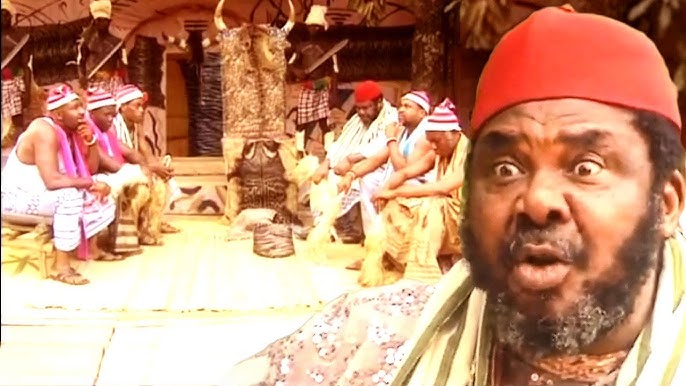
The elders’ meeting gathers grey-bearded men under a tree or inside an obi, the men’s reception room of an Igbo household. They debate. They drink palm wine. They send for someone. The dialogue, in Igbo or Yoruba with subtitles, often carries the actual moral verdict of the film.
The market day appears as a riot of fabric, peppers, smoked fish, hawkers calling prices, and a gossip exchange that delivers exposition the script could not deliver elsewhere. Two women buying ugu leaves will say more about the protagonist’s reputation in ninety seconds than any flashback could.
The shrine or dibia visit pulls the camera into low light. A native doctor reads kola nuts or cowries. Something is broken in the spirit realm and needs setting right. This scene is the engine of countless Nollywood horror plots, and even prestige films treat it with seriousness rather than mockery.
The town crier, walking through the village at dusk with a metal gong, summons the community to a meeting at first cockcrow. The trope is older than cinema and predates the colonial encounter. Its survival on screen tells you something about how stubbornly oral tradition has shouldered its way into a visual medium.
Why Yoruba Films Lean Harder on the Village
Yoruba-language films, the descendants of the Yoruba traveling theatre tradition that Hubert Ogunde shaped in the mid-twentieth century, treat the village as the default rather than the exception. The Alarinjo theatre roots run deep, and many of the genre’s biggest contemporary hits set their entire dramatic universe in pre-colonial or rural Yorubaland.
Kunle Afolayan’s “Anikulapo,” released in 2022 on Netflix, takes place almost entirely in the historical Oyo Empire. There is no Lagos to return to. The village, the palace of the Alaafin, the bush paths, and the spirit world are the only world. Femi Adebayo’s “Jagun Jagun,” released in 2023, similarly inhabits a war-camp village setting with no concession to modernity. Audiences globally responded. “Jagun Jagun” cracked Netflix’s non-English top ten in dozens of countries during its release week.
The Yoruba habit of centering the village is not a refusal to engage modernity. It is the assertion that the moral and cosmological universe of the village is sufficient for any story worth telling. The Oba, the traditional ruler, is the still point around which characters orbit. The babalawo, the Ifa priest, reads palm nuts and delivers truths the protagonist does not want to hear. The market is where reputations are made and unmade. Yoruba directors have generally trusted these conventions to carry blockbuster weight, and the streaming era has proved them right.
Why Igbo Films Anchor on the Homestead
Igbo Nollywood treats the village scene differently. The geographic anchor is the ancestral homestead, the obi or compound where a family’s lineage is recorded in the very arrangement of buildings. The kola nut breaking, the libation poured on the ground for the ancestors, the obi reception room with its mud bench and stacks of yam, these are the spatial signatures.
Pete Edochie, born in 1947, has played enough Igwes, traditional Igbo rulers, and village elders that his face has become a national emoji for ancestral authority. When he appears, draped in a red cap and white wrapper, with a horsetail whisk in one hand, audiences settle in for proverbs. His delivery of Chinua Achebe-adjacent wisdom in films from “Things Fall Apart” onward established a register that two generations of Igbo actors have inherited.
The Igbo version of the village scene often turns on the question of inheritance, both material and spiritual. Who gets the land. Who is owed a wife. Whose son was buried in the compound. The drama is genealogical, and the village is the archive.
Ad SpaceIn-Article - 300x250
Advertisement
Kannywood Goes a Different Direction
The Hausa-Fulani film industry, centered in Kano and called Kannywood, follows a different tradition. The village scene as Nollywood understands it is rarer. Kannywood is shaped by the Indian cinema influence that Hausa audiences absorbed during decades of dubbed Bollywood VHS imports, by Islamic narrative conventions, and by Hausa praise-song musical structure. Songs and dances stop the plot for emotional declaration in a way that owes more to Mumbai than to Onitsha.
When rural settings appear in Kannywood, they tend to be working pastoral landscapes rather than ancestral compounds, the Fulani cattle path, the millet field, the village mosque. The cosmology is Islamic rather than indigenous-traditional, so there is no dibia, no shrine, no kola breaking. The village functions less as a moral anchor and more as a setting for class drama and romance.
This is a useful comparative point. The “Nollywood village scene” is really a southern Nigerian convention, born of Igbo and Yoruba cosmology and the urbanisation patterns of the Niger Delta and southwest. It is not pan-Nigerian. Mapping the convention onto Kannywood would be a category error.
The Go-Home Trope
The most enduring narrative use of the village is the go-home arc. The Lagos protagonist is in crisis. A business deal collapses, a marriage fractures, a strange illness creeps in, a dream recurs. They cannot solve the problem in the city. They get in a car, drive five or seven or twelve hours, and arrive at the family compound. There they receive a diagnosis the city could not deliver. The grandmother sees what no doctor could see. The elder remembers the curse. The dibia reads the cowries. Healing or revelation happens. The protagonist returns to Lagos changed, or stays in the village forever.
This is not a Nollywood invention. The structure is older than cinema, present in Yoruba folktale, in Igbo origin narrative, in Hausa storytelling. Nollywood inherited it and gave it a car. But the cultural argument the trope makes is unmistakable. The city is where you earn. The village is where you are healed. The city has answers about money. The village has answers about meaning. A story that resolves entirely in Lagos is, by this older logic, half a story.
The Diaspora Returns Variation
A rich offshoot of the go-home trope is the diaspora returns plot. The cousin from London, the brother from Atlanta, the sister from Houston, lands at the village compound in a tailored suit and stiff new ankara, and immediately gets a cultural lesson. The diaspora character serves as audience proxy. They ask the dumb questions so the village character can explain Igbo or Yoruba practice for the camera. They embarrass themselves at the kola breaking. They eat fufu wrong. By the third act they have surrendered some Western posture and earned a place at the table.
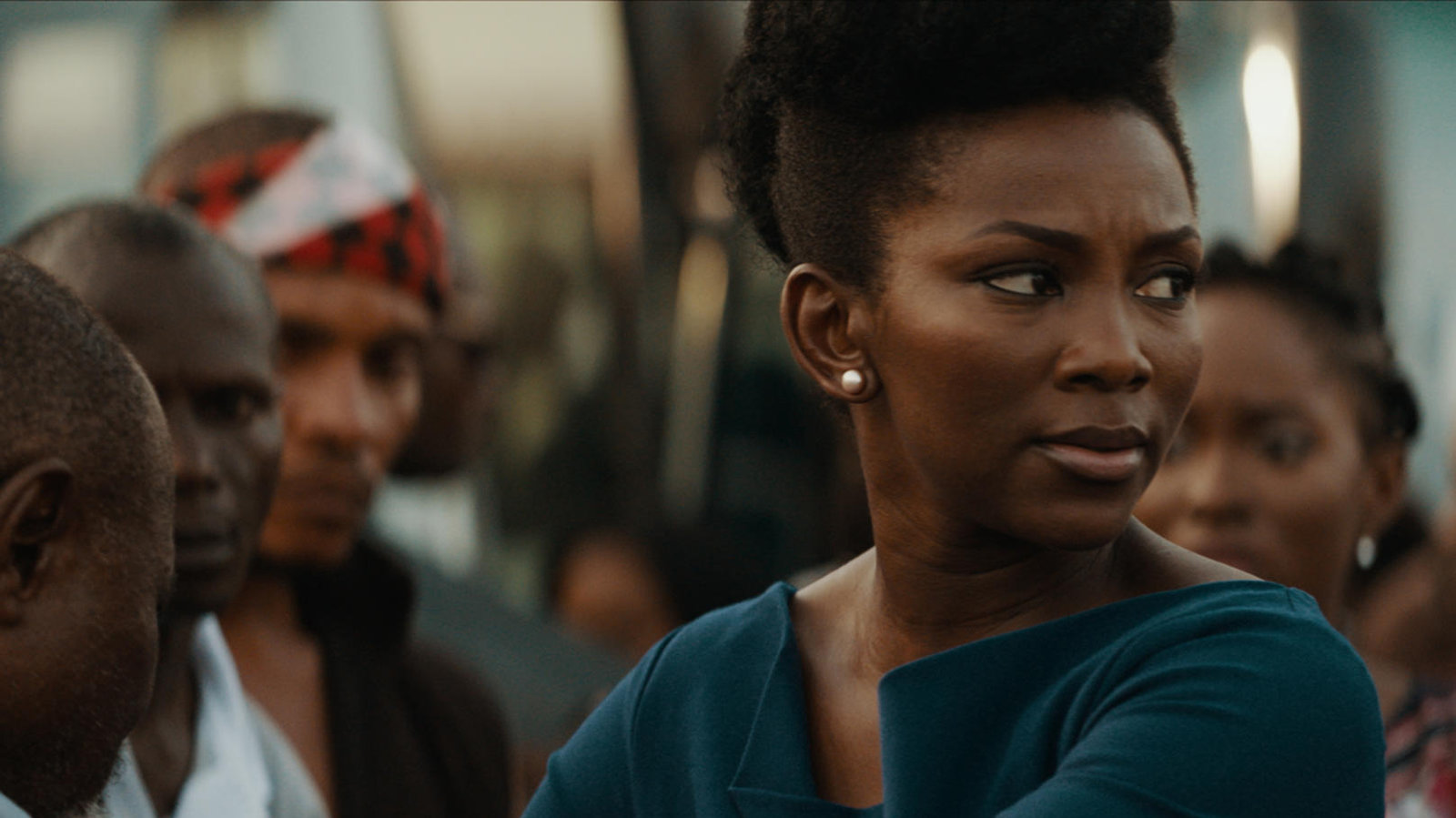
“The Wedding Party” series leaned into this. So did “Lionheart,” “Chief Daddy,” and countless straight-to-DVD comedies. The diaspora variation does cultural work that the basic go-home plot cannot. It explicitly stages the negotiation between Nigerian global mobility and Nigerian rootedness.
The Village Juju Genre
A whole strand of Nollywood horror grew from the village scene’s supernatural register. The village juju film, with its night shoots in actual rural locations, its low-key lighting, its drum-heavy score, and its painted-faced spiritual antagonists, ran the industry through the late 90s and 2000s. Titles like “Karishika,” “End of the Wicked,” and the sprawling “Nneka the Pretty Serpent” franchise made supernatural village horror a global Nigerian export.
C.J. Obasi’s “Mami Wata,” released in 2023, took the convention into prestige territory. Shot in stark monochrome in a coastal village in the Niger Delta, the film won the Sundance World Cinema Dramatic Special Jury Award for cinematography. The water spirit Mami Wata, drawn from Mami Wata cosmologies that span coastal West Africa, sits at the heart of a village’s internal conflict between traditional belief and modern reform. The film treats the village not as a colourful backdrop but as a complete metaphysical universe.
The Modernist Pushback
Not every Nollywood director accepts the village convention as automatic. A modernist wave that began emerging in the 2010s, exemplified by directors like Jadesola Osiberu, started producing films set entirely in Lagos, with no village interlude. “Sugar Rush,” “Gangs of Lagos,” and “Brotherhood” sit fully inside contemporary urban Nigeria. The argument is implicit. Lagos is itself worthy of full dramatic attention. The city is not a moral problem requiring rural correction. It is a universe.
This generation of filmmakers grew up Lagos-born, Lagos-raised, with grandparents the only remaining village link. For them, the obligatory village cutaway can feel like a forced gesture rather than an organic memory. Their films are not anti-village so much as Lagos-sufficient. The audience response has been split. Diaspora viewers and younger urban Nigerians tend to embrace the city-only film. Older audiences and viewers outside the metropolitan corridor often miss the village interlude when it is absent.
Kunle Afolayan represents the opposite pole, a director who has built a career on cinematic rural grandeur. “October 1,” “Citation,” and “Anikulapo” all use rural Nigeria not as backdrop but as protagonist. The Netflix money has made it possible to shoot village scenes with the lens choices and lighting setups that used to be reserved for international productions. The thatched roof in a modern Nollywood production is shot at twenty-four frames per second on an ARRI Alexa.
The Political Dimension
The village scene is also a political argument that most films do not announce. The recurring presence of the elder, the Oba, the Igwe, the kola breaking, the libation, makes a claim about authority that runs against the official Nigerian state narrative. The Nigerian constitution recognises federal, state, and local governments. Traditional rulers occupy an ambiguous zone, respected in custom, ignored in formal politics. Nollywood films restore them to centrality. When a Lagos protagonist needs justice they cannot get from the courts, they return to the village and the elders rule. The implication is hard to miss.
The village values versus modern values frame is not always conservative. Some films use the village to indict patriarchy, to show how custom can crush a widow. Others use the city to indict the village, showing how rural communities can hide cruelty behind tradition.
The Igbo Apprenticeship Pattern
An economic version of the go-home trope plays out in business-themed Nollywood. The Igbo apprenticeship system, called Igba boi or Imu ahia, sends a teenage boy from the village to serve a successful trader in a city for five to seven years. At the end the master settles the apprentice with capital to start his own business. The system runs through countless Nollywood plots. The young man arrives in Onitsha or Aba from a village in Anambra or Imo. He suffers. He learns. He returns to the village to marry. He sends money home to roof the family compound. The story is the village-city circuit made literal.
A Form That Refuses to Settle
The thatched roof remains, though it now sits inside frames composed by cinematographers who have shot for Netflix and the festival circuit. The drum still announces the elders’ meeting in films streaming to a hundred and ninety countries. The town crier still walks at dusk. Pete Edochie still raises a horsetail whisk. Somewhere this weekend in Lagos, a screenwriter is typing a slugline for INT. VILLAGE COMPOUND into a script that will eventually cut from a glass-walled office to a path between cassava plants, and a hundred million viewers across West Africa, the Caribbean, the United Kingdom, and the southern United States will lean forward because they know exactly what is about to happen. A woman with a clay pot on her head will walk into the frame, the child will run ahead, and the story will finally arrive at its real beginning.
Ad SpaceIn-Article - 300x250
Advertisement
Share
Get the recap
Loved this story? Get more like it.
Join readers who get our weekly entertainment recap - the stories worth your time, delivered every Friday.
No spam. Unsubscribe anytime. By signing up you agree to our Privacy Policy.