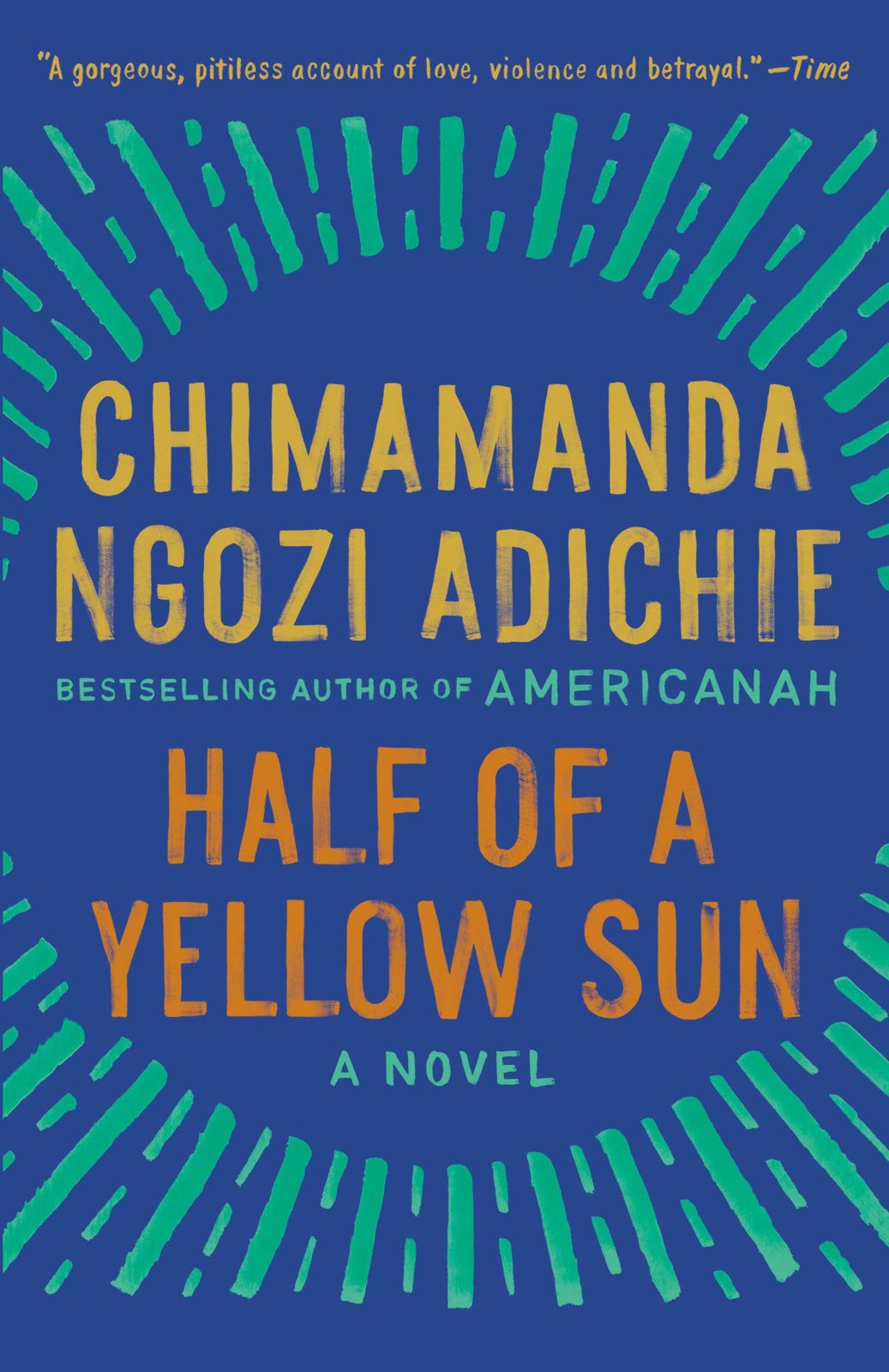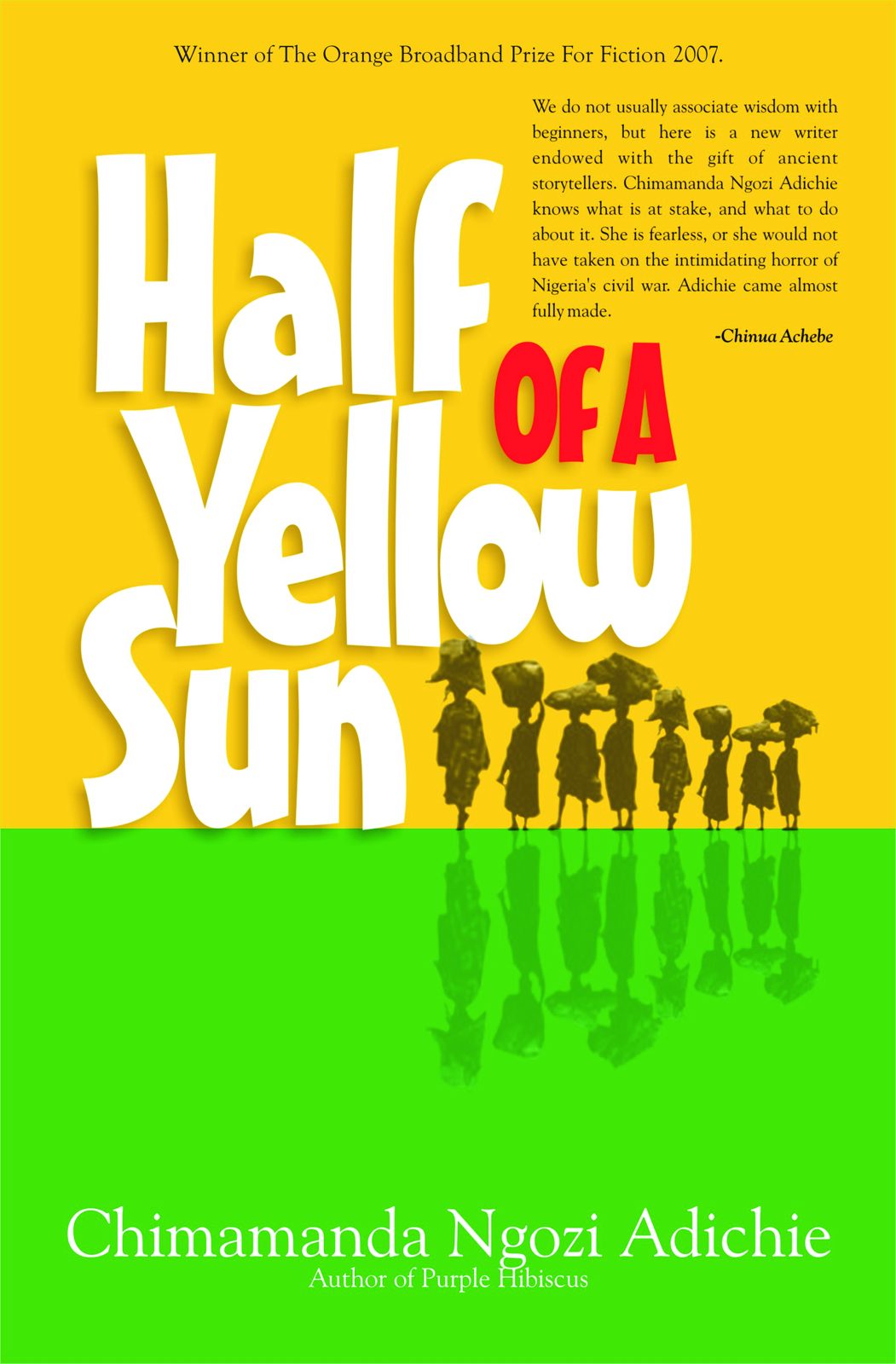
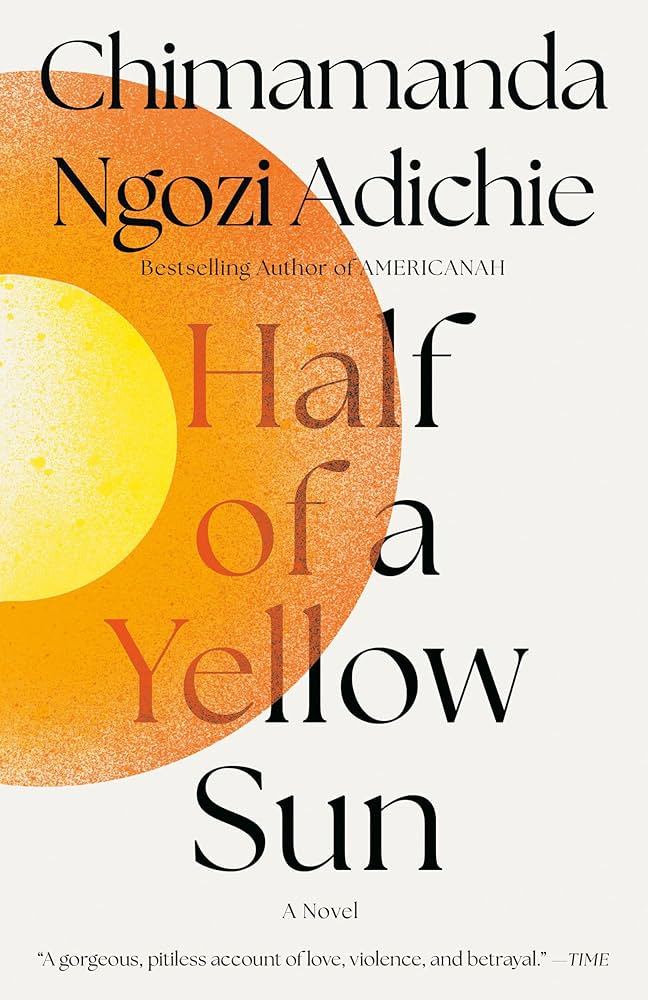

There is a moment about a third of the way into Half of a Yellow Sun when Olanna, the London educated daughter of a wealthy and compromised Lagos businessman, travels to Kano and finds her aunt Ifeka and uncle Mbaezi killed in the pogrom against Igbo northerners. On the train back south, a woman beside her is carrying a calabash that holds the severed head of her young daughter, and cannot stop talking about how fine the child’s plaits had been. Olanna gets on the train, the train moves, and Chimamanda Ngozi Adichie stakes the rest of her novel on the wager that domestic detail can hold up under the weight of mass killing. The calabash works because the plaits do.
| Title | Half of a Yellow Sun |
|---|---|
| Author | Chimamanda Ngozi Adichie |
| First published | 2006 |
| Publishers | Knopf (United States), Fourth Estate (United Kingdom) |
| Setting | Nsukka, Kano, Umuahia and Orlu, early 1960s through the Biafran war of 1967 to 1970 |
| Prizes | Orange Prize for Fiction, 2007 |
| Film | 2013, directed by Biyi Bandele |
How a Novel Got Written
Adichie was in her late twenties when Knopf and Fourth Estate published Half of a Yellow Sun in 2006, three years after her debut Purple Hibiscus. The book had been long in arriving. She has written about grandfathers she never knew who died during the war, one of them in a refugee camp, and about a family in Nsukka, where her father taught statistics at the university, whose world was taken apart by the fighting. The novel is dedicated to her grandparents and her parents. Nigerians still tend to refer to the whole catastrophe, with a deliberately neutral shrug of a phrase, as the war.
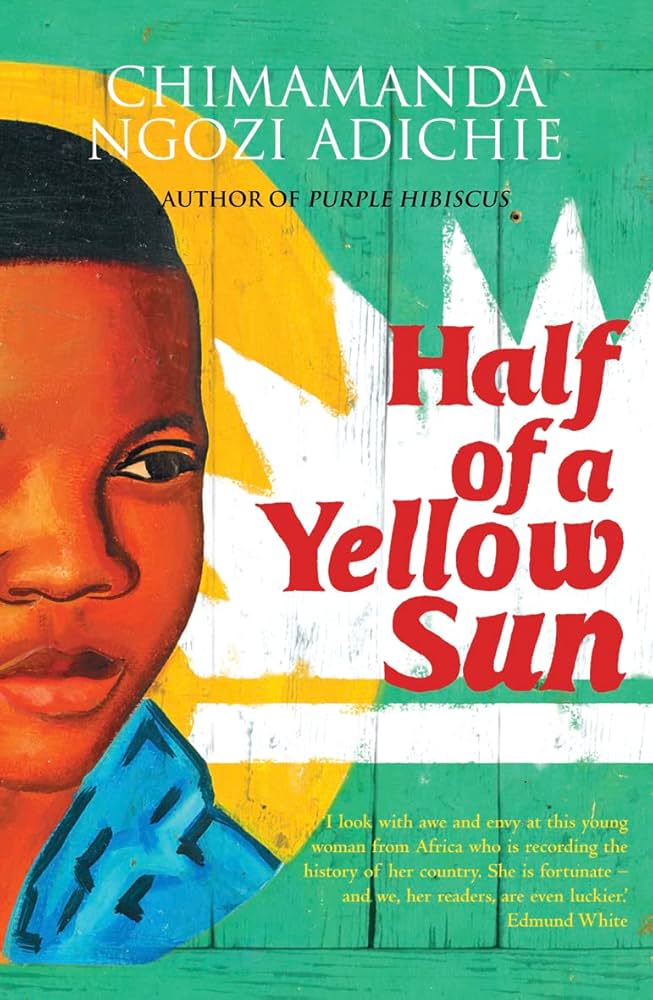
The war was the Nigerian Civil War, 1967 to 1970, in which the eastern region seceded as the Republic of Biafra after the pogroms in the north, was blockaded by the federal government, and lost an enormous number of civilians, most of them children and most of them to starvation; credible estimates range from several hundred thousand to more than two million dead. The book’s title refers to the Biafran flag: red, black and green horizontal stripes with a rising half sun on the black. The half sun had eleven rays, one for each of the provinces that joined the secession. By 1970 it had set.
What Adichie does that earlier Biafran war novels such as Buchi Emecheta’s Destination Biafra, Chukwuemeka Ike’s Sunset at Dawn and Eddie Iroh’s Toads of War had not quite managed is to make the war legible at the scale of a household. She tells it through three points of view: Ugwu, a thirteen year old houseboy from Opi village brought to work in the Nsukka home of Odenigbo, a radical mathematics lecturer; Olanna, Odenigbo’s educated and much admired lover; and Richard Churchill, a shy English expatriate writing a book about Igbo Ukwu art and in love with Olanna’s twin sister Kainene.
The Houseboy Who Becomes the Novelist
Ugwu is the novel’s quiet structural triumph. Adichie introduces him in the first sentence: “Master was a little crazy; he had spent too many years reading books overseas, talked to himself in his office, did not always return greetings, and had too much hair.” Ugwu arrives in Nsukka knowing nothing of refrigerators or indoor taps, and becomes, over several hundred pages, the consciousness through which we watch a comfortable academic household disintegrate into a wartime kitchen with nothing in it. He is the servant who ends up holding the book, and Adichie earns that reversal slowly rather than announcing it.
Her decision to give Ugwu the eventual authorship of the book within the book, a manuscript called The World Was Silent When We Died whose fragments are interleaved between chapters, was a calculated risk, and it does not entirely come off. Some readers feel his elevation from semi literate teenager to historian of the war happens too neatly, and the manuscript fragments can read like exhibits rather than discoveries. But the gamble pays for itself in the late war section where Ugwu, by then conscripted into the Biafran army, takes part in the gang rape of a bar girl. The scene is brief, brutal and refuses to let him off. He is the novel’s most loved character, and Adichie writes him into a war crime. The Biafran cause does not protect him, and the book’s politics become far more interesting than a straightforward elegy for the Republic.
The Politics of the Half Sun
Reception divided on a fault line that has run through Nigerian letters since the war ended. In the Igbo southeast the novel was received as a long delayed catharsis. Elsewhere in the federation the reception was cooler and in places hostile: critics noted that the federal perspective is essentially absent, that the starvation blockade strategy is condemned without a dramatised counter argument, and that the novel risks consolidating a sectional memory rather than a national one. When the Nigerian Film and Video Censors Board halted the Lagos premiere of Biyi Bandele’s film adaptation in April 2014 and withheld certification for months, it confirmed how unresolved the war remains in the federation’s official memory.
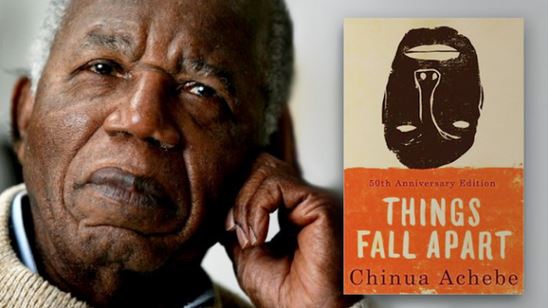
Western reception was different again. The Orange Prize for Fiction, which Adichie won in 2007, arrived attached to marketing that sold the book as a sweeping humanitarian epic, a love story with a Biafran backdrop, when the actual project was much harder than that. Achebe, by then a kind of patriarch in exile of African letters, wrote in his endorsement that Adichie “came almost fully made” as a writer. The blessing mattered, and Adichie has said so. It also produced a dynastic framing that some younger African critics found constricting, as if her work could only be read along a line of descent from Achebe rather than on its own terms.
What the Domestic Detail Does
The novel’s craft is in its furniture. Adichie is a writer who knows how a meal works. The early Nsukka scenes, before the war, are organised around food: Ugwu learning the household’s standards in the kitchen, Odenigbo’s circle of intellectuals arguing late into the night over whatever Ugwu has cooked and whatever is in the drinks cabinet, Olanna adding her own instructions to his. When the war comes, the food disappears, and the novel starts measuring the war in calories. Garri rations shrink. Relief supplies arrive and then stop. The children in the compounds around Olanna develop the reddened hair and swollen bellies of kwashiorkor. Kainene, running a refugee camp at Orlu, improvises with whatever can be bartered for.