
Walk into any Lagos bar on a Saturday night and listen to what’s playing. Within three songs, somebody on the speakers will be calling somebody else sweet, comparing a lover to honey, threatening to chop a heart, or promising suya before sunrise. This is not coincidence and it is not lazy lyricism. Afrobeats has built one of the most consistent metaphor systems in modern popular music, and that system runs almost entirely through the kitchen, the market, and the buka.
The food-as-love equation sits so deep in West African musical tradition that English-language listeners often miss how layered it is. “Sweet like sugar” gets dismissed as a cute line. “Come and chop my heart” gets translated as a sex joke. Both readings are partial. What’s actually happening is a centuries-old conversation between Yoruba praise singing, Igbo highlife storytelling, Pidgin street poetry, and contemporary global pop, all routed through a culture where feeding someone is the most concrete proof of love you can offer.
The Foundational Vocabulary

Three words anchor almost every Afrobeats love song written in the last two decades. Sweet. Honey. Sugar. They appear so often that producers joke about them being default vocal samples.
“Sweet like sugar” is the entry-level metaphor. It compares the beloved to refined sweetness, the kind found in every household, accessible and uncomplicated. “Sweet like pepper” is more interesting because it flips the expected register. Pepper is hot, sharp, intense. Naming a lover “sweet like pepper” is admitting that desire and discomfort live in the same body. The pepper here is rodo, ata rodo, the Scotch bonnet that defines Nigerian stews. To say a lover is sweet like pepper is to say she lingers, burns, satisfies.
Honey works differently. Honey is the endearment of choice across Yoruba, Igbo, and Pidgin love songs because it carries weight from oral tradition. Yoruba praise poetry has called desirable women “oyin” for generations, and the word survives intact into modern lyrics. When Wizkid sings honey, when Davido sings honey, when Rema sings honey, they are pulling from a vocabulary that predates the recording industry.
Rema, the Fanta Line, and the Global Crossover

Rema’s “Calm Down” became one of the biggest Afrobeats exports of the decade, and the line that listeners around the world started singing back compares the beloved to a cold bottle of Fanta. That line is doing a lot of work. It takes the standard sweet-comparison and hands it to a supermarket soft drink, an object any Nigerian child recognises on sight, rather than to anything poetic. The register drops from praise poetry to corner shop, and the compliment gets warmer rather than cheaper for the fall. Fanta is orange, cold, familiar, faintly childish, and completely unpretentious. Naming it in a love song says the beloved is not exotic and does not need to be. She is the thing you already reach for without thinking.
That single line shows why the food vocabulary travels so well. It’s flexible. You can swap the noun and keep the structure.
Food as Sexual Innuendo, Politely Coded

Pidgin English does a lot of the heavy lifting in Afrobeats euphemism, and food is the safest cover for sexual content. “Come and chop my heart” lands on streaming services because “chop” reads as eat, but in West African English chop carries another full register that any native listener catches immediately. To chop is to consume, to enjoy, to take. The romantic and the sexual collapse into the same verb.
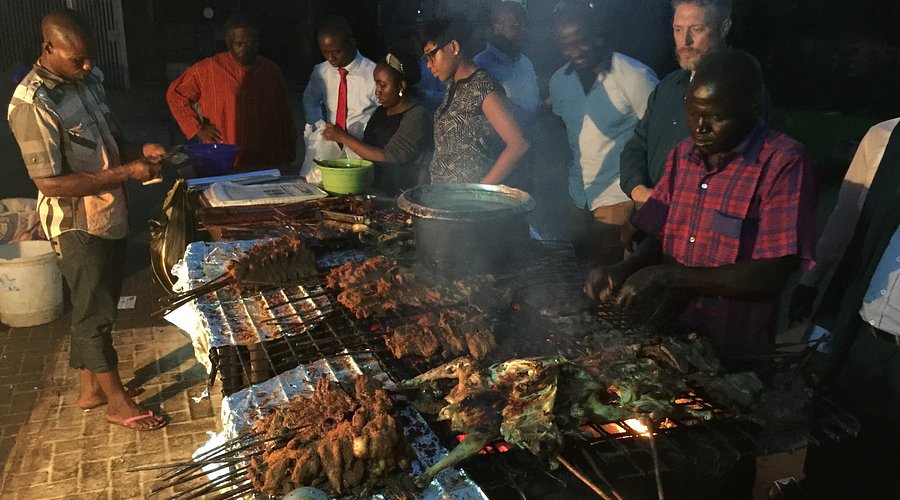
“Suya tonight” works the same way. Suya is the spiced grilled beef sold from charcoal stands across northern and central Nigeria, traditionally eaten late, often with cold beer. To invite somebody for suya tonight is rarely about the meat. It’s an invitation that travels through plausible deniability, the same way “Netflix and chill” travels in American English. The food gives the proposition cover.
Burna Boy works this register constantly. “Anybody” and several of his deeper cuts deploy food references that read innocent on first listen and sexual on the second. The double meaning is the point. Afrobeats grew up under conservative social codes where direct sexual content gets censored on radio and pulled from family playlists. Coding desire through stew, pepper soup, and suya let artists say what they meant without saying it out loud.
The Davido “Fall” Architecture

“Fall” by Davido sits in this same tradition. The lyric about wahala and hand on the waist reads as romantic on the surface, but the song’s whole posture is about appetite. Wahala in this context means the productive trouble that comes from desire, the back-and-forth that ends with food, drink, and a closed door. The song became a global hit partly because the surface metaphor was approachable and partly because the underlying appetite was universal.
This is the trick the best Afrobeats love songs pull off. The food works as decoration for casual listeners and as a complete sexual grammar for listeners inside the culture.
The Kitchen as the Real Romantic Stage

If you ignore the innuendo for a second, there’s a more tender food tradition running through Afrobeats. Songs about being fed. Songs about cooking. Songs that treat the kitchen as the actual location of love.
“Akara and pap” shows up as a homely metaphor in dozens of songs because that breakfast combination is the most ordinary morning food in southern Nigeria. Akara is the bean cake fried in palm oil, pap is the corn pudding called ogi or koko depending on region. To name akara and pap in a love song is to claim domesticity, to suggest a relationship that survives past the club into the morning after, into the months of ordinary Tuesdays.
“Pounded yam” is the heavier version. Pounded yam takes work. You boil the yam, you pound it in a mortar until it ripens into a smooth, elastic dough, and then you serve it with a soup that took its own hour to build. To compare satisfaction to pounded yam is to claim a thick, earned, weight-bearing kind of pleasure. The metaphor only works because everybody listening knows the labor that went into the dish.
Asake leans into these homely food references in his love songs, blending Yoruba street wisdom with mid-tempo grooves that name specific foods rather than generic sweetness. Adekunle Gold’s “Pretty Girl” and several of his other ballads use food metaphors as a stand-in for the long-term arithmetic of love, the kind that includes who cooks, who provides, and who shows up at the table.
Ofe Nsala and the Igbo Love Song

The Igbo tradition has its own food vocabulary in highlife and contemporary Afrobeats. Ofe nsala, the pale white soup from southeastern Nigeria, gets named in Igbo love songs as the dish a woman might cook to confirm a relationship is serious. Ofe nsala demands specific ingredients, careful seasoning, and patience. It is not a casual soup. To sing about ofe nsala in a love context is to talk about commitment.
Phyno has built parts of his romantic catalogue on this kind of Igbo food signaling. His verses often name specific dishes, specific market days, specific regional foods that locate the love song in a precise cultural geography. The food becomes a flag of identity as much as a metaphor for desire.