

Consider the title story of Friday Black. A Black Friday sale at a suburban American mall. Shoppers stampede through the doors with the desperation of people trying to outrun their own debt. By page two a man has been trampled to death. By page four the narrator, a salesman with a bonus structure tied to clearance volume, is hosing blood off the merchandise while a fresh wave of customers paws at the discounted parkas. The dead pile up in the food court. Mall security drags them out the back. The salesman, who is Black and underpaid and one good quarter from a promotion that will not actually come, keeps working. The story is funny in the way George Saunders is funny, which is to say that the laughter dies in your throat about halfway through. When the collection arrived in 2018 from Houghton Mifflin Harcourt, the cover was a startling gradient of red and the table of contents promised eleven more stories operating at the same temperature. Almost all of them delivered.
A Bronx Childhood and the Inheritance of Two Geographies
Nana Kwame Adjei-Brenyah was born around 1991 in the Bronx, New York City, to Ghanaian immigrant parents, and the family later moved to Spring Valley, a working-class town in Rockland County north of Manhattan, where he spent most of his school years. The geography is the first thing to understand about his fiction. He is not a writer of Accra or Kumasi. He is a writer of the American suburb where the Ghanaian church meets in a rented hall on Sundays and the children grow up Black American by ambient pressure while still eating jollof at home. He has talked, in interviews and essays, about the particular doubleness of being Ghanaian inside an African American context, and about the way that doubleness made certain American racial scripts both familiar and slightly off-key.
He studied at the State University of New York at Albany, then took an MFA at Syracuse University. The Syracuse program is the institutional fact his press coverage returns to most often, because George Saunders taught there and taught him. Saunders is not just any MFA mentor. He is the writer whose particular blend of dystopian satire and moral seriousness most visibly underwrites the first half of Adjei-Brenyah’s career. Adjei-Brenyah has been graceful about the mentorship without being deferential, and his work has at this point clearly outgrown the comparison. Friday Black is a Saunders-influenced book; Chain-Gang All-Stars is Saunders-influenced only in the way a serious novel is influenced by everything its writer has read, which is to say the influence has been digested.
The Ghanaian inheritance shows up less in setting than in moral framework. He has described being raised in a household where stories were treated as ethical instruments, where the question of how a person ought to live was not separable from the stories the family told. His fiction carries that pressure. The dystopias are not exercises. They are tests of how a Black American life can be lived inside an economic and racial system designed to consume it.
The Books at a Glance
| Title | Year | Form |
|---|---|---|
| Friday Black | 2018 | Short story collection (twelve stories) |
| Chain-Gang All-Stars | 2023 | Novel |
Friday Black and the Trick of Satire That Will Not Let You Laugh
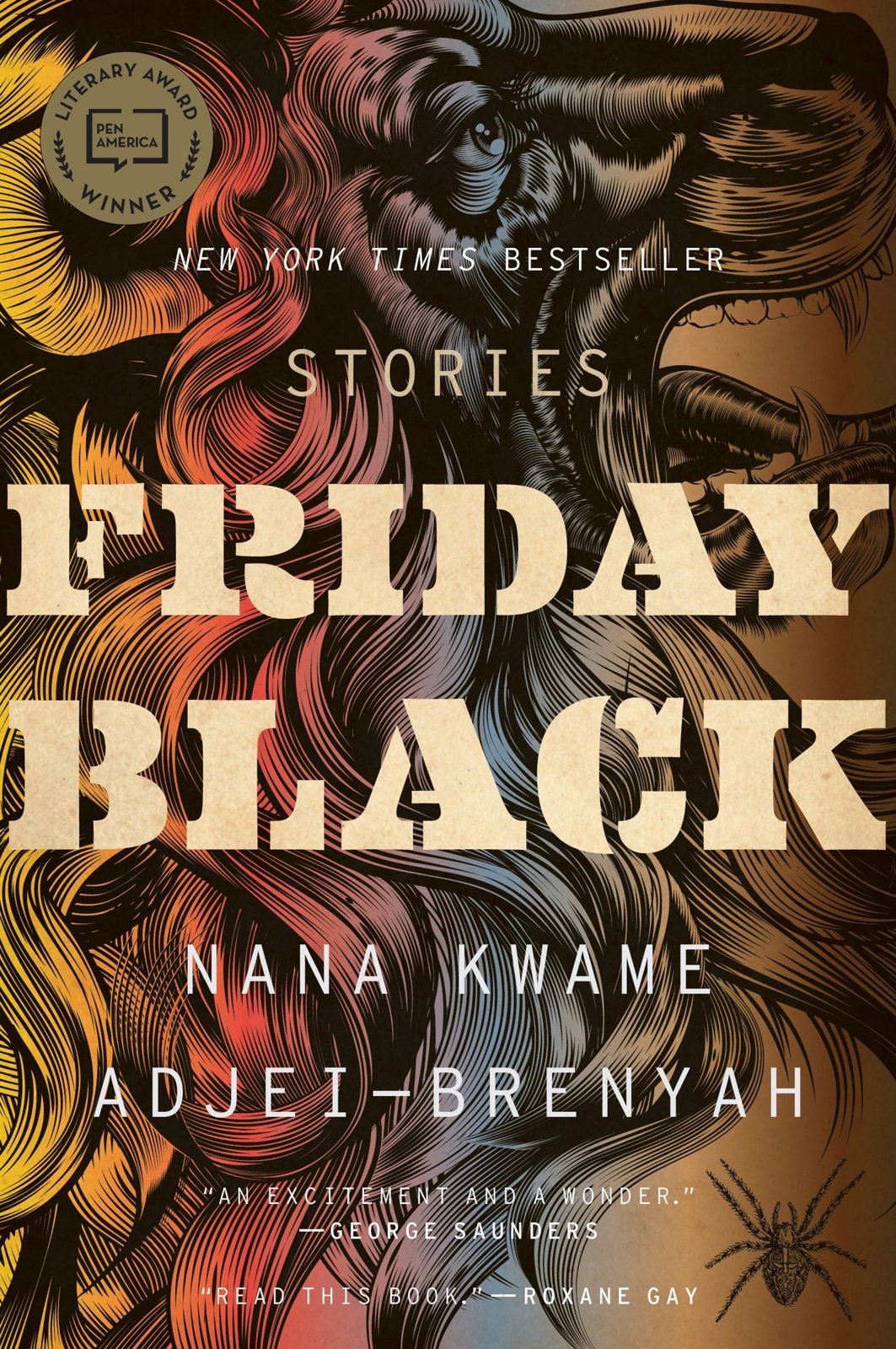
It is worth being exact about the form, because the book is routinely miscalled a novel. Friday Black is a collection of twelve short stories, and the collection shape is load-bearing: the stories rhyme with each other rather than building a plot, and the retail dystopia of the title story recurs as a setting rather than a storyline. They operate at the intersection of Black American experience and consumer capitalism pushed past its breaking point. The Finkelstein 5, the opening story, begins with five Black children killed outside a library by a white man who claims self-defence and is acquitted. It follows George, a young Black man trying to keep his rage manageable while applying for a job and dating a woman who wants him to dial down his political grief. The satire is dialled to twelve, but the satire is not the point. The point is the cost of carrying that rage without anywhere to put it.
Zimmer Land follows a Black actor employed by a theme park where white customers pay to roleplay shooting unarmed Black men in scripted self-defence scenarios. The premise is monstrous in a way that, in 2018, felt one degree away from a news headline. The Era, set in a future where genetic optimisation has produced a racial caste system, follows a schoolboy whose teacher delivers Optimism Modules while the students openly slur each other. How to Sell a Jacket as Told by Ice King is a sales-floor monologue from the same retail dystopia as the title story. The collection’s range is wider than the dystopian-satire label suggests. There are tender stories here too, among them The Lion and the Spider and The Hospital Where, which handle family and faith and intergenerational obligation with very little of the high-concept armour.
The prize record is worth grading precisely, because it has been reported loosely elsewhere. Adjei-Brenyah was named a National Book Foundation 5 Under 35 honouree in 2018. Friday Black then won the PEN/Jean Stein Book Award in 2019 and won the William Saroyan International Prize for Writing. It was a finalist for the National Book Critics Circle’s John Leonard Prize for a first book. That is a win, a win and a finalist placement, not three nominations. The criticism, when it came, focused on what some reviewers called the collection’s volume: the stories operate so consistently at high pitch that reading them straight through can feel exhausting in a way the writer may not have intended. The complaint has merit. Read one story a night for two weeks and the collection earns its reputation. Read it in two sittings and the satirical machinery starts to expose its own gears.
Chain-Gang All-Stars and the Longer Form
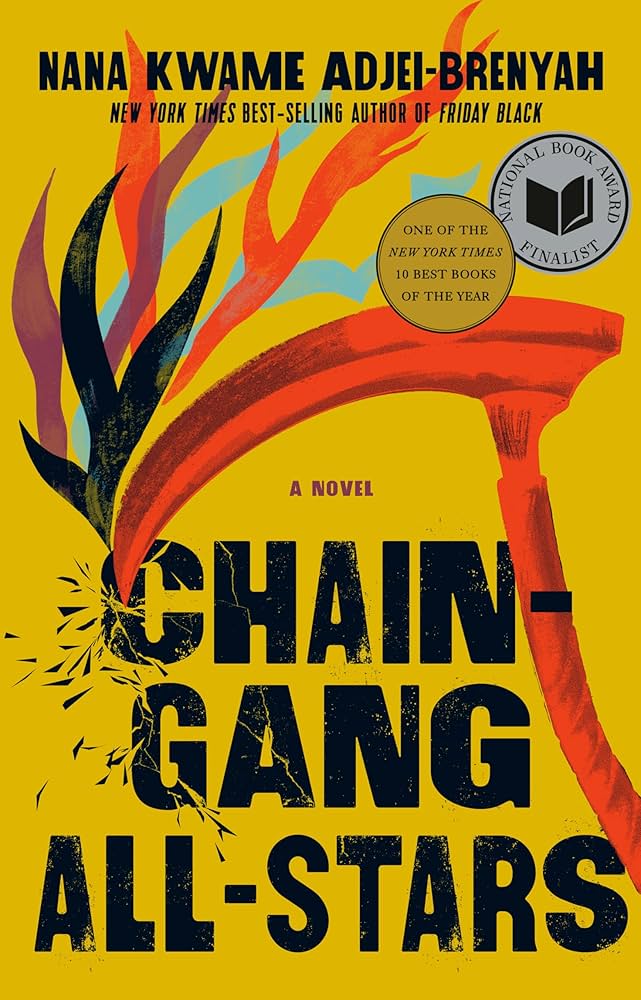
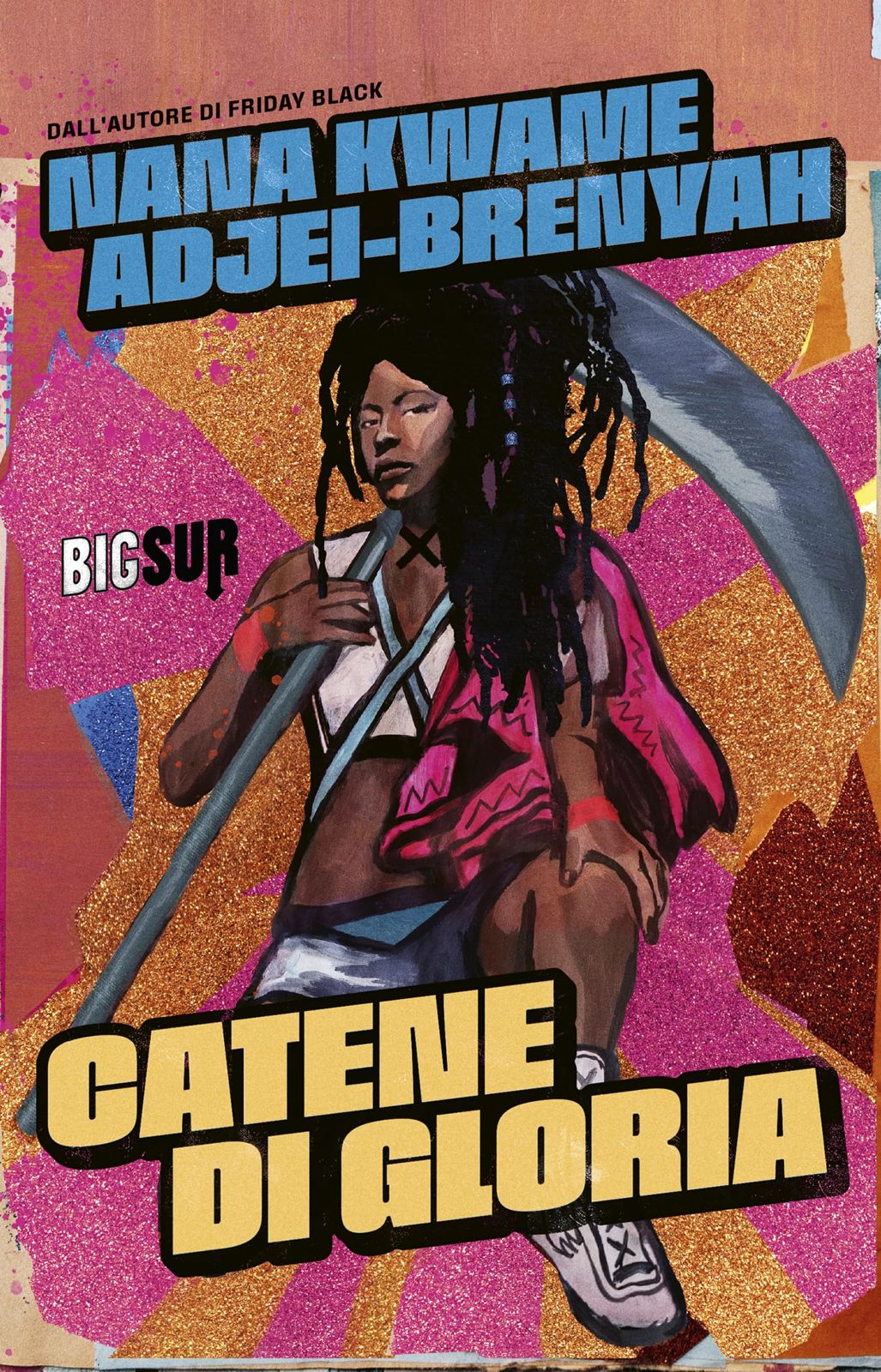
Chain-Gang All-Stars, published in 2023 by Pantheon, is his first novel, and it takes the dystopian framework of the stories and stretches it to novel length. The premise is a near-future America in which the prison industrial complex has been monetised as a gladiator entertainment league. Convicts opt into Criminal Action Penal Entertainment, hand-to-hand combat televised live, in exchange for the possibility of eventual freedom after a sufficient number of kills. The two central characters are Loretta Thurwar and Hurricane Staxxx, the most decorated women fighters in the league, both Black, both lovers, both calculating how close they are to the number that will get them out.
The novel was a finalist for the 2023 National Book Award for Fiction, the prize position that matters here and the one most often misstated: a finalist placement for the novel, and nothing attaching to the earlier collection. It was also named one of The New York Times ten best books of 2023, longlisted for the 2024 Aspen Words Literary Prize and nominated for the 2024 Dublin Literary Award. No Booker Prize placement is claimed here, because none appears on that prize’s own record. What it announced was something the stories had only hinted at, which is that Adjei-Brenyah could sustain a long-form structure without losing the satirical compression that made the short fiction work. The book moves between the two protagonists’ chapters in the arena, a constellation of supporting characters including fighters, fans and abolitionist organisers on the outside, and dense footnotes that walk the reader through American prison policy and practice. The footnotes are the boldest formal choice. They could easily have read as didactic. In execution they read as a writer who has done the research and is unwilling to let the reader treat the satire as merely metaphorical. The carceral system he is writing about exists. The book wants you to know that.
Critically the novel divided readers along predictable lines. Reviewers who wanted the lean compression of the stories found it overlong; reviewers who wanted a serious political novel about American carcerality found it the most ambitious book on the subject in years. The truth is closer to the second reading than the first. The middle section sags, the supporting cast is too large by perhaps three characters, and a few of the propaganda-broadcast set pieces lean too hard on the satirical instinct. But the closing stretch, in which Thurwar and Staxxx have to choose whether to honour the love they have built inside a system that requires one of them to kill the other, justifies everything around it.