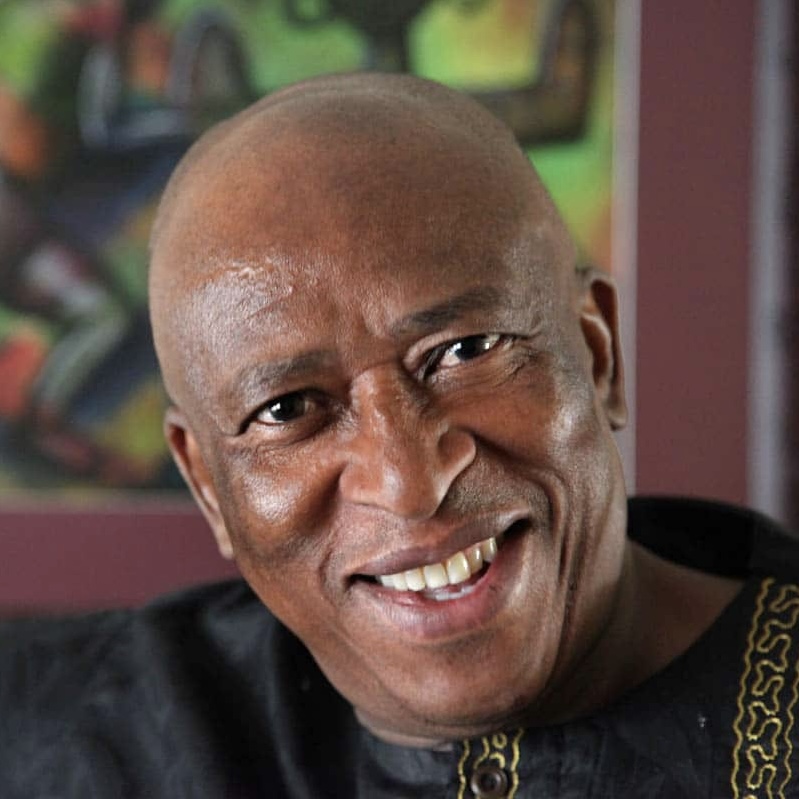


Seventeen years is the figure that hangs over Dinaw Mengestu’s first novel, the time Sepha Stephanos has been gone from Ethiopia, counted out in a failing grocery store in a Washington neighbourhood that is gentrifying around him. He plays a game with two friends, also African exiles, in which they name a year and the coup that defined it somewhere on the continent. It is a game about memory and about distance, about men who have built lives in America while their interior weather stays fixed on the countries they fled. That scene, played out among the dusty shelves of a corner store, is the keynote of Mengestu’s fiction. He writes about the people who left, who arrive somewhere new, and who carry the unfinished business of elsewhere inside them for good.
The Beginning Before Memory
Dinaw Mengestu was born in Addis Ababa on 30 June 1978, during the period of political repression known as the Red Terror. His father, an executive with Ethiopian Airlines, applied for political asylum while on a business trip to Italy, at a point when Mengestu’s mother was pregnant with him. Two years later, mother, sister and toddler son were reunited with him in the United States. The family settled in Peoria, Illinois, where his father worked first as a factory labourer before moving into management, and later moved to the Chicago area, where Mengestu finished high school in Oak Park. The country he had been born into existed for him only as story, as the thing his parents carried and occasionally let slip.
This is the crucial fact about Mengestu and it separates him from writers who fled as conscious witnesses. He has no real memory of Ethiopia. The homeland is for him a place reconstructed from his parents’ grief and silence rather than from his own experience. He is a writer of the second position, the child of exile rather than the exile himself, and that distance gives his work its particular melancholy. He writes about a loss that is inherited, a homesickness for a place he never knew.
He took a bachelor’s degree in English at Georgetown University and an MFA in writing at Columbia University in 2005. The early recognition came fast and it came in a specific, verifiable order. In 2007, the year of his first novel, the National Book Foundation named him one of its “5 Under 35” honourees and he held a Lannan Fiction Fellowship. In 2010 The New Yorker placed him on its “20 Under 40” list. In 2012 he was selected as a MacArthur Fellow, the award popularly called the genius grant, while still in his early thirties. The speed of the acclaim could have inflated a lesser writer. Mengestu instead kept circling the same wound with increasing precision.
The Beautiful Things That Heaven Bears
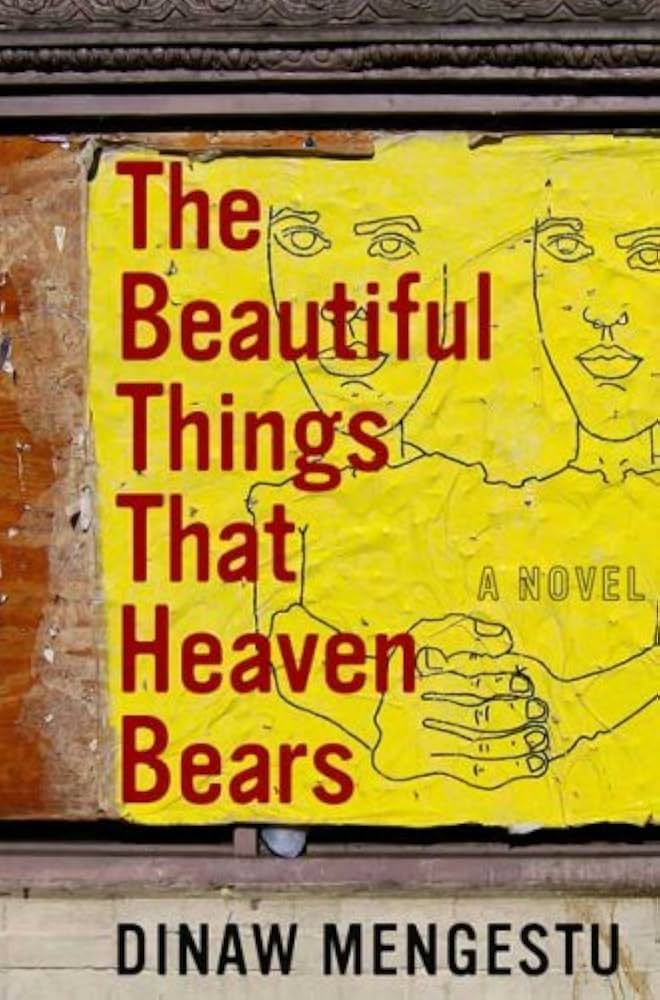
His debut, published in 2007, introduced Sepha Stephanos, an Ethiopian who fled the revolution and now runs a small grocery store in Logan Circle, then a poor, predominantly Black neighbourhood of Washington that was beginning to gentrify. A white woman and her biracial daughter move in next door, and a tentative friendship forms, charged with possibility and class anxiety and the awkwardness of a man who has spent years not allowing himself to want anything. One point of bibliographic housekeeping matters here: the novel was published in the United Kingdom under the title Children of the Revolution. It is the same book, not a second one, and reading lists that count it twice are wrong.
The novel is quiet and devastating. Its true subject is the inertia of exile, the way a person can build a life that is really a long deferral of living. Sepha and his two friends, one from Congo and one from Kenya, meet to drink and to play their game of naming African coups, performing their erudition and their displacement at once. They are educated men reduced to immigrant labour, and the gap between who they were and who America has made them is the ache that drives the book.
Mengestu writes the gentrifying neighbourhood with real acuity. He sees how the arrival of money displaces the people who held the place together, and he refuses to make the white newcomer a simple villain or the immigrant a simple victim. The title comes from Dante, and the borrowing is deliberate: Sepha is a man in a kind of purgatory, neither in his homeland nor fully arrived in his new one. The store itself, slowly failing, stocked with goods nobody in the changing neighbourhood wants, becomes a precise emblem of a man whose moment passed before he ever had it.
The prize record for the debut is strong and specific. It won the Guardian First Book Award in 2007, outright rather than as a shortlisting, took the Art Seidenbaum Award for First Fiction at the Los Angeles Times Book Prizes and the French Prix du Premier Roman Étranger, and was shortlisted for the Dylan Thomas Prize and the Young Lions Fiction Award and longlisted for the Prix Femina étranger.
How to Read the Air
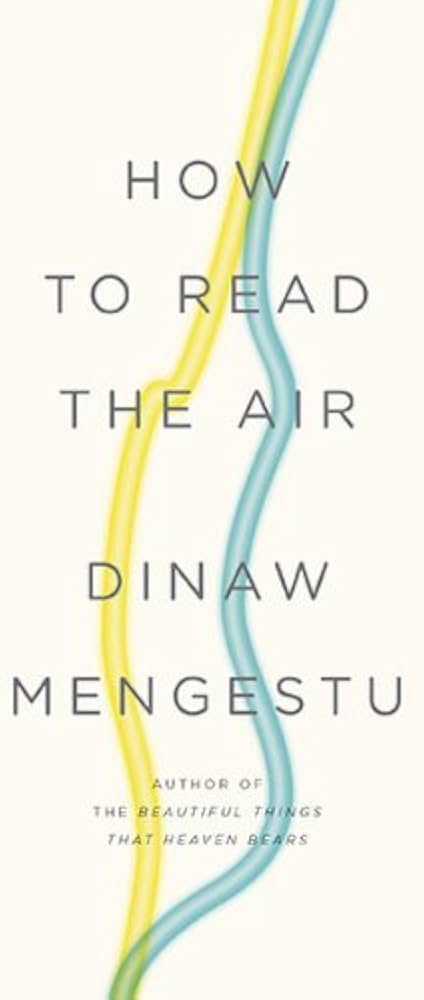
His second novel, published in 2010, deepens the inheritance theme. Its narrator, Jonas, is the American-born son of Ethiopian immigrants, and the book braids two journeys, his own failing marriage and a road trip he reconstructs that his parents took years earlier across America. Jonas is a fabulist, embellishing and inventing the stories of his parents’ lives, and the novel becomes a meditation on how the children of immigrants narrate a past they did not witness. Part of it was excerpted in The New Yorker in July 2010, in the wake of the “20 Under 40” selection.
The book is more formally restless than the debut. It moves between time frames and between truth and invention, and it asks whether the stories we tell about our parents can ever be anything but fiction. Jonas works at a refugee resettlement centre, helping others craft the asylum narratives that will let them stay, and the irony is sharp. He is a professional shaper of other people’s stories who cannot tell the truth about his own.
Some readers found How to Read the Air colder than the debut, its narrator harder to love, its sadness more diffuse. It won the Ernest J. Gaines Award for Literary Excellence in 2011 all the same, and it is the novel where Mengestu most fully confronts his own position as the writer who inherited a homeland secondhand. Jonas is the closest thing he has written to a self-portrait, and the discomfort of the book is the discomfort of a writer interrogating his own authority to speak for a country he never knew.
All Our Names
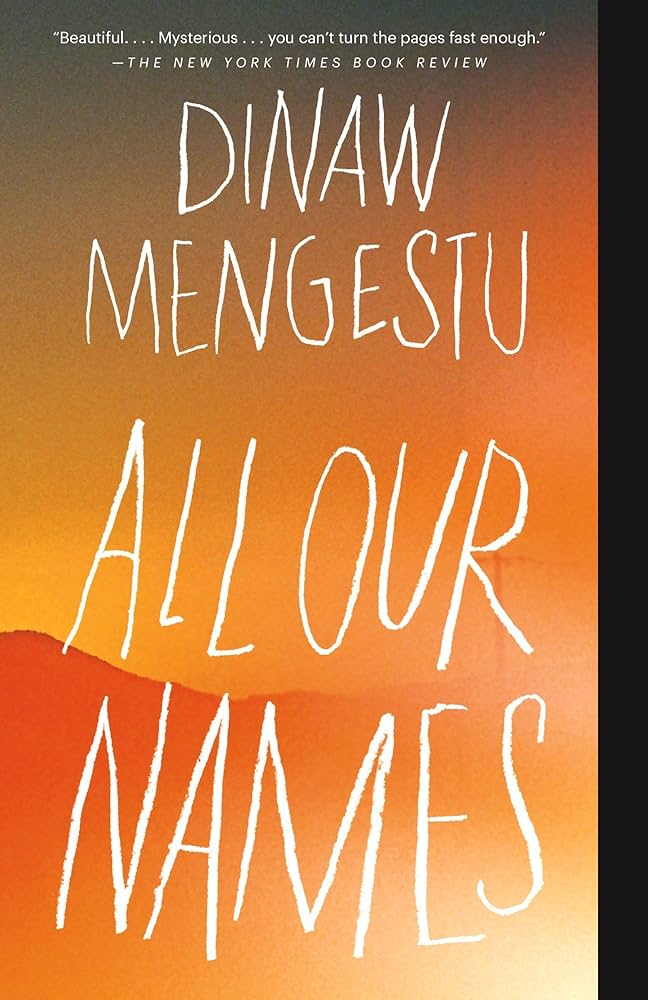
The third novel, published in 2014, marks his most ambitious structure. It alternates between two narrators. One is a young African man caught up in revolutionary politics in a newly independent country, unnamed in the book though generally read as Uganda, during the upheavals of the era. The other is Helen, a white American social worker in a small Midwestern town who falls in love with an African student named Isaac who has arrived under murky circumstances.
The two strands slowly reveal their connection, and the novel becomes a study of how revolution and intimacy distort identity, how a name can be borrowed, traded or shed entirely. The African chapters, with their account of friendship curdling into political violence, show Mengestu reaching beyond the diaspora to write the convulsions of the continent itself. The American chapters return to his familiar territory, the impossibility of fully knowing the person who has crossed an ocean to be with you.
It is also his most plot-driven book, and for some readers the most rewarding, because the withholding that characterised the earlier novels here becomes a genuine mystery, a slow uncovering of who Isaac really is and what he fled. The treatment of friendship deserves particular attention. The bond between the two young men in the African chapters, forged in revolutionary hope and then twisted by the compromises of power, is among the most affecting things he has written. By placing that drama alongside the American love story, Mengestu insists the two worlds are not separate, that the convulsions of a distant continent live on inside the quiet rooms of Midwestern life.