


Yvonne Adhiambo Owuor: A Reader's Guide to the Kenyan Author's Most Essential Books
Image: Wikipedia
Books

Yvonne Adhiambo Owuor: A Reader's Guide to the Kenyan Author's Most Essential Books

Arianne ColeArianne Cole··9 min read
Ad SpaceArticle Top - 728x90
Advertisement

The first page of Dust throws the reader into the middle of a chase, a young man named Odidi Oganda running through Nairobi as bullets find him, the city’s neon and rain and the fact of his dying spilling across the prose in long, panting sentences that refuse to slow down for the usual courtesies of exposition. By the time he hits the pavement the reader has been initiated into Yvonne Adhiambo Owuor’s particular method. She writes as if language itself were a kind of grief, dense and lyrical and unwilling to thin itself out for the reader’s convenience. Dust announced in 2014 that Kenyan literature had a new major voice, and the years Owuor had spent on the manuscript showed in every paragraph. The book did not arrive so much as accumulate.

A Slow-Burning Career, Then a Caine Prize

Yvonne Adhiambo Owuor was born in Nairobi in 1968. She studied English at Kenyatta University, took an MA in television and video development at the University of Reading, and later completed an MPhil in creative writing at the University of Queensland in Australia. Her path to the novel was unhurried and ran through film and cultural management rather than the newsroom or the writing programme. She has worked as a screenwriter, and from 2003 to 2005 she was executive director of the Zanzibar International Film Festival, a post that put her in the middle of the Swahili coast and the Indian Ocean world that would become her great subject. Her short story “The Knife Grinder’s Tale” was made into a short film of the same name, released in 2007. She is also a co-founder of the Macondo Literary Festival.

The breakthrough came in 2003, when she won the Caine Prize for African Writing for her short story “Weight of Whispers.” The Caine Prize is awarded for a single short story and not for a book, which is worth stating plainly, because the distinction is often lost. The story, first published in the Kenyan literary magazine Kwani?, follows an aristocratic Rwandan refugee in Nairobi after the genocide, a man reduced by exile to keeping his family alive in a city with no patience for his lost dignity. Kwani Trust issued it as a standalone edition in 2003. The prize put Owuor on the international map at a moment when the Caine had become the most important launchpad for new African writing, and the Kenyan press noted the double, since Binyavanga Wainaina had won the year before. In 2004 she was named Kenya’s Woman of the Year in the arts and heritage category.

The novel did not follow quickly. Owuor spent the next decade circling, drafting and rebuilding her first book, and the long gap between the prize and the novel was itself part of the story when Dust finally appeared. She is, by temperament and practice, a slow writer, the kind whose books accumulate over years of revision into something denser and stranger than a faster writer would produce.

Dust
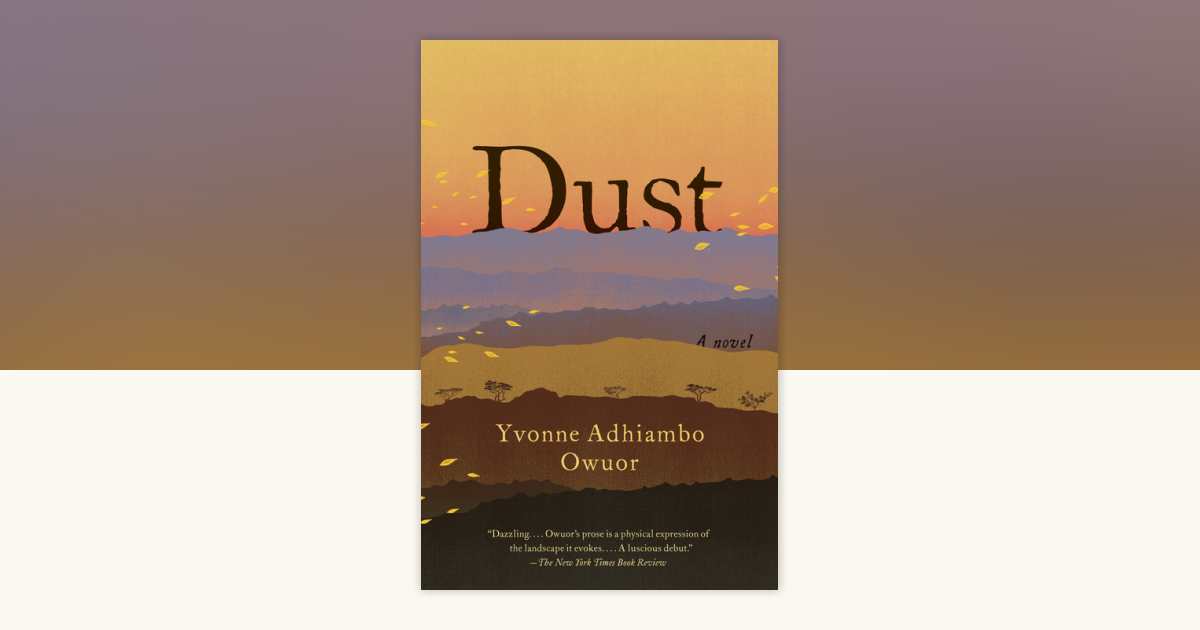
Yvonne Adhiambo Owuor - Dust
Image: Penguin Random House

Dust, published in 2014, is one of the most ambitious Kenyan novels of recent decades. Odidi’s death pulls his family back to their home in the dry country of northern Kenya, at a place called Wuoth Ogik. His sister Ajany returns from Brazil. His father, Nyipir, who has carried Kenyan history in his body for half a century, must finally face what he has buried. A British stranger, Isaiah, arrives at the homestead searching for his own missing father, and as the family pieces together what happened to Odidi, the larger question of what happened to Kenya rises with it.

The novel reaches back to independence in 1963 and to the political killings that shaped the new nation, including the assassination of Tom Mboya in 1969, and to the longer pattern of state violence that successive governments worked to keep out of the national story. The post-election violence of 2007 and 2008, which killed more than a thousand Kenyans, is the fresh wound the family’s story bleeds into. Owuor is not interested in the official account of any of this. She is interested in the buried, the half-remembered, the things spoken in silence between parents and children and between the dead and those who survive them.

The prose is the most distinctive thing about the book. Reviewing it in The Washington Post, Ron Charles wrote that “her style is alternately impressionistic and harsh, incantatory and propulsive.” The northern Kenyan landscape, the dust and heat and unforgiving sun, is rendered with a precision that is itself a kind of love. The novel demands patience and gives back a depth of historical and emotional reach few Kenyan novels have matched. In September 2015 it was shortlisted for the Folio Prize and won the Jomo Kenyatta Prize for Literature, Kenya’s pre-eminent literary award.

The Dragonfly Sea
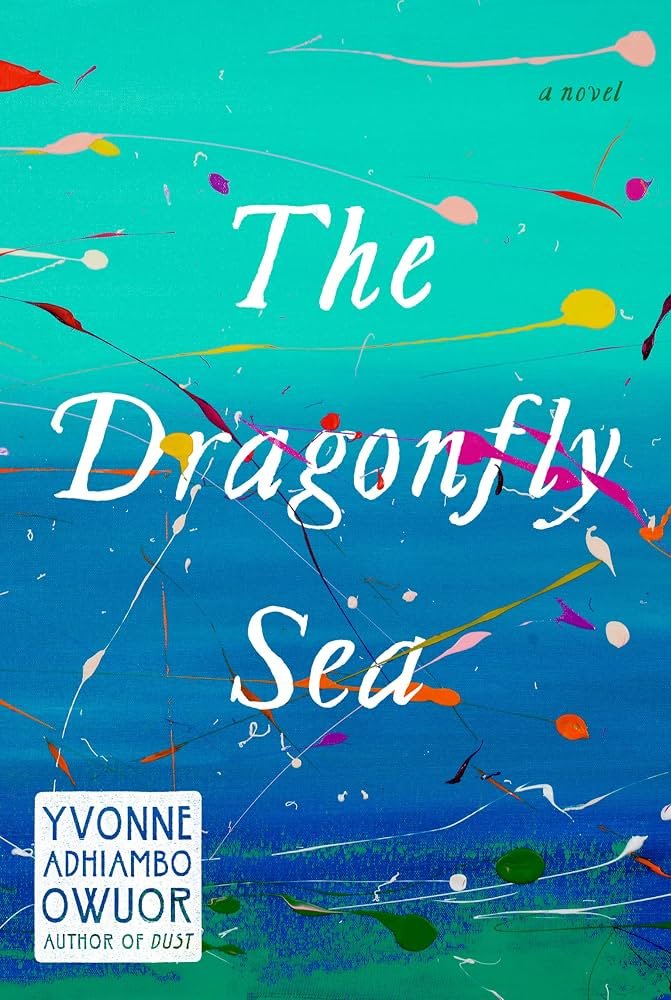
The Dragonfly Sea by Yvonne Adhiambo Owuor
Image: Amazon.com

Her second novel, published in 2019, widens the canvas dramatically, leaving the Kenyan interior for the Indian Ocean world. The Dragonfly Sea follows Ayaana, a girl growing up on Pate Island off the Kenyan coast with her mother Munira, in a Swahili island community whose people have spent centuries trading and travelling across the ocean to Arabia, India and China. A sailor named Muhidin enters their lives and becomes the father Ayaana has never had. When cultural emissaries from China identify her as a descendant of sailors said to have been wrecked on the East African coast centuries earlier, in the era of the Ming navigator Zheng He, she is offered a scholarship and finds herself travelling east across the same ocean her ancestors crossed.

The novel is at once a coming-of-age story and a meditation on the Indian Ocean as a world, the dhow routes and trading languages and intermingled lineages that connected East Africa, the Arabian peninsula, India and China for a millennium before European colonisation recast the region in its own image. Owuor writes the ocean itself as a presence, alive with monsoons and currents and old stories, and the prose moves with the same patient density that made Dust so distinctive. Ayaana’s journey through Turkey and China and back becomes a journey through the layered identities the ocean has always produced, where any clean division between African and Asian misses how much the two have been braided together.

The book is also a love story, a story about piracy and naval politics in the contemporary Indian Ocean, and a study of a Swahili coastal community that mainland Kenyan fiction has rarely centred. It is a less tightly constructed novel than Dust, more meandering, more willing to follow its protagonist into long stretches of contemplation, but it confirms Owuor’s stature and shows her ambitions widening rather than narrowing.

Ad SpaceIn-Article - 300x250
Advertisement

What Her Books Are About, Underneath the Plot

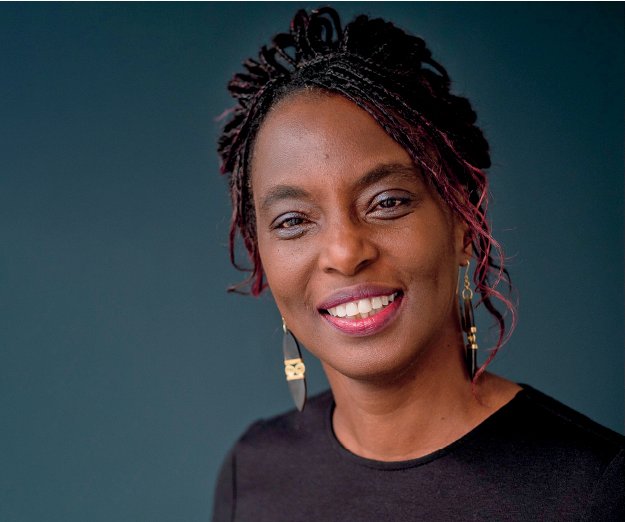
Yvonne Adhiambo Owuor
Image: Debunk Media

A handful of preoccupations animate the fiction. The first is the Indian Ocean as a world: the long pre-colonial history of Swahili coastal life, the dhow trade, the mingling of African, Arab, Indian, Persian and Chinese populations that produced a cosmopolitanism the European empires later tried to erase. Owuor is one of the few contemporary African writers to take the Indian Ocean seriously as a frame for African identity, and she has pursued it in essays as well as fiction, including her work on the Swahili sea poems of Haji Gora Haji.

The second is Kenyan political violence and its buried histories, the assassinations and disappearances and massacres that successive governments worked to keep out of the national story. Dust is the most direct treatment, but Owuor keeps returning to the question of what a nation does with the dead it has refused to mourn, and with the children who grow up not knowing what happened to their parents or what their parents did. This is political fiction, but political fiction interested in interiority rather than polemic.

The third is memory itself, the way the past survives in objects, gestures and silences, the way characters carry history in their bodies and on their tongues even when they do not consciously remember. Owuor writes memory with the patience of a sculptor, letting it accumulate detail by detail and refusing to summarise. Underneath all of it runs a lyrical maximalism, a commitment to density and beauty over economy, that distinguishes her sharply from the leaner contemporary voices.

The Cost of Lyrical Density

Owuor’s strengths are also, predictably, what makes her difficult. Her prose is demanding, her sentences long and digressive, her metaphors sometimes piling onto one another to the point of obscuring the action. Readers trained on the spare, propulsive style that dominates much contemporary literary fiction will find her slow going, and some will give up before the long-range reward of the method becomes visible. She is not for every reader, and the books have to be approached with patience.

The pacing of both novels has drawn complaints from readers who wanted faster forward motion. Dust takes its time piecing together the family’s history, and the time it takes is the point, but a reader looking for thriller mechanics will be frustrated. The Dragonfly Sea meanders more, willing to spend long stretches inside Ayaana’s interiority or to follow a tangent across the ocean, and some critics wished for a tighter hand. The lyricism can tip, occasionally, into the overwritten. And the long gaps between books are a limitation in the harsh terms of contemporary publishing: two novels, a prize-winning short story and a body of essays across two decades is a small output by current standards, and readers who want to live inside a writer’s work over a long career will find the shelf slim.

A Voice the East African Tradition Has Long Needed

Owuor occupies a distinctive position in contemporary African letters. She is a Kenyan writer who refuses the conventional Nairobi-centred frame of much Kenyan fiction, turning instead to the northern dry country and to the Indian Ocean coast, and insisting by the simple act of writing about them that these places are central rather than peripheral. Her lyrical method aligns her more with certain South American or Caribbean writers than with the leaner mainstream of contemporary African fiction, and that distinctiveness is part of the contribution.

She has helped expand what East African literature looks like, in setting and in style. The Indian Ocean world she opens in The Dragonfly Sea is a frame that other writers, including the Nobel laureate Abdulrazak Gurnah on the Tanzanian side, have also worked, and Owuor’s contribution is to bring Pate Island into that conversation with a density few have matched. Her place in the canon of post-independence Kenyan fiction is secure, and her influence is visible in the way more recent East African novels have started to take the coast and the ocean seriously.

Where to Begin

Start with Dust. It is the more focused and structurally controlled of the two novels, and the story of the Oganda family and the buried history of Kenyan political violence will pull you into the prose in a way that rewards the demands of the style. Be patient with the first fifty pages; the prose teaches you how to read it. Then move to The Dragonfly Sea, the wider-ranging book, where the Indian Ocean opens up and the preoccupation with maritime cosmopolitanism takes its fullest form. Having absorbed the rhythms of her style, you will be ready for the meandering generosity of the second novel. Read “Weight of Whispers” alongside the novels, as a compressed early instance of the gift, and seek out her essays on the Swahili seas if the ocean material grips you.

Bibliography at a Glance

Title Year Form
Weight of Whispers 2003 Short story, issued as a standalone Kwani Trust edition
Dust 2014 Novel
The Dragonfly Sea 2019 Novel

Alongside the books, her short stories have appeared in anthologies including New Daughters of Africa, and her essays and literary reportage have run in Granta, Chimurenga Chronic, academic journals and National Geographic.

Reading an Ocean Writer in the Right Order

Two novels and a prize-winning story is a short shelf, which makes the order of approach unusually important. Dust teaches the style and supplies the Kenyan political history that the rest of the work assumes. The Dragonfly Sea then opens the ocean, and reading it second means its digressions feel like generosity rather than drift. “Weight of Whispers” works at any point and takes an hour. Taken together, the three show a writer who has spent two decades arguing that the African world she writes about is older, larger and more layered than the postcolonial frame alone can hold, and who has been willing to take as long as that argument required.

Ad SpaceIn-Article - 300x250
Advertisement
Share
Get the recap

Loved this story? Get more like it.

Join readers who get our weekly entertainment recap - the stories worth your time, delivered every Friday.

No spam. Unsubscribe anytime. By signing up you agree to our Privacy Policy.

Yvonne Adhiambo Owuor: A Reader'... | Sidomex Entertainment