Ayobami Adebayo: A Reader's Guide to the Nigerian Author's Most Essential Books
Arianne Cole··9 min read
Ad SpaceArticle Top - 728x90
Advertisement
Consider the marriage at the centre of Stay With Me. Yejide and Akin meet at a film screening at the University of Ife and fall in love. By 1981 they are married, and four years on they still have no children. Akin comes from a traditional Yoruba family, both of them grew up in polygamous households and neither wants one, but his mother, Moomi, arrives with a young woman named Funmi and announces that she is now his second wife. Akin gives in. Yejide has to accept it. The rest of the novel is the consequence of that capitulation, and of the much larger thing Akin has not told her.
This is the kind of scene Ayobami Adebayo writes better than almost anyone else of her generation. She is not interested in the plot machinery of polygyny as a Nigerian social problem. She is interested in what happens inside a marriage at the moment of betrayal, in the few seconds in which a person decides what they are going to be from now on. Her two novels run on those seconds, expanding and contracting around them.
Background
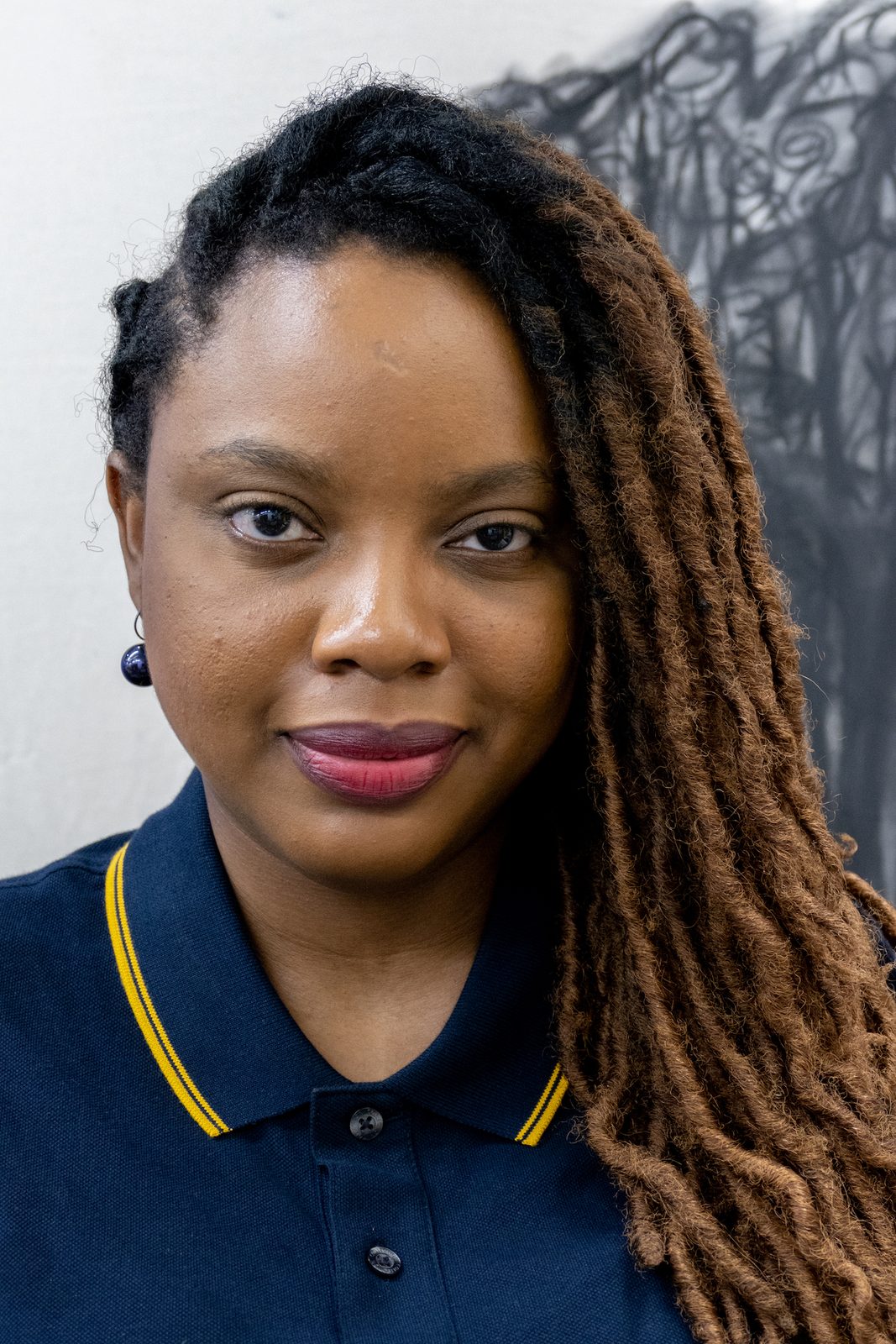
Adebayo was born on 29 January 1988 in Lagos. Her family moved to Ilesa and then to Ile-Ife, where she spent most of her childhood in the staff quarters of Obafemi Awolowo University. She took both a BA and an MA in Literature in English at that university, the same Ife that opens Stay With Me, and then studied creative writing at the University of East Anglia on an international bursary. She has also studied writing with Chimamanda Ngozi Adichie and Margaret Atwood, which happened through workshops rather than through her degree, a distinction that is often blurred in accounts of her career.
The debut took its time. Stay With Me was shortlisted for the Kwani? Manuscript Project in 2013, several years before it was published, and she was shortlisted for the Miles Morland Foundation writing scholarship in 2014 and again in 2015. The Financial Times named her among the bright stars of Nigerian literature in 2015. She has held residencies at Ledig House Omi, Hedgebrook, the Sinthian Cultural Institute, the Ox-Bow School of Art, MacDowell and Ebedi Hills. Her poems and stories have appeared in Saraba, Farafina, the Kalahari Review, Gambit: Newer African Writing and the anthology New Daughters of Africa, and she has written non-fiction for Elle UK and the BBC. She is married to the writer Emmanuel Iduma. In April 2026 she was awarded a Gates Cambridge Scholarship for doctoral work in digital humanities, on how African literary magazines have carried stylistic and thematic innovation between writers and editors.
Stay With Me
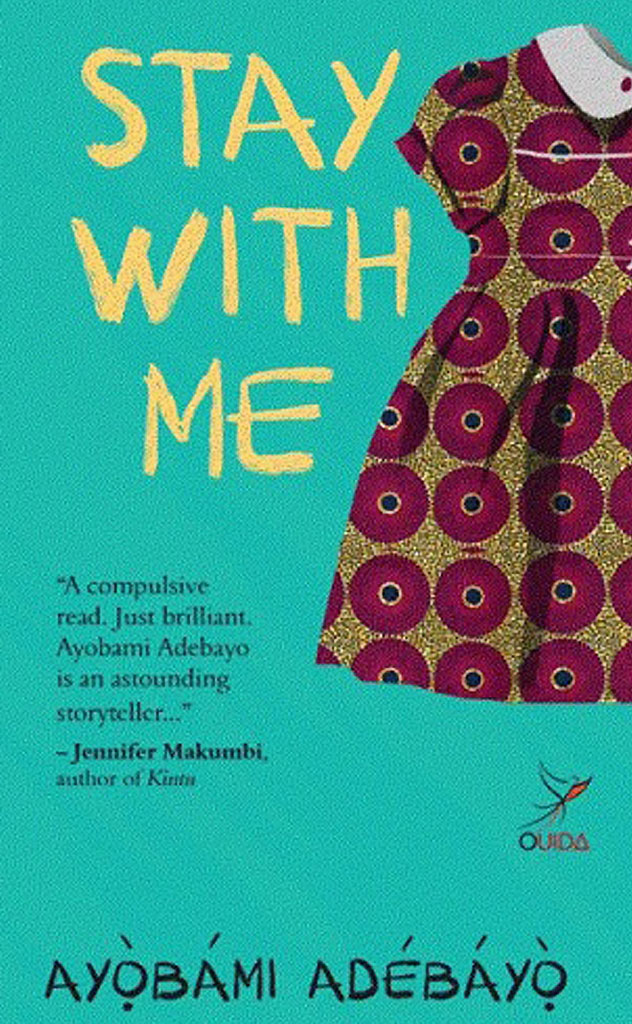
Image: Ouida Books
Canongate published Stay With Me in the United Kingdom in March 2017, Knopf in the United States and Ouida Books, Lola Shoneyin’s Lagos imprint, in Nigeria. It is set mainly in Ife, Ilesa and Jos, and the chapters alternate between Yejide and Akin, each narrating in the first person. That alternation is the novel’s spine, because it means the reader is never given more than one spouse’s share of the truth at a time. The period setting is a choice rather than a default: Adebayo places the marriage in a Nigeria where structural adjustment was beginning to bite and where decisions about having children, and how many, were being weighed with new economic urgency. The politics sit in the price of bread and the queue at the petrol station rather than in speeches.
The thing the novel finally turns on has to be stated carefully, because it is frequently got wrong. Akin is impotent, and he has concealed it from Yejide, whose own sheltered upbringing has left her without the knowledge to see it. Under the pressure to produce a child, he asks his younger brother Dotun to sleep with her. Dotun fathers all three of her children. Sickle cell disease is real and central to the book, but it functions as the mechanism by which the deception comes apart rather than as the revelation itself: Yejide carries the trait and Akin does not, so when a child presents with the disease the arithmetic of paternity collapses. Two of the children, Olamide and Sesan, die. The third is named Rotimi, an abiku name that means, roughly, stay with me.
The hospital chapters are the novel’s most devastating, and Adebayo writes them without sentimentality. Michiko Kakutani, reviewing the book for The New York Times in July 2017, called Adebayo “an exceptional storyteller”. The prize record is specific and worth stating exactly: shortlisted for the Baileys Women’s Prize for Fiction in 2017, shortlisted for the Wellcome Book Prize in 2018, longlisted for the International Dublin Literary Award and for the Dylan Thomas Prize, and winner of the 9mobile Prize for Literature, announced in 2019. The French translation, Reste Avec Moi, won the Prix Les Afriques in 2020. She also took The Future Awards Africa prize for arts and culture in 2017. The novel has been translated into more than eighteen languages.
A Spell of Good Things
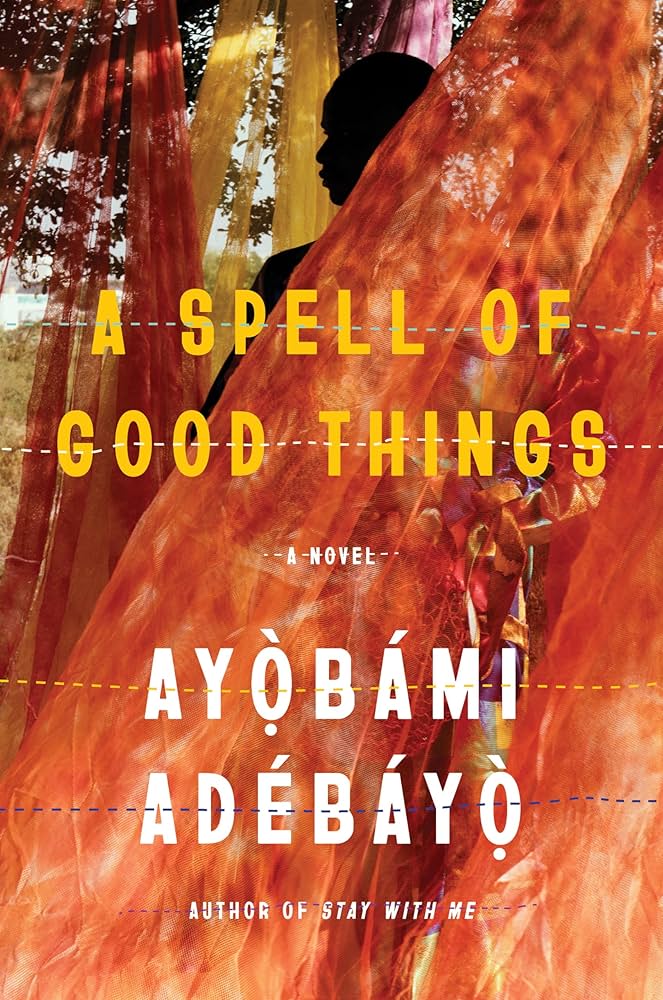
Image: Goodreads
Canongate acquired the second novel in 2021 and published it, with Knopf in the United States, in 2023. It is set in contemporary Nigeria and tracks two families across an enormous class divide. Eniola is the son of a sacked schoolteacher whose household is sliding into destitution. Wuraola is a young doctor from a wealthy family, engaged to a man her family approves of and her body is beginning to fear. The two storylines converge in the last third in a way that is both inevitable and shocking.
Ad SpaceIn-Article - 300x250
Advertisement
The novel is angrier than the debut and more directly concerned with power: godfather politics, the machinery around elections, the everyday violence of being poor in a Nigerian city. There is less interiority and more incident, and some readers who came for the marital chamber piece found the adjustment difficult. Its strongest material is still the relationships. Wuraola’s slowly dawning recognition that her fiancé Kunle is dangerous gets the same attention to interior silence that Yejide and Akin received, and the scenes between Eniola and his sister Busola, watching their parents’ marriage strain under poverty, are among the best sibling writing in recent Nigerian fiction.
Here too the record needs stating precisely, because the second novel’s standing is often inflated. A Spell of Good Things was longlisted for the Booker Prize in 2023. It was not shortlisted. It went on to be shortlisted for the Dylan Thomas Prize in 2024 and for the Royal Society of Literature’s Encore Award in the same year, a prize given specifically for a second novel. The Observer called it immensely readable, and in The New York Times Aamina Ahmad noted that where a raw, dynamic storytelling had energised the prose of Stay With Me, here “the graceful, stately quality of the sentences evokes restraint, avoiding sentimentality”.
Themes and preoccupations
Adebayo is the most clear-eyed contemporary novelist of the Nigerian marriage. She is interested in what marriage is in a Yoruba context beyond the romantic comedy and beyond the polygamy debate: as an economic unit, as a theatre of family power, as the place where reproductive expectation gets settled, and as a place where two people sometimes manage genuine intimacy against the odds. She is also interested in class. Her novels are populated by doctors, bankers and academics, a Nigerian middle class that has been remarkably under-written in the post-Adichie wave, where the celebrated books have tended to be diaspora stories or accounts of extremity at one end of the income scale or the other.
A third preoccupation is medicine. Sickle cell disease and the hospital in Stay With Me, the medical profession in A Spell of Good Things: both novels have major characters who are doctors, and both write hospitals with the specificity of someone who has paid close attention. That is partly political. Nigerian medicine is a usable microcosm, because it shows class, the brain drain, the failure of the state and the resilience of professional networks all at once, without the novelist having to editorialise.
Honest critique
Adebayo’s prose is more functional than ornamental. Readers who come to her after Chigozie Obioma or Helon Habila will find the sentences plainer and less ambitious at the line. That is a choice rather than a limitation, a register designed to be transparent to the emotional content, but it does mean the books reward reading for character and structure more than for sentence-level pleasure. A Spell of Good Things is structurally messier than the debut, and the convergence of its two plotlines, powerful as it is, is set up with a heavy hand in the middle section. Kunle in particular is more a function than a person, although the function is one the novel needs. There is also a fair observation about setting: her books live in Ife, Ilesa, Jos and an unnamed south-western city, and she has not written the Lagos novel that most of her contemporaries have.
Where she fits
Image: The Paris Review
Adebayo sits near the centre of the contemporary Nigerian canon. She shares Adichie’s interest in character, marriage and social life, but works with a more restrained palette and a sharper attention to medical and economic detail. She is the rare novelist of her generation taken seriously by prize juries and by Nigerian book clubs at the same time, and the institutional recognition runs both ways: she judged the Women’s Prize for Fiction in 2024 and sat on the Booker Prize jury in 2025. A Baileys shortlisting for the first novel and a Booker longlisting for the second is a strong base, and the honest way to describe it is as a strong base rather than as two shortlistings.
The bibliography at a glance
Title
Year
Form
Stay With Me (Canongate, UK; Knopf, US; Ouida Books, Nigeria)
2017
Novel
A Spell of Good Things (Canongate, UK; Knopf, US)
2023
Novel
Contributions to New Daughters of Africa and Gambit: Newer African Writing
2019
Anthology pieces
Recommended reading order
Read Stay With Me first. It is the more emotionally direct book, the more controlled one, and the one most likely to convert a reader permanently. Read it slowly, because the alternating narration is doing concealment work that rewards patience, and resist looking up the plot before you finish. Read A Spell of Good Things second, approaching it as a different kind of project: angrier, broader, more politically explicit. Some readers prefer it to the debut and many do not, and both reactions are reasonable. For supplementary reading, her Elle UK essay, her BBC work, Alice O’Keeffe’s 2017 Guardian interview and her conversation with Claire Armitstead for English PEN are all genuinely useful; she is articulate about her own work in a way many novelists are not.
Where the record stands after two novels
Two books is not yet a body of work, but it is enough to see the method. Both novels put a household under pressure that comes from outside it, economic or familial, and then watch the people inside decide what they will conceal. In the first that concealment is a husband’s impotence and a brother brought in to cover it; in the second it is class, hidden inside a prospective marriage. The research is real, the medical detail is exact, and the restraint is deliberate. Readers looking for the single best entry point to the post-Adichie Nigerian novel will find it in Stay With Me, and readers who want to see what happens when the same intelligence is turned on inequality rather than infertility will find that in the second.
Ad SpaceIn-Article - 300x250
Advertisement
Share
Get the recap
Loved this story? Get more like it.
Join readers who get our weekly entertainment recap - the stories worth your time, delivered every Friday.
No spam. Unsubscribe anytime. By signing up you agree to our Privacy Policy.