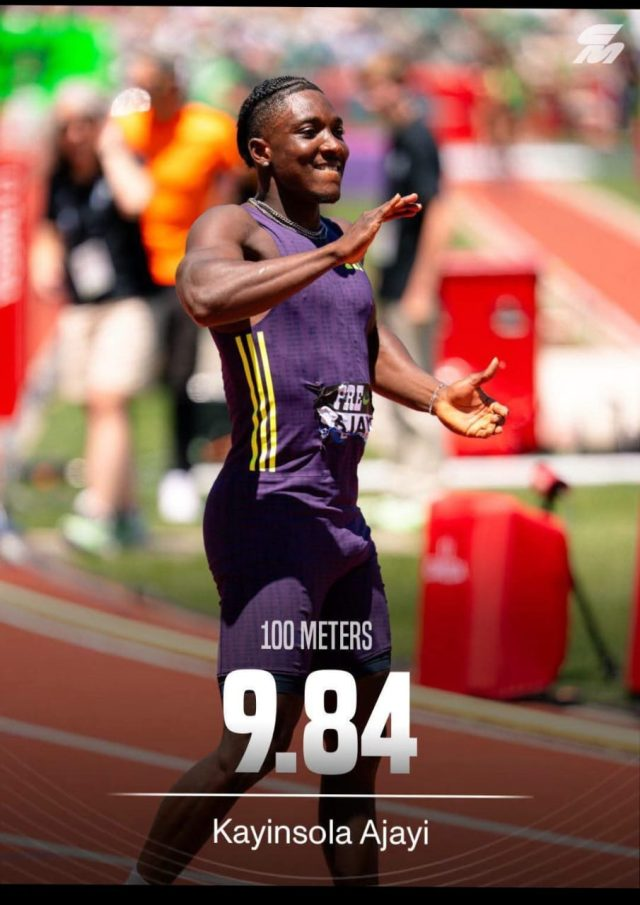
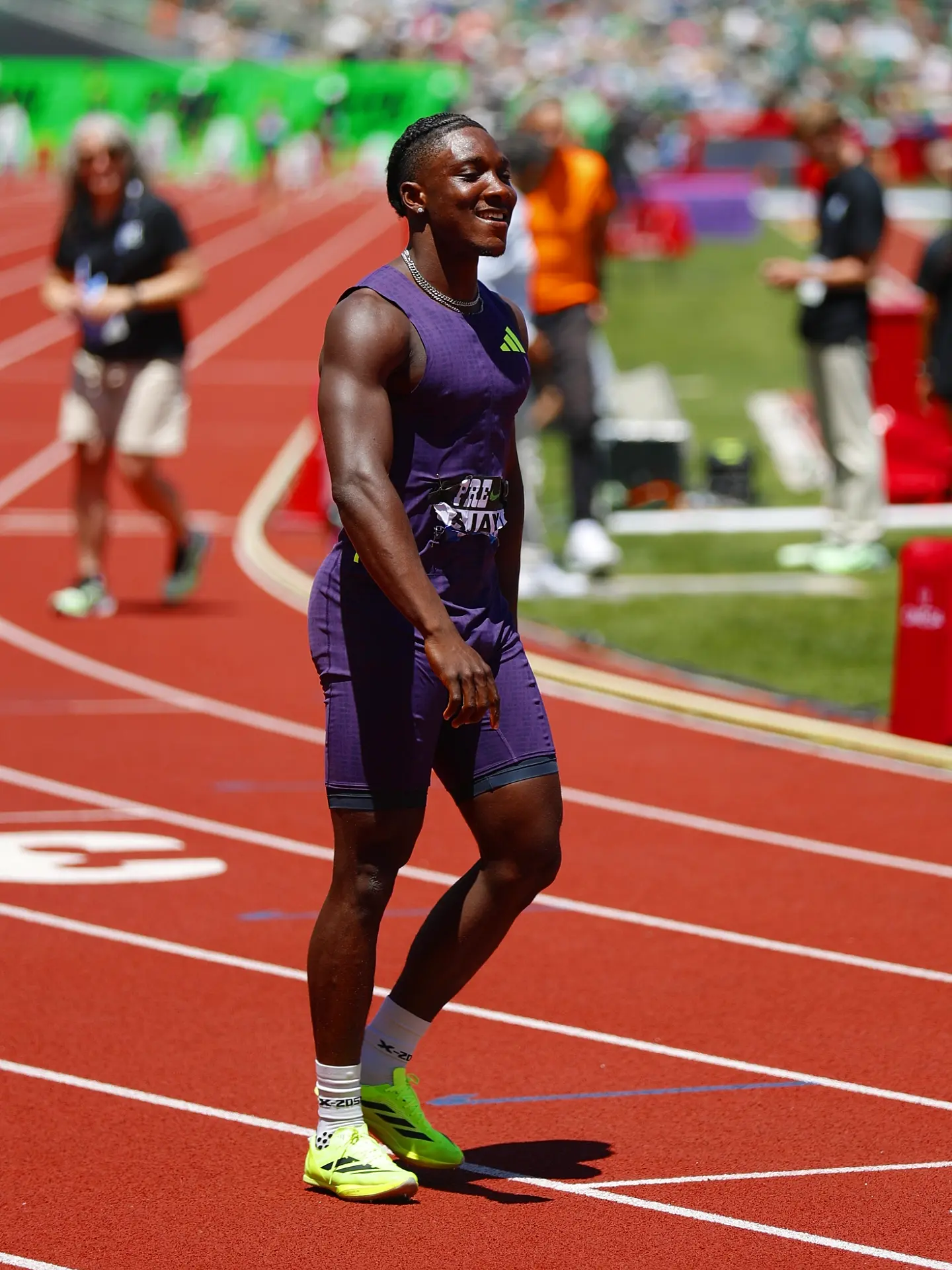
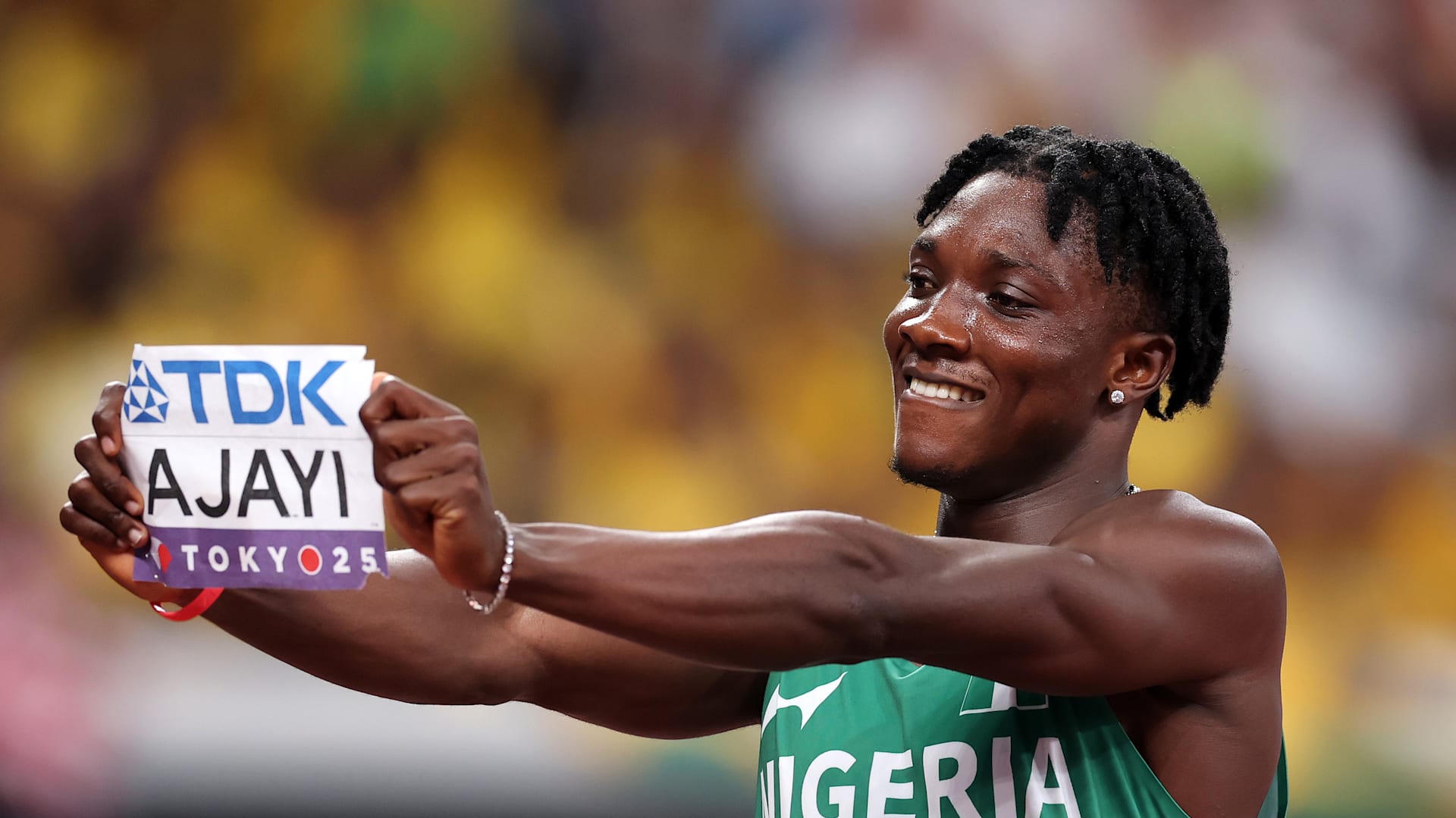
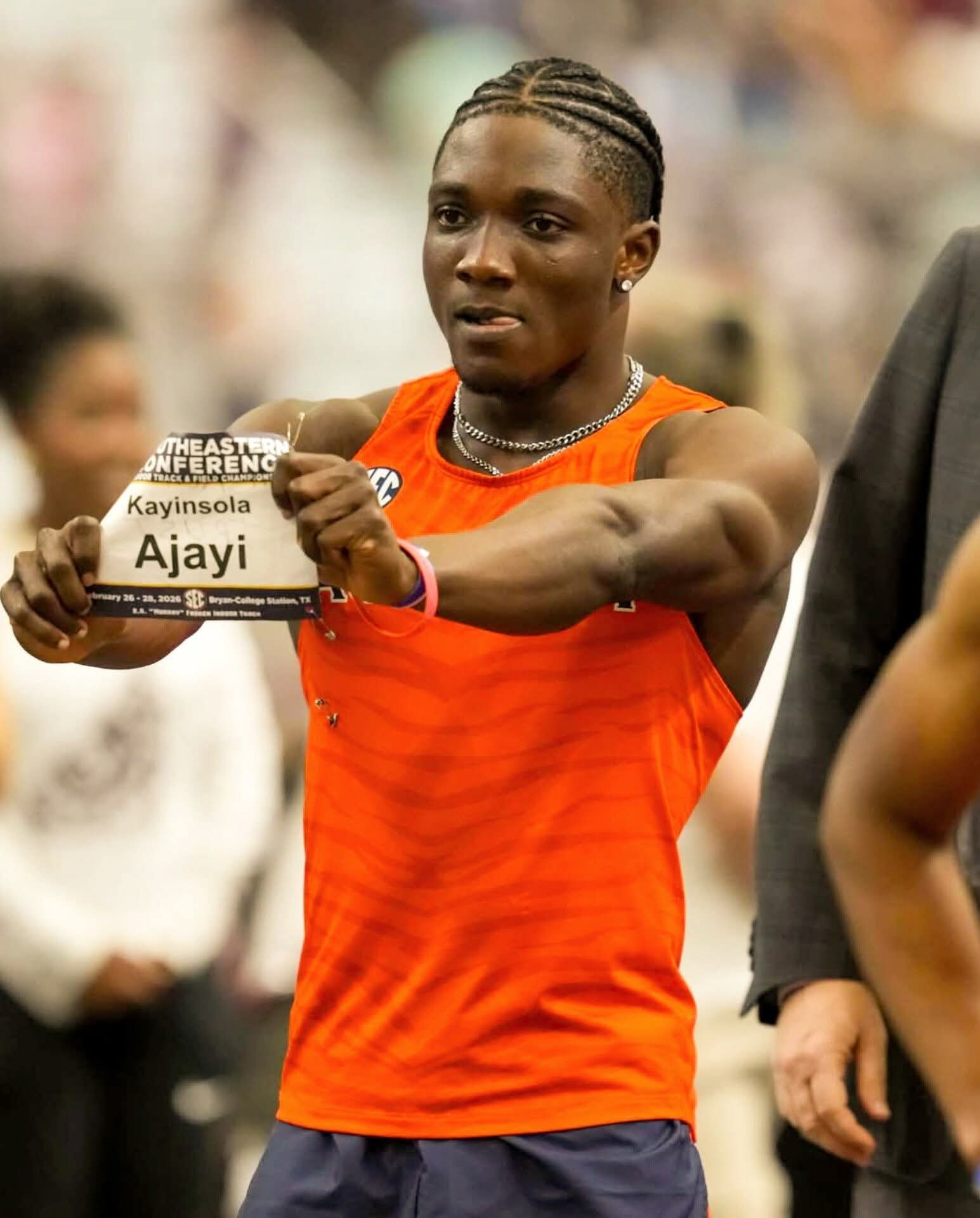
There is a particular kind of silence that falls over Hayward Field in Eugene, Oregon, in the split seconds after a 100-metre final - a silence that exists somewhere between collective exhale and disbelief. That silence descended on the 2026 Prefontaine Classic crowd when the scoreboard confirmed what their eyes had just witnessed: a 21-year-old Nigerian, running his first-ever Diamond League race, had just beaten the reigning world champion. Kanyinsola Ajayi crossed the line in 9.84 seconds, composed, powerful, and completely unhurried, as if he had been doing this at the highest level for years. He hadn’t. This was his debut.
Image: BellaNaija
The Prefontaine Classic is not a casual meet. Held annually in Eugene at the University of Oregon’s Hayward Field - one of the most technically sophisticated athletics venues in the world - it serves as one of the marquee stops on the Diamond League calendar, the premier global circuit for track and field. The names that come to Eugene are the names that matter. Coaches, agents, federations, and sponsors all have eyes on the results. To win here is to announce yourself to the world in the loudest possible way. Ajayi did not announce himself. He detonated.
Who Exactly Is Kanyinsola Ajayi?
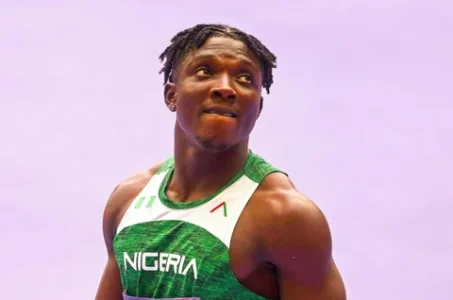
If the name Kanyinsola Ajayi is new to you, that is not entirely your fault - and it won’t stay that way for long. Born in Nigeria in 2004 or 2005 (making him 21 at the time of the race), Ajayi represents a generation of African athletes who are coming through domestic and collegiate systems with significantly more structured support than their predecessors had. While Nigerian athletics has historically struggled with funding, federation politics, and infrastructure, a new wave of young sprinters has been developing quietly, sharpening their craft at universities and emerging on the international junior circuit before making the leap to senior competition. Ajayi appears to be the sharpest edge of that wave.
A time of 9.84 seconds in the 100 metres is not a fluke. To put it in context, 9.84 is the same time Donovan Bailey ran when he broke the world record at the 1996 Atlanta Olympics - a time that, at the moment of that race, was the fastest any human being had ever run. The fact that Ajayi produced that mark on his Diamond League debut, without the benefit of dozens of elite-level races under his belt, suggests a physical and mental profile that is genuinely exceptional. Nigerian athletics fans on social media have noted that Ajayi has been building steadily, with performances at the collegiate and national level that hinted something special was on its way. On Saturday in Oregon, the hint became a statement.
Oblique Seville and What This Defeat Means
To fully appreciate what Ajayi accomplished, you need to understand who he beat. Oblique Seville is not a fading champion coasting on reputation. The Jamaican sprinter, born in 2000, became the 100m world champion at the 2023 World Athletics Championships in Budapest, clocking 9.82 seconds in that final and announcing himself as the heir apparent to the legacy of Jamaican sprint dominance that includes Usain Bolt, Asafa Powell, and Yohan Blake. Seville is fast, experienced, and deeply competitive. He is not the kind of athlete who loses to beginners - at least, not without that loss meaning something significant about the beginner in question.
The result reframes the narrative around the global sprint hierarchy in a way that will not be ignored. Since Bolt’s retirement in 2017, the 100 metres has been searching for its next defining personality - the athlete who doesn’t just win races but owns the event culturally and commercially. Marcel Jacobs, the Italian who won gold at the Tokyo Olympics, held the crown briefly. Noah Lyles has made compelling arguments. Seville staked his claim with the world title. And now Ajayi, a 21-year-old Nigerian on his very first Diamond League start, has beaten the world champion in a legitimate, high-stakes race. The sprint world will be paying attention in a way it was not last week.
Ad SpaceIn-Article - 300x250
Advertisement
Nigeria’s Sprint Legacy and Why This Moment Lands Differently
Nigerian athletics has a sprint tradition that is often underappreciated on the global stage. Deji Aliu reached the 100m final at the 2000 Sydney Olympics and ran 9.94 seconds in 2001. Francis Obikwelu, who later competed for Portugal, ran 9.86 seconds and won silver at the 2004 Athens Olympics. Seun Ogunkoya ran a then-national record in the 200m. More recently, Favour Ofili has been one of the most exciting sprinters in the women’s game globally, running 10.79 seconds in the 100m and putting up times in the 200m that have placed her among the fastest women alive. Nigerian sprinting, in other words, has never lacked for talent. What it has sometimes lacked is the international visibility and institutional support to turn that talent into sustained dominance at the global level.
Ajayi’s win at the Prefontaine Classic lands differently because of where we are in the cultural moment. Nigeria - and Africa broadly - is experiencing a period of extraordinary global soft power, driven substantially by music. Afrobeats has gone from a regional genre to a global commercial force, with artists like Burna Boy, Wizkid, Davido, and Tems reshaping the international music landscape. Afrobeats songs chart on Billboard. Nigerian artists headline Coachella and sell out Madison Square Garden. The cultural confidence that comes with that kind of visibility has a knock-on effect: young Nigerians in every competitive field are arriving on global stages with a different energy, a different sense of what is possible. Kanyinsola Ajayi, whether he frames it this way or not, is running in the slipstream of a larger cultural moment that says Nigeria does not come to participate - it comes to win.
Debuting on the Biggest Stage - and Winning
The Diamond League circuit is the Champions League of athletics. There are fourteen meetings per season across cities including Doha, Shanghai, Stockholm, London, Zurich, and Brussels, culminating in the Diamond League Final where the season’s best athletes compete for the Diamond Trophy and substantial prize money. The Prefontaine Classic in Eugene is consistently one of the most prestigious stops on the circuit, partly because of the venue, partly because of Oregon’s deep athletics culture, and partly because of the proximity to Nike’s global headquarters in Beaverton - meaning sponsor eyes are always watching. For a first appearance, the Prefontaine Classic is about as high-pressure an entry point as a young sprinter could choose.
What makes Ajayi’s 9.84 debut particularly remarkable is the mental component. Young athletes who are technically gifted frequently underperform in their first elite-level races because the environment - the crowd, the competition, the cameras, the weight of the moment - overwhelms their ability to execute the technical aspects of their sprint mechanics. Ajayi did none of that. A 9.84 at any level requires near-perfect execution: a clean start, a powerful drive phase, strong mechanical maintenance through 60 metres, and the composure to hold form when the body is fighting lactic acid in the final 20 metres. That he produced this on his Diamond League debut against a field that included the world champion tells you something important about his psychological makeup, not just his physical gifts.
Ajayi, the Afrobeats Generation, and Why 9.84 in Eugene Is Just the Opening Line
There is a generation of young Nigerians and Africans for whom the ceiling has been demolished. They grew up watching Afrobeats conquer streaming platforms, watching Nollywood films trend on Netflix - where Nigerian productions like Gangs of Lagos and Blood Sisters pulled massive viewership numbers in their opening weeks - and watching African footballers dominate the Premier League and Champions League. Victor Osimhen won the Serie A top scorer award. The Super Eagles remain continental contenders. The Afrocentric wave is not a talking point; it is a documented, measurable reality. Kanyinsola Ajayi is 21 years old and already has a Diamond League win over a world champion. He exists in a context where young African excellence is not a surprise - it is an expectation.
For Nigerian sports fans specifically, this result comes at a meaningful time. Nigerian athletics has been navigating a complicated few years at the federation level, with administrative challenges that have at times affected athlete participation and preparation. Against that backdrop, a 21-year-old arriving on the global Diamond League circuit and immediately winning - beating the world champion, clocking a time that would have been a world record thirty years ago - carries a particular kind of weight. It is a reminder that the talent pipeline in Nigerian athletics is real and that when young athletes get the right preparation and the right platform, the results speak plainly. Kanyinsola Ajayi spoke at 9.84 seconds on a Saturday afternoon in Eugene. The sprint world heard him clearly.
Ad SpaceIn-Article - 300x250
Advertisement
Share
Get the recap
Loved this story? Get more like it.
Join readers who get our weekly entertainment recap - the stories worth your time, delivered every Friday.
No spam. Unsubscribe anytime. By signing up you agree to our Privacy Policy.