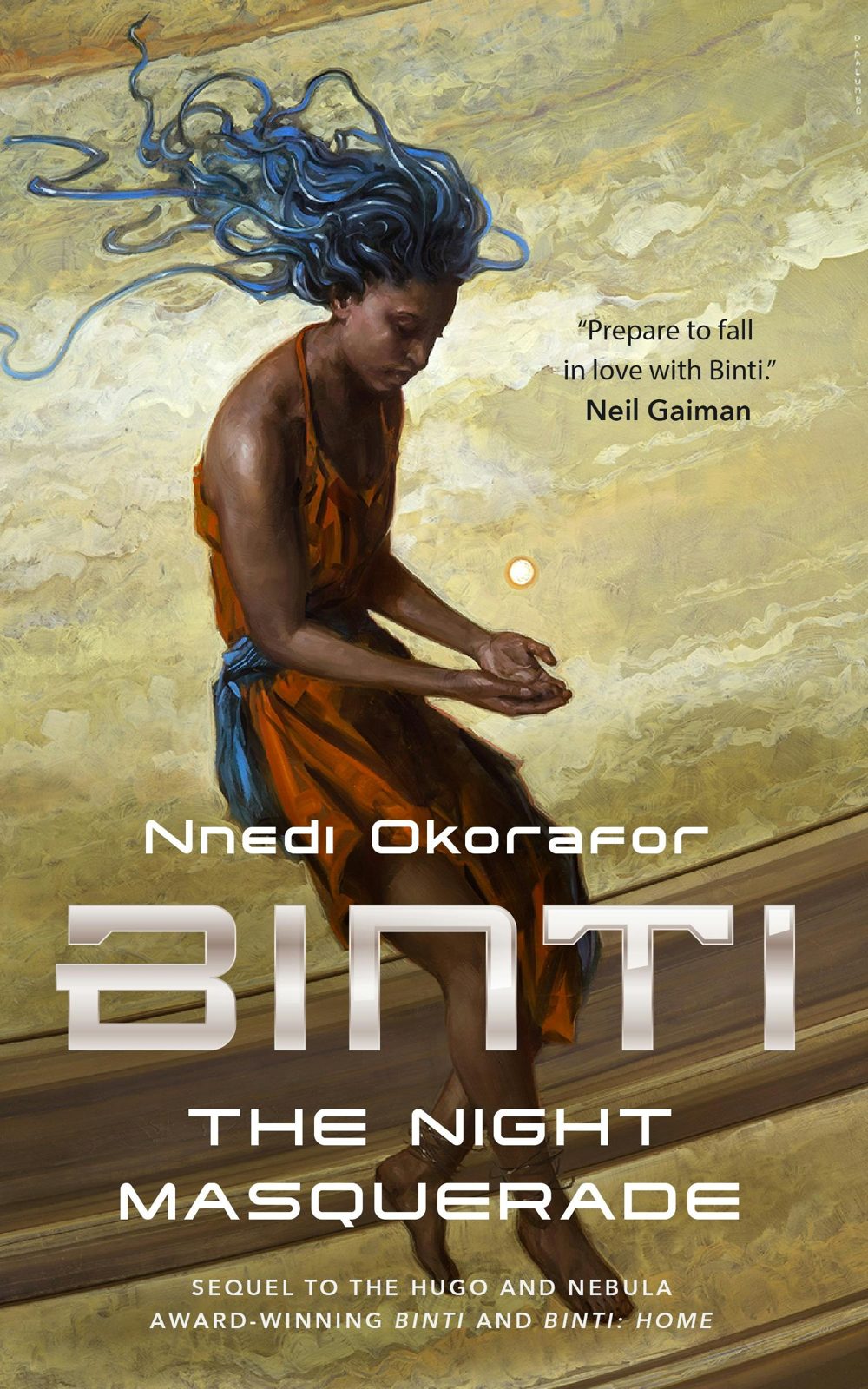
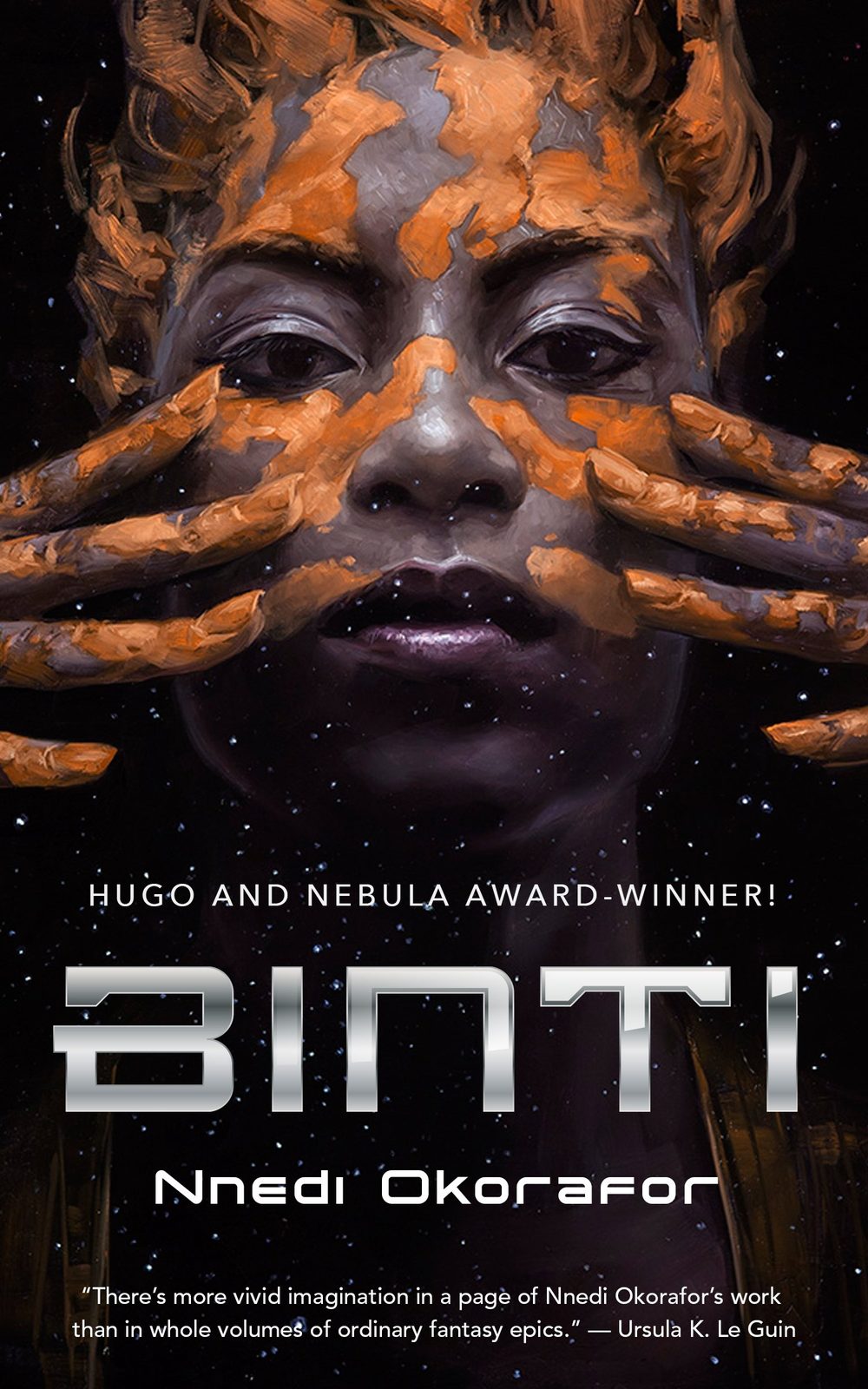

A teenage girl sits in a launch bay with sand still clinging to the soles of her feet, her hair coated in a red paste her people have been mixing for generations, and she has decided to do something no Himba has done before: leave Earth. She has not told her family. She has stolen out before dawn. In her hand is an acceptance letter from the most prestigious university in the galaxy, and in her chest is a fear so specific it has its own physics. This is how we meet Binti, and within a few dozen pages of Nnedi Okorafor’s novella she will be the only human alive on a hijacked transport ship, negotiating with jellyfish-shaped aliens who have killed everyone else aboard. That is the engine of the book. The book itself is doing something stranger than its plot suggests.
The Book at a Glance
| Title | Binti |
| Author | Nnedi Okorafor |
| First published | 2015 |
| Publisher | Tor.com Publishing |
| Form | Novella, the first of three |
| Prizes | Hugo Award for Best Novella (2016) and Nebula Award for Best Novella (2015), both for this novella alone |
| Sequels | Binti: Home (2017) and Binti: The Night Masquerade (2018), both novellas, both award finalists rather than winners |
A Novella That Punched Far Above Its Size
Binti arrived in 2015 from Tor.com Publishing, a small imprint that had become unexpectedly important in short-form science fiction. It is a novella, not a novel, and the distinction matters to how the book works and to what it won. It took the Nebula Award for Best Novella for 2015 and the Hugo Award for Best Novella in 2016, the two highest honours in the genre, something close to taking the Booker and the Pulitzer in the same season. Okorafor was not new to recognition, since her 2010 novel Who Fears Death had already established her as one of the most original voices working in the form, but Binti was the breakthrough that pulled her into the orbit of mass readership and school curricula.
It is worth being precise about the prizes, because they are routinely misreported. The Hugo and the Nebula went to this first novella on its own. Binti: Home and Binti: The Night Masquerade were finalists in their years and did not win either award. The Lodestar Award and the 2018 Locus Award for young adult book went to Okorafor’s novel Akata Warrior, not to any book in the Binti sequence. Any account that has the three novellas jointly collecting a Hugo, a Nebula and a Lodestar has merged four separate books.
What is unusual is how compact the achievement is. Most prizewinning novellas in science fiction are dense, gnarled, philosophical things designed to reward a reader willing to slow down. Binti moves at the speed of a thriller. A girl boards a ship. The ship is attacked. She survives because of a device she happens to be carrying. She arrives at a university where she must persuade an alien delegation not to go to war. The pacing is so propulsive that you can read the whole thing in a single sitting and not realise until the last page that Okorafor has loaded it with several novels’ worth of ideas about identity, mathematics, trauma, diaspora and the violence of leaving home.
Africanfuturism, Not Afrofuturism
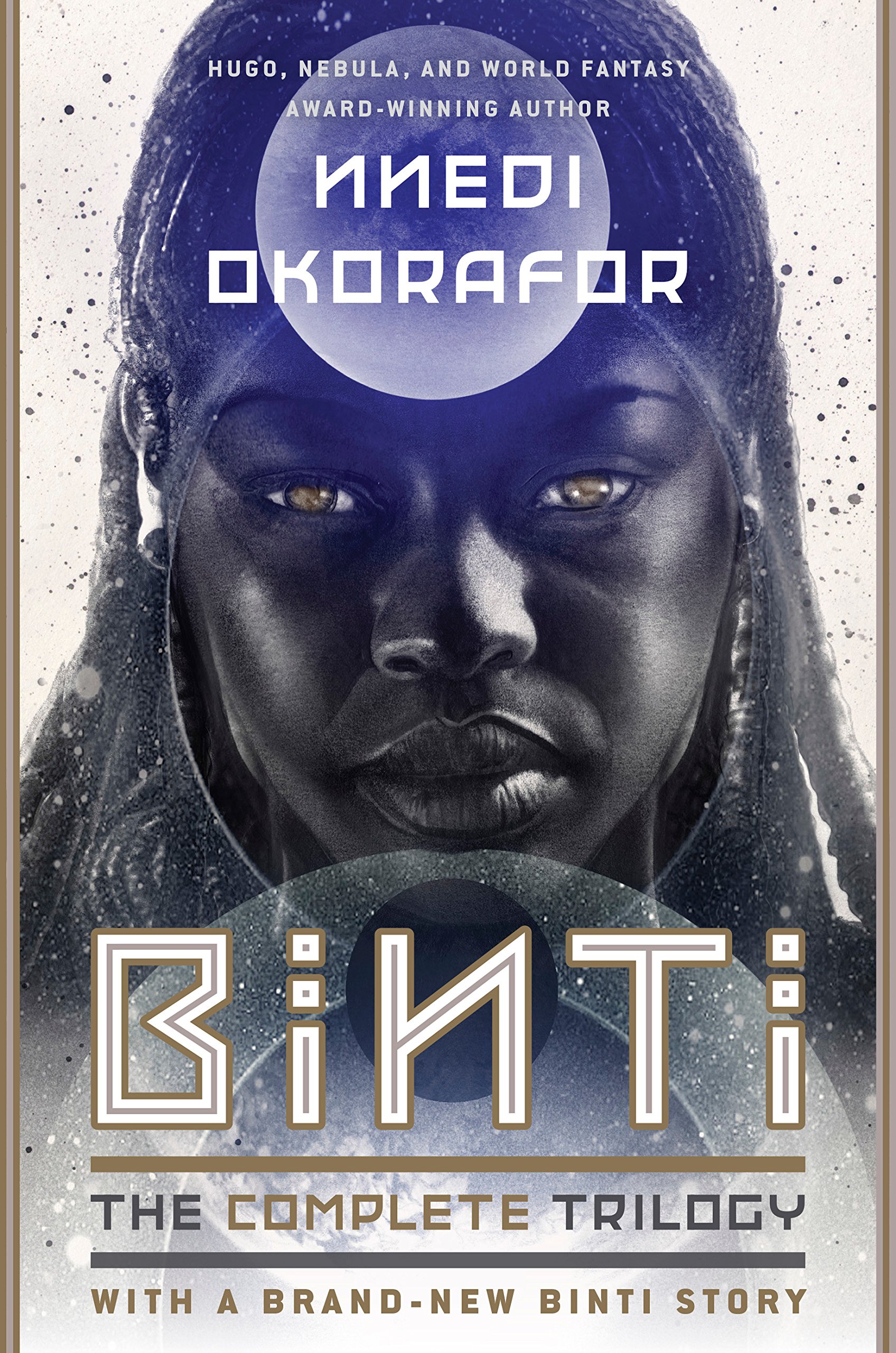
Okorafor has been firm, sometimes prickly, about the label. She does not write Afrofuturism. She writes Africanfuturism, a term she coined and has defended in essays and interviews, most directly in a 2019 post on her own blog. The distinction matters to her. Afrofuturism, as she describes it, is rooted in the African diasporic experience and particularly in Black American culture, with its long shadow of slavery and the Middle Passage. Africanfuturism is rooted on the continent itself, in the cultures, cosmologies and futures of people who never left.
Binti is the cleanest demonstration of what she means. The Himba are a real people, a semi-nomadic group living mostly in northern Namibia, whose women have for generations coated their skin and hair in otjize, a paste of red ochre, butterfat and aromatic resin. It is not a costume. It is daily practice, sun protection, beauty and a marker of cultural identity. Okorafor’s protagonist carries the paste with her into space, applies it on the transport ship, is treated as an object of curiosity by the Khoush passengers for it, and eventually finds that it has properties no Earth scientist has bothered to study. The otjize becomes the hinge of the plot, the thing the Meduse, the jellyfish-shaped aliens, want to understand.
The cleverness here is not only narrative. It is political. Okorafor has taken a piece of African cultural practice that has often been exoticised in Western photography, the red-skinned women of the desert, frequently photographed without consent or context, and made it the most consequential technology in her invented galaxy. She has rerouted the gaze.
Mathematics as a Kind of Prayer
Binti is a harmonizer. The term, in the world of the book, refers to a person who can manipulate equations to produce physical effects, a kind of mystical mathematics her family has practised for generations as makers of astrolabes. When she is afraid, and she is afraid almost constantly in the first half, she trees. The word becomes a verb. To tree is to enter a state of mathematical flow, where numbers branch and bloom and the mind reaches a focused calm. Okorafor uses it as Binti’s coping mechanism, her meditation and eventually her weapon.
This is the most graceful piece of writing in the book. The treeing passages are short, almost lyric, and they let Okorafor sidestep one of the chronic problems of science fiction, which is how to make a clever character feel clever on the page. She does not lecture and she does not infodump. She lets Binti slip into mathematics the way another writer might let a character slip into music. By the time Binti is trying to broker a peace with creatures who have just killed the other students she travelled with, the reader has been trained to feel her concentration as something physical.
The Trauma the Novella Refuses to Soften
A great deal has been written about Binti as a coming-of-age story, an immigration story, a story about a girl finding her place. All of that is true. But the second half of the novella, and especially the two novellas that follow it, is a story about the aftermath of violence and the impossibility of going home unchanged.
The killings on the ship are not handled lightly. Okorafor lingers on them. Binti survives because she is holding the edan, a small, ancient device of unknown make that she found in the desert as a child and does not understand. The other students, the bright laughing young people she had spent the journey getting to know, are dead in their seats. She has to move among their bodies, and one of them, a student named Heru whom she had noticed and liked, stays with her as an image she returns to later, when the Meduse put her through a physical transformation she did not choose.
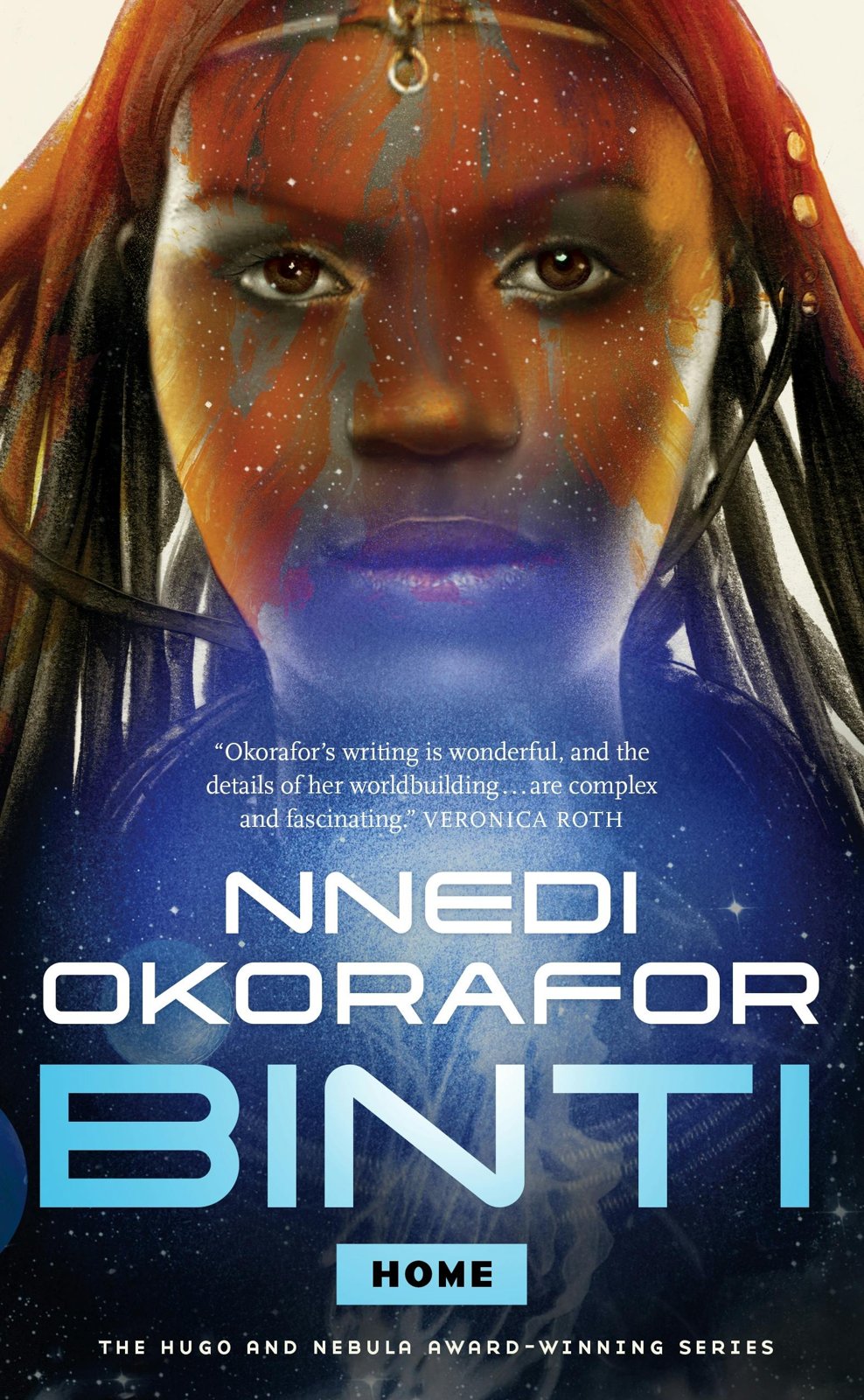
When Binti returns home to her family in the desert in the second novella, she is not the daughter who left. Her hair is no longer hair but living tendrils. Her sense of self has been altered at the cellular level. Her family is afraid of her. Her father, a master astrolabe maker, treats her with a sorrow that is not quite acceptance. Okorafor refuses the easy reconciliation. The Himba, in her hands, are not a museum exhibit of cultural authenticity. They are a community capable of being wrong, capable of fear, capable of failing their own daughter.