The Best Acceptance Speeches by African Artists at International Award Shows
Jalen Ross··11 min read
Ad SpaceArticle Top - 728x90
Advertisement
Acceptance speeches are the part of an awards night nobody can rehearse into perfection. The trophy is in hand, the camera is locked, the orchestra is forty-five seconds from playing the winner off, and what comes out is whatever the artist has been carrying for the last decade. When African artists step up to those microphones at the Grammys, the BRITs, the BETs, the Mercury Prize, and the Soul Train Awards, they carry the weight of being asked to represent a continent in sixty seconds. Some rise with grace, some crack open and weep, some are sharp and political, some so brief they leave the audience leaning forward.
What follows is a tour through speeches that have entered the archive as defining moments: documented and transcribed ones that fans, journalists, and the artists keep returning to.
Burna Boy at the 2021 Grammys: A Virtual Acceptance for “Twice as Tall”
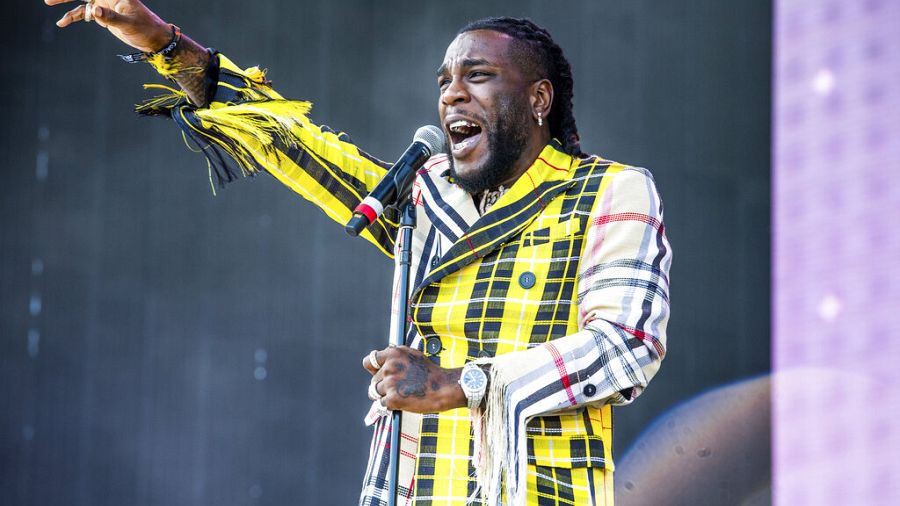
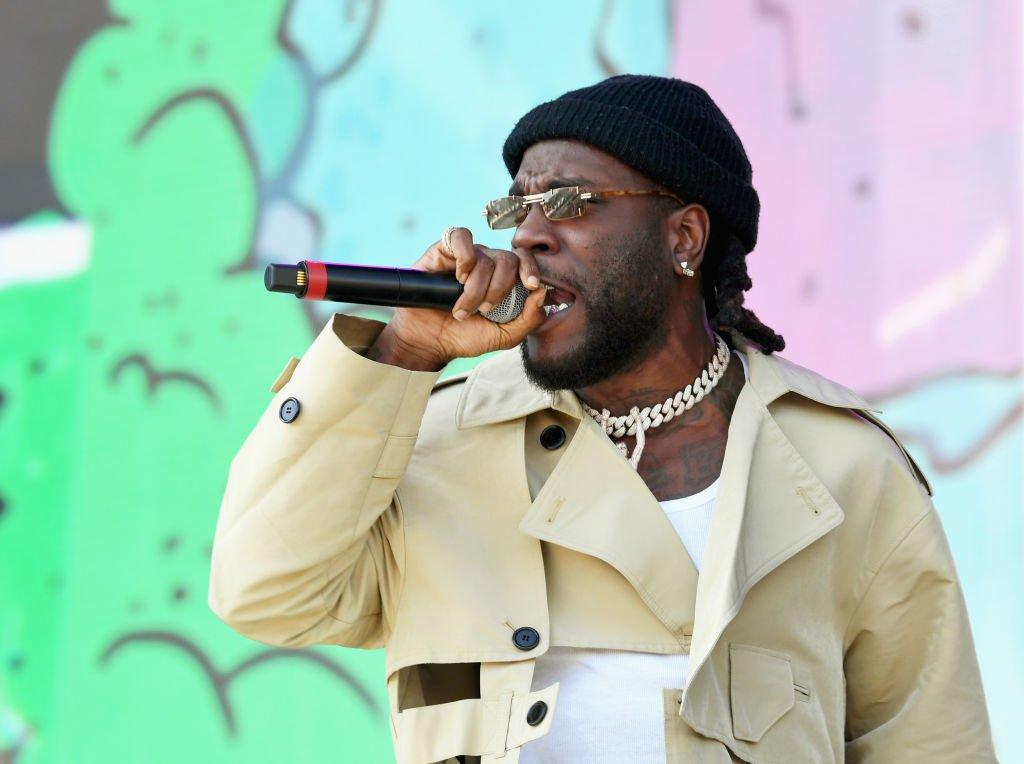
When “Twice as Tall” won Best Global Music Album at the 63rd Grammy Awards, Burna Boy was not in Los Angeles. The pandemic had shut down the in-person ceremony, and the acceptance happened via pre-recorded video from Lagos. He sat in a relaxed posture, gold chain visible, and acknowledged that the win belonged as much to the people around him as to him.
He thanked his mother and manager Bose Ogulu first, recognised the team at Atlantic Records and Spaceship Entertainment, and framed the win as a moment for “every African.” The speech was short, generous, and built on the same argument he had pressed in interviews for years: African music does not need a separate, lesser table.
Bose Ogulu at the Headies: “Don’t Be Afraid to Receive Criticism”
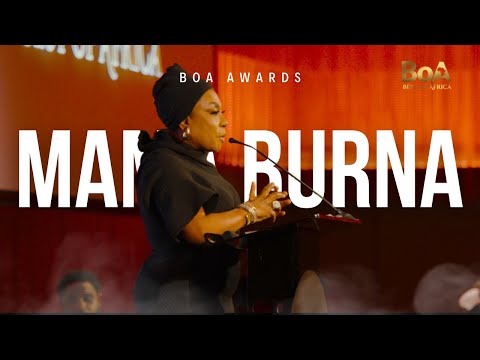
Before Burna Boy was a global Grammy fixture, his mother and manager Bose Ogulu collected an award on his behalf at the Headies and used the platform for something other than thanks. Her line, delivered with the calm of a parent speaking to a room of younger siblings, has been quoted ever since: “Every Outside Success Has Inside Source. Don’t be afraid to receive criticism.”
The full speech reminded the room that the African Giant brand existed because of an entire support system, and that artists should not flinch at honest feedback. The clip went around the African music internet repeatedly. It reframed the public role of the manager in Afrobeats, where for years the artist alone had been seen as the brand.
Tems at the 2023 Grammys: A First Win and a Mother’s Name
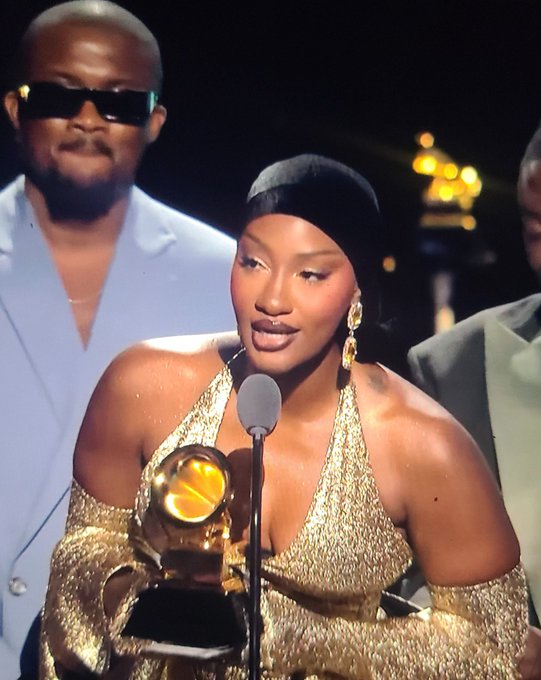
When Tems collected the Grammy for Best Melodic Rap Performance for “Wait for U” alongside Future and Drake, she was the first Nigerian woman to win in that category. She held the trophy with both hands, paused to gather herself, and led with gratitude to God in a register that anyone raised in a Nigerian Pentecostal household would recognise instantly.
She thanked her mother by name, recognised Future and Drake for trusting her on the song, and acknowledged the producers and engineers who shaped the sample-led record. There were pauses and small breath catches, and that was what made it land. For Tems, the category mattered less than the simple fact of standing there with her mother watching from the audience.
Tems at the 2025 Grammys: “Love Me JeJe” and a Nod to Seyi Sodimu
Two years later, Tems returned to the Grammy stage as a solo winner. “Love Me JeJe” took Best African Music Performance, and the speech carried an extra layer of cultural homework. The song reinterprets Seyi Sodimu’s 1997 record of the same name, a Nigerian classic older listeners grew up on, and Tems named him from the stage.
She spoke about her Nigerian heritage in clear, unhurried sentences, thanked her family, her team, and the Recording Academy, and pointed at the lineage behind the song rather than presenting herself as a sole author. By naming Seyi Sodimu, she paid the original artist publicly. That gesture set a tone for how interpolation in Afrobeats can be handled with respect rather than quiet rights paperwork.
Tyla at the 2024 Grammys: “This Is for Everyone in Johannesburg”
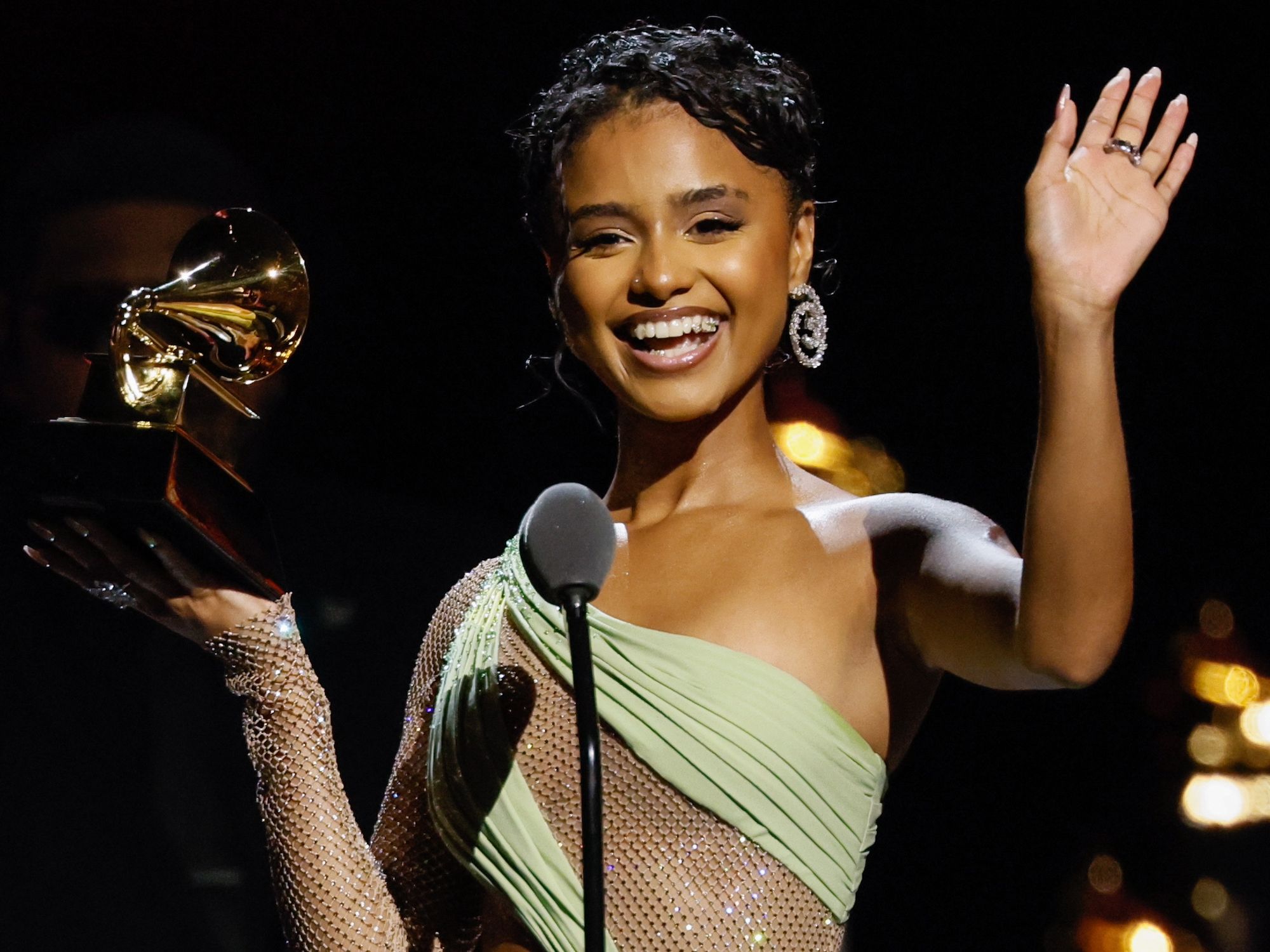
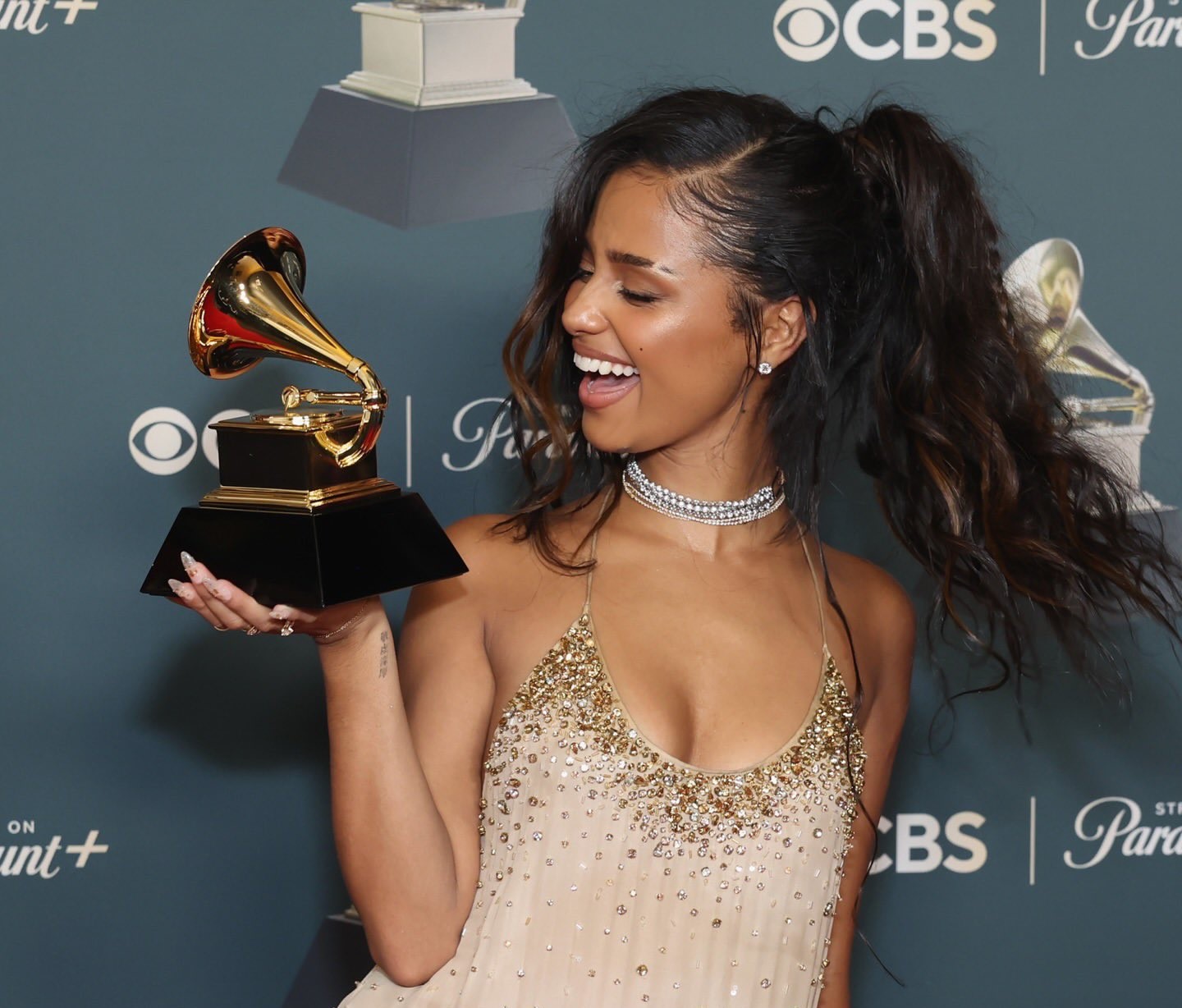
Tyla won Best African Music Performance at the 2024 Grammys for “Water” and became, at twenty-two, one of the youngest African solo artists to take home a Grammy in that category. She walked to the stage in a structured dress that immediately became its own fashion conversation and opened with shaking hands and visible disbelief.
The line that travelled fastest was her dedication to Johannesburg and South Africa. She framed the moment as a win for amapiano, for South African dance music, and for every kid back home watching from a living room in Jozi. For South African listeners who had spent years watching amapiano and Afro-house build a global following without institutional recognition to match, the speech was a marker. The youngest person in the room had just told the Recording Academy where the song came from and why it mattered.
Wizkid: The Art of the Pre-Recorded Message
Wizkid’s relationship with awards-show stages is one of the most discussed in Afrobeats. He often does not show up, and his acceptances have repeatedly arrived as short recorded messages rather than podium walks, with a brief thank-you to fans, family and team. He won BET’s Best International Act: Africa award in 2017, the final year the category ran in that form, having shared it with Sarkodie in 2012.
Some read the decision as detachment from the awards-circuit theatre. Others see it as a Lagos-based artist refusing to bend his calendar around ceremonies that historically did not bend for African artists. Whatever the reading, the absence has its own message.
Davido at the BET Awards: Passion for the Fans
Davido has won BET’s international award twice, taking the Africa category in 2014 and the unified Best International Act in 2018, and he stepped to the mic both times with the energy he brings to a stadium show. His acceptance speeches lean hard into gratitude for fans, often delivered with arms wide and voice raised, and shout out his team, his family and the wider 30BG community.
Where Wizkid retreats, Davido leans in. He often slides briefly into pidgin or Nigerian inflection, which lands as a small cultural reminder for the broadcast audience. For viewers in Lagos watching the BET feed late at night, the speeches function as a kind of communal celebration.
Burna Boy at the BETs: Brief and Family-First
Across his BET Award wins in 2019, 2020, and 2021, Burna Boy kept his acceptance speeches short. He has used the moments to thank his mother, his sister Ronami, his grandfather Benson Idonije, and his team. He has framed the recognitions as wins for “every African child,” consistent with the album-cycle language of “African Giant” and “Twice as Tall.” The brevity is its own statement. The family comes first, the continent comes second, and the rest is left for the music to argue.
Ad SpaceIn-Article - 300x250
Advertisement
Angelique Kidjo: Bilingual Speeches and the Passing of a Torch
No discussion of African acceptance speeches at the Grammys is complete without Angelique Kidjo. With multiple Grammy wins across the Best World Music and Best Global Music Album categories, she has built a body of acceptance moments that move between French, English, and Fon, and that consistently point forward.
Her speech for “Mother Nature” in 2022 is the most cited example. She used her time to name younger African artists, including Burna Boy, Yemi Alade, and others, and to position her win as part of a continuous African moment rather than an isolated honour. That habit of passing the torch from the podium has become her signature. Watching Kidjo accept a Grammy is watching a senior artist refuse to hold the spotlight alone.
Black Coffee at the 2022 Grammys: Dance Music Has a Home
When Black Coffee won Best Dance/Electronic Album for “Subconsciously” at the 64th Grammy Awards, his acceptance was a quiet anchor for South African dance music. He thanked his children, his team at Soulistic Music, his collaborators, and the global dance community. He named his country with the same calm precision that defines his DJ sets.
The win mattered because the Grammy dance/electronic category had rarely centred an African producer. By accepting the trophy with composure and naming Johannesburg from the stage, Black Coffee planted a flag for South African house music in a room that had often treated it as a guest. His speech was not loud. The point was that it did not need to be.
Cynthia Erivo: Representation Across the Tony and Grammy Stages
Cynthia Erivo, the British Nigerian actress and singer, has built an acceptance-speech archive across the Tony and Grammy stages. Her 2016 Tony win for the revival of “The Color Purple” included tearful recognition of the show’s company and a stillness the room answered with a long standing ovation. Her Grammy the following year for the cast recording continued the same themes. She has been a fixture at British ceremonies as a nominee and presenter without yet converting there, which makes her American acceptances the ones fans return to.
The throughline is representation. She speaks regularly about being a dark-skinned Black British woman of Nigerian heritage at the top of multiple Western performance industries. For Nigerian audiences watching from home, Erivo’s speeches sit alongside those of Tems and Burna Boy as part of a broader claim on global stages.
Stormzy at the 2018 BRITs: Tribute to Grenfell
Stormzy collected Best British Male and Best British Album at the 2018 BRITs and used part of his platform to address the Grenfell Tower fire. The freestyle and the speech that followed paid direct tribute to the victims and called out the government response. The acceptance was not a soft thank-you. Stormzy named the dead, named the failures, and made clear that the night’s celebration could not be separated from the city’s grief. For a British Ghanaian artist standing at the centre of UK pop on its biggest awards night, the speech reset what was possible from that podium.
Dave at the 2020 BRITs: Politics from the Piano
Two years after Stormzy’s Grenfell moment, Dave won British Album of the Year at the 2020 BRITs for “Psychodrama” and continued the politicisation of the stage. His performance of “Black” earlier in the show included pointed lines about racism and government policy, and the acceptance carried the same charge. Dave thanked his family and his team, and spoke about his brother, who had been incarcerated. The British Nigerian rapper made clear that the personal and the political were one story for him. The room received it without flinching.
Skepta at the 2016 Mercury Prize: A Win for Grime
Skepta’s Mercury Prize win for “Konnichiwa” in 2016 was a watershed moment for British grime. His acceptance was unforced, full of pride for the scene, and built around the recognition that grime had just been handed one of the UK’s most prestigious music awards. He thanked his family, his crew at Boy Better Know, and the wider grime community that had carried the genre for over a decade. The British Nigerian rapper accepted the prize with a calm that signalled the obvious: the scene had been on this trajectory long before the panel agreed.
Sarkodie and Wizkid at the 2012 BET Awards: A Shared Trophy
BET introduced Best International Act: Africa in 2011, handing the inaugural award jointly to 2face Idibia and D’banj. In 2012 it split the trophy again, this time between Ghana’s Sarkodie and Nigeria’s Wizkid, with reports at the time describing the vote as too close to separate. Neither man collected on the live broadcast, and the fact that African winners were being handed their awards away from the cameras became a complaint the continent’s artists kept raising for years. The speeches that did emerge, thanking Ghana and Nigeria in turn, set a quiet template for the African winners who followed.
Olamide at the 2015 Headies: A Controversial Moment
Olamide’s 2015 Headies moment is documented for reasons beyond gratitude. After losing Next Rated to Reekado Banks, he took the stage and made remarks defending his label and his city in pidgin and Yoruba. The exchange with Don Jazzy that followed dominated Nigerian entertainment headlines for weeks. It sits in the archive as a reminder that acceptance moments are not always neat, and it captured the tension between street-rap aesthetics and the polished pop-industry framing the Headies leaned toward.
Asake at the 16th Headies: Humble and Brief
Asake’s wins at the 16th Headies came with acceptance speeches that surprised those who had only heard the maximalist energy of his albums. He spoke briefly, thanked God, his label YBNL, and his team, and walked off without dragging the moment out. The contrast with his stage performances was the story. Fans noticed. The brevity read as confidence rather than nerves.
Patoranking at the Soundcity MVP Awards
Patoranking’s Soundcity acceptance speeches have followed a consistent template: thanks to God, thanks to the streets, thanks to the fans, and a short shout to the broader African dancehall community. He typically keeps the speeches under a minute and uses pidgin freely. The pidgin matters. It signals that the recognition belongs to a Lagos audience first, and the broadcast to other African markets second.
Tems and Wizkid at the 2021 Soul Train Awards: “Essence” Takes Best Collaboration
“Essence” arrived at the 2021 Soul Train Awards with several nominations and converted one of them, winning Best Collaboration. Song of the Year went elsewhere that night, to Silk Sonic’s “Leave the Door Open,” but the collaboration win was the first major American ceremony to formally recognise the record. The acceptance moments around it were warm and centred on gratitude to the collaborators and the fans who had pushed the song into a global cultural moment. The Soul Train Awards carry particular weight in Black American music culture, and that recognition sat alongside Tems’ later Grammy moments as part of a broader integration into the global R&B and soul ecosystem.
The Cultural Threads Running Through Every Speech
A few patterns repeat across these moments. Speaking pidgin or a local language on a global stage. Thanking mothers by name. Framing the win as representation of Nigeria, Ghana, South Africa, or Africa as a whole. Refusing to flatten the speech into generic showbiz English. These are small acts of cultural insistence delivered when the cameras are on and the audience is global.
Burna Boy thanking Bose Ogulu, Tems naming Seyi Sodimu, Tyla shouting out Johannesburg, Angelique Kidjo listing the next generation, Black Coffee anchoring the podium for South African dance, Stormzy reading out Grenfell, Skepta holding the Mercury for grime: each is a sentence that now lives in the archive of African and African-diaspora music. The trophies sit on shelves. The speeches keep playing.
Ad SpaceIn-Article - 300x250
Advertisement
Share
Get the recap
Loved this story? Get more like it.
Join readers who get our weekly entertainment recap - the stories worth your time, delivered every Friday.
No spam. Unsubscribe anytime. By signing up you agree to our Privacy Policy.