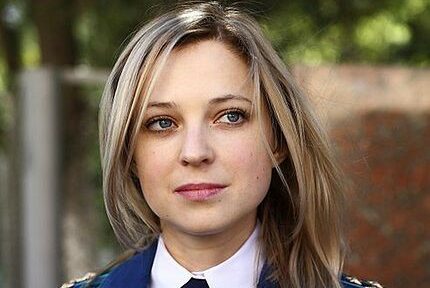
Natalia Poklonskaya is a Russian politician who is serving as Deputy of the State Duma of Russia, deputy chairman of the State Duma Committee on Foreign Affairs. She resumed office on 18 September 2016 and served under President Vladimir Putin and Prime Minister Sergey Aksyonov.
Before serving in this capacity, Poklonskaya was the Prosecutor of the Autonomous Republic of Crimea from 11 to 17 March 2014. Then, between 2 May 2014 and 6 October 2016, she was the Prosecutor of the Republic of Crimea. Additionally, she served as State Counselor of Justice 3rd Class in 2015.
While you may not know her name, you may have seen her anime character used to depict a hot Russian girl or hot Ukrainian girl. The cartoon has become the most popular Russian women meme and has given the former Crimean prosecutor a lot of fame. There are lots of facts you should know about Poklonskaya and we will reveal them in this article.
Top ten facts about Natalia Poklonskaya
- She was born in Mikhailovka; a village in Voroshilovgrad Oblast, in the former Ukrainian SSR and she turned 41 years old on 18 March 2021.
- Her parents live in Crimea and are retired while her two grandfathers died in the Second World War. Only her Serbian grandmother survived the German occupation that left millions of civilians dead in The Holocaust.
- Poklonskaya graduated from the University of Internal Affairs in Yevpatoria in 2002.
- She started working as an assistant prosecutor to the Acting Prosecutor of the Republic of Crimea after her graduation and was the assistant attorney of Krasnogvardeysky district in Crimea from 2002 to 2006.
- In 2011, she acted as the state prosecutor in the trial of Ruvim Aronov as the leader of the Bashmaki gang in Simferopol. She was assaulted in the stairwell of her own home and she suffered multiple injuries including partial facial paralysis. Many believed the attack was related to the high-profile case.
- The Ukrainian Prosecutor General’s Office in Kyiv hired her as a senior prosecutor in 2012, and she worked as a senior attorney of the 2nd division of the General Directorate of Internal Affairs until 2014 when she submitted her resignation.
- Natalia Poklonskaya was appointed Prosecutor of the Autonomous Republic of Crimea on 11 March 2014, when Crimea was no longer under Ukraine. This put her at loggerheads with the Ukrainian government because it still claims Crimea as an integral part of its territory.
- The European Union has added Poklonskaya to its sanctions list, officially barring her from entering EU countries. Canada, Japan, and the United States also have travel bans placed on her as well.
- Poklonskaya was elected as a member of parliament (MP) in the State Duma during the 2016 Russian legislative election and had to resign from her role as Prosecutor General on 27 September 2016. She had been the youngest female general in Russia, at 36.
- She became famous after a video of her at a press conference on 11 March 2014 posted on YouTube went viral because of her beauty and youthfulness. Since then, she has become the subject of memes and cartoons.
Also read: Scott Ruffalo biography: early life, family, death investigation and mystery
Early life and education
Poklonskaya is 41 years old and was born on 18 March 1980 in Mikhailovka; a village in Voroshilovgrad Oblast, in the former Ukrainian SSR. When she turned ten in 1990, her family relocated to the Crimean city of Yevpatoria.
Her parents live in Crimea and are retired while her two grandfathers died in the Second World War. Only her Serbian grandmother survived the German occupation that left millions of civilians dead in The Holocaust.
According to an interview with the Rossiyskaya Gazeta, Natalia Poklonskaya graduated from the University of Internal Affairs in Yevpatoria in 2002. The Ukrainian Ministry of Internal Affairs owns this institution. In 2016, the university was recognized as the best educational institution in the region in the field of jurisprudence.
Career
Early career in Crimea and Ukraine
Poklonskaya started working as an assistant prosecutor to the Acting Prosecutor of the Republic of Crimea after her graduation. It was her first time working in a professional capacity in the Ukrainian Prosecutor’s Office.
From 2002 to 2006, she was the assistant attorney of Krasnogvardeysky district in Crimea. She then worked as the assistant attorney of Yevpatoria from 2006 to 2010. Later, she served as the deputy chief of a surveillance law enforcement unit of the Prosecutor’s Office of Crimea. The unit dealt with organized crime and she worked there between 2010 and 2011.
It was in 2011 that she handled one of her earliest high-profile cases. Poklonskaya acted as the state prosecutor in the trial of Ruvim Aronov in Simferopol. Aronov had been a former deputy of the Supreme Council of Crimea and a former manager of the Saki soccer club. He was on trial as the leader of the Bashmaki gang.
The organized crime group was feared in Crimea, Zaporizhia, Kharkiv, and Kyiv. It arose after the 1990 dissolution of the USSR. According to reports, the Bashmaki gang was involved in racketeering, robberies, eight abductions, and 50 murders.
In December 2011, Poklonskaya was assaulted in the stairwell of her own home and she suffered multiple injuries including partial facial paralysis. Many believed that the attack was a message from the Bashmaki gang due to her involvement in the case.
However, she got appointed as the inter-district environmental prosecutor of Simferopol. The following year, the Ukrainian Prosecutor General’s Office in Kyiv hired her as a senior prosecutor.
See also: Five quick facts on how to find love like Henry Cavill and girlfriend Natalie Viscuso
By October 2012, she was working as head of the prosecutors with the proceedings of the Court of Appeal of Crimea until December 2012. After this, she served as a senior attorney of the 2nd division of the General Directorate of Internal Affairs. Her new job involved pre-trial investigation and public prosecution management supervision. Her office was also responsible for overseeing law enforcement in criminal proceedings.
Poklonskaya made the news in February 2014 when she tendered her resignation from the office of the General Directorate of Internal Affairs. As her reason, she said; “[I am] ashamed to live in the country where neo-fascists freely walk about the streets.” She further told Voice of Russia that she wanted her child to live in an ‘honest country’, something that neo-fascism may ruin, according to her line of thought.
The government did not accept her resignation and they gave her a vacation instead. She seized the opportunity to leave Kyiv and go back to Crimea. Poklonskaya visited her parents before approaching the Crimean government for a job.
Crimean prosecutor
Natalia Poklonskaya was appointed Prosecutor of the Autonomous Republic of Crimea on 11 March 2014, when Crimea was no longer under Ukraine. Russia formally annexed Crimea on 18 March 2014 and incorporated it as federal subjects of Russia. Despite this move, Ukraine continues to claim Crimea as an integral part of its territory and most foreign governments and the United Nations General Assembly Resolution 68/262 supports it. Meanwhile, 17 other UN member states support Russia.
Prime Minister Sergei Aksyonov appointed Poklonskaya to the role which four other appointees had rejected. The Ukrainian government launched a criminal case against her because of her earlier mentioned criticism of neo-fascism and new role in Crimea. They went ahead to strip her of the civil service rank of Counsellor of Justice.
As the prosecutor of Crimea, she joined an investigation into the violent attacks on Crimean Berkut members. Poklonskaya was also at press briefings often to address the media. She told listeners that she believed the shooting in Simferopol which killed two and the February 2014 sniper attacks on Independence Square in Kyiv were meant to provoke violence between the military forces of Ukraine and Crimea.
Relationship with Russia
Since Crimea was under Russian control at the time, the new Prosecutor’s Office was under Russia’s Prosecutor General Yury Chaika. Chaika appointed Poklonskaya as acting Prosecutor of the Republic of Crimea.
During this time that her relationship with Russia blossomed, her relationship with Ukraine deteriorated quickly. The Ukrainian Ministry of Internal Affairs listed her as a wanted criminal on its website. They alleged that she had been involved in a conspiracy to overthrow constitutional order or seize state power. Meanwhile, Russia defended her and called the charge a bluff. Prosecutor General Yury Chaika granted Poklonskaya the rank of Senior Counsellor of Justice during this time as well.
As a sign of honor, Chaika personally presented Poklonskaya with her official papers as a Russian legal officer on 11 April 2014. In May, Russian President Vladimir Putin appointed Poklonskaya Chief Prosecutor of Crimea.
She worked with the Russian security force, the FSB, granting it approval to arrest Yevgeniy Pomelov, the assistant attorney of Yalta, as part of a larger bribery case. She also labelled the Crimean Tatars’ self-governmental body, the Mejlis, an extremist group.
In November 2014, she declared the deportation of anyone who did not recognize Crimea as a republic. The next year, she was appointed the head of the Japanese-Russian Friendship Society; a move aimed to soften the tension between both countries over Russia’s annexation of Crimea.
In June of the same year, Vladimir Putin gave Poklonskaya the rank of 3rd Class State Counsellor of Justice; this corresponds with the military rank of Major General.
Sanctions and travel bans
On 12 May 2014, the European Union added Poklonskaya to its sanctions list, officially barring her from entering EU countries. This also meant that any of her assets there were to be frozen. Canada and Japan also followed suit in placing sanctions on her. On 19 December 2014, the United States placed sanctions on Natalia Poklonskaya and several other Ukrainian separatists and Russians.
Political career
MP in the State Duma
Natalia Poklonskaya declared her intention to run as a member of parliament (MP) in the State Duma for the United Russia party. The State Duma is the lower house of the Federal Assembly of Russia. She was elected during the 2016 Russian legislative election and had to resign from her role as Prosecutor General on 27 September 2016. She had been the youngest female general in Russia, at 36.