How Travis Scott's Afrobeats Collaborations Are Shaping Hip-Hop's Global Sound
Jalen Ross··9 min read
Ad SpaceArticle Top - 728x90
Advertisement
“From the H to Ikeja.” Five words, dropped by one of the most divisive voices in American rap, stitching the H of Houston to the heart of Lagos State in a single breath. Travis Scott delivered that line on “Active,” his 2024 link-up with Asake, and for a lot of Nigerian listeners it landed harder than the beat itself. Here was a Grammy-magnet trap superstar - the man behind “SICKO MODE” and the “Utopia” arena spectacle - shouting out Ikeja the way a Lagos boy name-drops his ends. That one bar tells you almost everything about where the music is heading. The center of gravity in pop is shifting, and the artists who built their careers on Atlanta hi-hats and Houston chopped-and-screwed are now reaching toward Lagos and back.
For years the conversation around Afrobeats going global leaned on a handful of crossover moments and a lot of hope. The story has changed. There are now real, verifiable records with Travis Scott’s name next to a Nigerian lead artist, and they sit inside a much larger pattern of US hip-hop and Afrobeats feeding off each other. The interesting part is not just that these collaborations exist. It is what they reveal about who holds the power in the exchange, and whether a feature credit is a doorway or a ceiling.
The Sound Bridge Between Houston and Lagos
Start with the obvious, because the obvious is where the chemistry lives. Travis Scott’s signature mode is atmosphere over everything: cavernous reverb, drugged-out melody, ad-libs that function more like percussion than lyrics. Afrobeats, at its core, is a rhythm-first genre built on polyrhythmic log-drum patterns, call-and-response vocals, and a groove engineered to move a body before it moves a mind. On paper these are different planets. In practice they share a spine. Both prize feel over technical rapping. Both treat the voice as a texture you can stretch, pitch, and layer. Both build songs that work in a dark room with a heavy subwoofer.
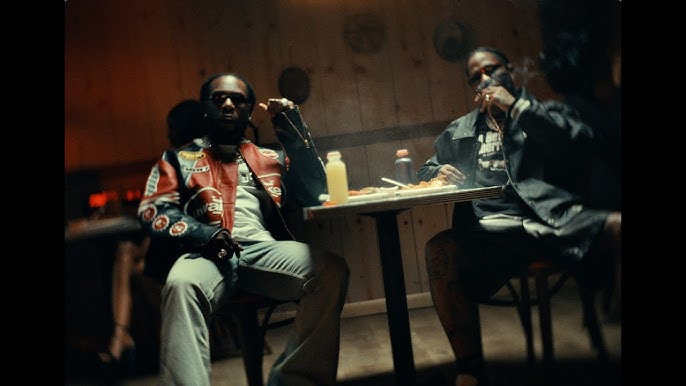
That overlap is why “Active” does not sound like a hostage negotiation between two genres. Produced by Mike Dean - Travis Scott’s longtime sonic architect - alongside Nigerian hitmaker Sarz, the track folds Afrobeats and trap into house and fuji, sampling Jazzman Olofin’s 2006 crossover record “Raise Da Roof.” Asake keeps his trademark cool in Yoruba; Travis adapts his flow to ride the bounce instead of fighting it. The result topped the US Afrobeats Songs chart and the UK Afrobeats chart, earned a double-platinum certification in Nigeria, and gave Travis Scott his first ever No. 1 on Billboard’s Afrobeats list. The bridge held weight.
What Travis Scott Actually Shares With Afrobeats
It is worth being precise here, because hype tends to invent connections that do not exist. Travis Scott is not an Afrobeats artist and has never claimed to be one. What he has is a toolkit that maps unusually well onto the genre’s instincts.
Consider the ad-lib. In Travis Scott’s catalogue, the ad-lib is a structural device - the “it’s lit,” the “yeah,” the “straight up” that punctuate a verse and give it momentum. In Afrobeats, that same percussive vocal habit shows up in Asake’s stacked harmonies and Burna Boy’s interjected Pidgin asides. Both artists use the human voice as a rhythm instrument rather than purely a delivery system for words. Then there is the atmosphere. Travis Scott records are designed to feel enormous and slightly woozy, and Afrobeats has been drifting toward that same widescreen, melodic, reverb-soaked space for years. When the two meet, the seams do not show because the underlying aesthetic - mood as the main event - is already shared.
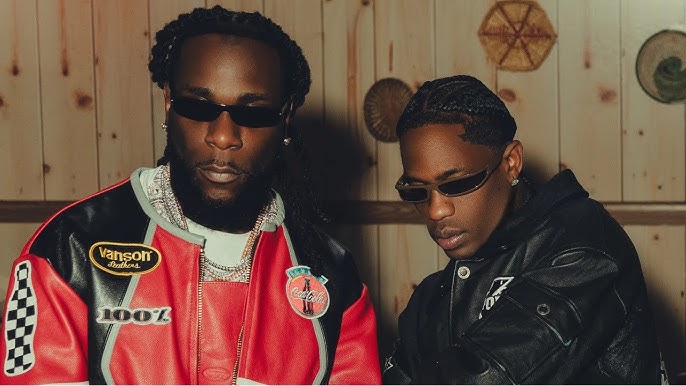
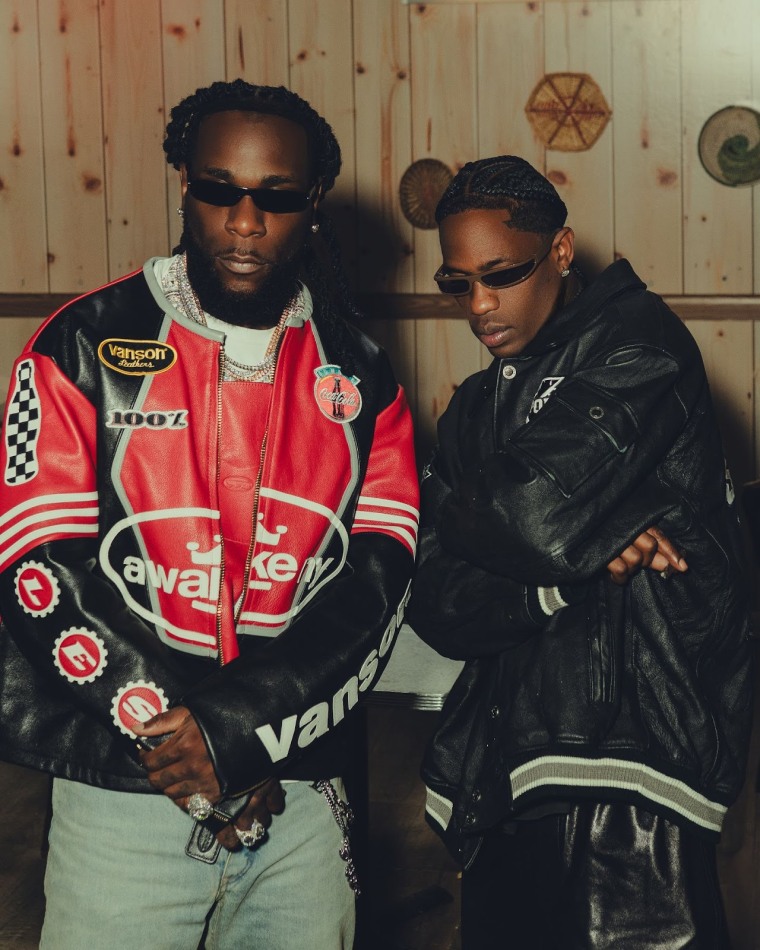
His follow-up appearance proves the point. On Burna Boy’s “TaTaTa,” released in May 2025 as a single from the album “No Sign of Weakness,” Travis Scott slots his trap-influenced verses against Burna’s Afro-fusion, the beat handled by Nigerian producer Chillz. Two collaborations, two of the biggest Nigerian artists alive, both built on the same principle: find the rhythmic and atmospheric common ground, then let each artist stay fully himself.
The Gatekeepers Who Opened the Door
Travis Scott did not pry this door open. He walked through one that others had already unbolted, and Nigerian audiences should remember who turned the key first.
The foundational moment was Drake and Wizkid’s “One Dance” in 2016. It spent ten weeks at No. 1 on the Billboard Hot 100, the longest-leading chart-topper of Drake’s career at that point, and it made Wizkid the first Nigerian artist to top that chart, even as a featured act. That record taught the American industry a lesson it had been slow to learn: a Lagos voice and a Lagos cadence could sell to the entire planet.
Beyonce widened the lane. Her 2019 album “The Lion King: The Gift” and the 2020 visual companion “Black Is King” pulled Burna Boy, Wizkid, Tems, Shatta Wale, and a roster of African talent into a mainstream American superstar’s flagship project. It was a statement of intent, framing Afrobeats not as a novelty but as a creative wellspring worth building an album around. Chris Brown leaned in hard with multiple Wizkid links. And Future - Travis Scott’s frequent collaborator and a pillar of the same Atlanta-to-Houston trap world - put Tems at the center of “Wait For U” alongside Drake in 2022. That song debuted at No. 1 on the Hot 100, became Tems’s first chart-topper, and won the Grammy for Best Melodic Rap Performance. Tems went on to earn a writing credit on Beyonce’s catalogue too. The point is that by the time Travis Scott reached for Asake and Burna Boy, the path had been paved by Drake, Beyonce, and Future. He is an extension of a movement, not its origin.
Producers Are the Real Connective Tissue
Look closely at every one of these crossover records and you find the same quiet truth: the producers are doing the heavy lifting. The collaboration that matters most is often the one in the booth, not the one on the marquee.
Ad SpaceIn-Article - 300x250
Advertisement
“Active” works because Sarz, one of Nigeria’s most respected beatmakers, sat in the room with Mike Dean and translated between two sonic languages. Sarz already had the credibility - his fingerprints are on a decade of Afrobeats and his ear for global production is sharp - so the track never felt like a foreign artist dropped onto a Nigerian instrumental. It felt co-built. The detail that gives it away is the sample at its core: that recurring vocal chop lifted from Jazzman Olofin and Adewale Ayuba’s “Raise Da Roof” roots the entire record in Nigerian fuji tradition, the genre Asake has spent his career modernizing. A producer who did not understand that lineage could not have placed it there. The decision to build a Travis Scott collaboration on a fuji sample is a quiet act of cultural insistence, and it only happens because a Lagos ear was in the room with veto power. “TaTaTa” runs on the same logic, with Chillz anchoring the beat so Burna Boy and Travis Scott could meet in the middle. This is the layer Nigerian fans should watch most closely. When a Lagos producer is in the credits next to an American one, the genre is not just exporting voices, it is exporting craft. That is how influence becomes structural rather than decorative. A featured verse fades; a production style spreads through every studio that copies it.
What a US Co-Sign Does for a Nigerian Artist’s Numbers
The business case is blunt. An American superstar feature is a passport, and the stamps it provides are measurable.
“Active” landed Asake on charts he would have struggled to reach alone: a Billboard Global 200 placement, a Canadian Hot 100 entry, a UK Singles Chart position, and that No. 1 on the US Afrobeats Songs ranking. Travis Scott’s audience - tens of millions of streaming listeners conditioned to press play on anything with his name - became Asake’s audience for the length of that song. The same dynamic explains why “Wait For U” mattered so much for Tems. A featured slot on a Future and Drake record put her in front of the largest possible American rap audience and converted her, overnight, from a respected Lagos talent into a Hot 100 No. 1 artist and a Grammy winner.
This is the genuine, defensible upside. A co-sign collapses years of grinding for international visibility into a single release cycle. For an artist trying to break beyond the continent, the math is hard to argue with. The reach, the playlist placements, the algorithmic lift, the festival bookings that follow - these are real, and they compound.
The Risk of Being a Feature Instead of a Headliner
Here is where Nigerian fans should resist the temptation to celebrate every collaboration as an unqualified win. A feature is not the same as a headline, and the difference decides who owns the long-term value.
When Wizkid sang the hook on “One Dance,” the song was filed under Drake. When Tems lit up “Wait For U,” the credit read Future featuring Drake and Tems. The Nigerian artist supplies the spice that makes the record unforgettable, but the ownership, the catalogue value, and the headline narrative stay with the American star. There is a version of the cross-pollination story where Afrobeats artists become the world’s most sought-after seasoning and never the main dish - permanently valuable, permanently in a supporting role.
The genre has its own answers to that risk, and they are worth naming honestly rather than inflating. Burna Boy is the clearest counter-example. He sold out London’s Wembley Stadium as a solo African headliner in front of roughly 90,000 people, a feat no other African act has matched, and his US run has filled arenas under his own name. That is headlining, not featuring. The trajectory elsewhere is rising but still short of the summit, and it helps no one to pretend otherwise. No African artist has headlined Coachella as of 2026 - Burna Boy played afternoon and sub-headline slots in 2019 and 2023, Rema performed in 2023, and Tyla took the stage in 2024, all real milestones, all still rungs on a ladder rather than the top of it. No Afrobeats song has reached No. 1 in the UK; Rema’s “Calm Down” with Selena Gomez peaked at No. 3, which is the highest an Afrobeats lead artist has ever climbed on the Billboard Hot 100 and remarkable on its own terms, but a peak is a peak. The honest read is that the ceiling is rising fast and has not yet been broken. Collaborations with someone like Travis Scott accelerate the climb. They do not, by themselves, finish it.
Where the Convergence Heads Next
The trajectory is set, even if the destination is not. Travis Scott’s two Nigerian links in roughly a year are not isolated experiments; they are part of a steady normalization where American rap’s biggest names treat Afrobeats as a peer scene to draw from rather than a curiosity to sample. The interesting question for the next few years is which direction the power flows.
Watch the producers. If Sarz, Chillz, P.Priime, and the next wave of Lagos beatmakers keep landing in the credits of major American releases, the influence stops being a series of one-off features and becomes a permanent fixture in how global pop is built. Watch the ownership. The breakthrough that actually matters will be the record where a Nigerian artist is the lead and the American superstar is the guest - the inversion of “One Dance,” with the credit reading the other way. “Active” gestures at it, with Asake’s name first and Travis Scott in the feature slot, and that detail is more significant than the chart numbers. Watch the rooms. The most durable convergence will not be announced on a single; it will happen quietly, in sessions where the Houston engineer and the Lagos producer stop translating for each other because they have started speaking the same language.
Travis Scott shouting out Ikeja was a moment. The real shift is what happens when that shout-out stops being notable - when a Lagos reference on an American rap record, or an American verse on an Afrobeats anthem, is simply what the music sounds like. That day is closer than it has ever been, and the H-to-Ikeja line is the sound of it arriving.
Ad SpaceIn-Article - 300x250
Advertisement
Share
Get the recap
Loved this story? Get more like it.
Join readers who get our weekly entertainment recap - the stories worth your time, delivered every Friday.
No spam. Unsubscribe anytime. By signing up you agree to our Privacy Policy.