


Mice in a Stanford lab press a lever to receive a sugary, calorie-dense liquid. Eventually the lever delivers a small electric shock alongside the reward. Most mice learn, after the first or second shock, to leave the lever alone. A small subset keep pressing. They press because the reward overrides the punishment. Gifty, the narrator of Yaa Gyasi’s second novel, is a neuroscience doctoral student watching those mice. Her brother Nana, a high school basketball star, became addicted to OxyContin prescribed after an ankle injury and died of a heroin overdose. He could not stop pressing the lever.
The Book at a Glance
| Title | Transcendent Kingdom |
| Author | Yaa Gyasi |
| First published | September 2020 |
| Publisher | Alfred A. Knopf |
| Form | Novel |
| Prizes | Shortlisted for the Women’s Prize for Fiction, 2021; a New York Times Notable Book |
| Other novel | Homegoing (2016), which won the National Book Critics Circle John Leonard Prize and the PEN/Hemingway Award and took the American Book Award in 2017 |
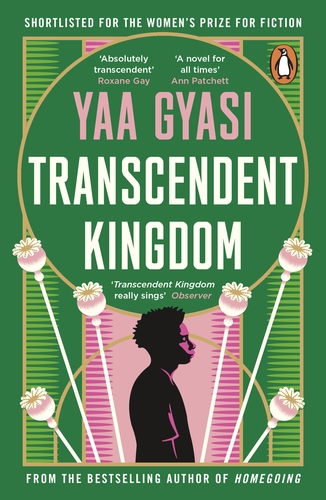
Transcendent Kingdom came out in September 2020 from Knopf, four years after Homegoing. It was shortlisted for the Women’s Prize for Fiction in 2021 and named a Notable Book by the New York Times. It is worth separating the two books’ honours, because they get muddled: the National Book Critics Circle John Leonard Prize, the PEN/Hemingway Award, the 2017 American Book Award and the National Book Foundation’s 5 Under 35 listing all belong to Homegoing, not to this novel. The reception of the second book was respectful rather than ecstatic, which is what tends to happen to a quiet second novel after a noisy first one. It deserved better, and time has been correcting the record. It is the more mature work.
A Different Architecture
Where Homegoing sprawled across generations and fourteen point-of-view characters, Transcendent Kingdom stays inside Gifty’s head. She is in her late twenties, finishing her doctorate, sleeping with no one, mostly avoiding her colleagues, and recently joined by her mother, who has flown in from Alabama and is now lying immobile in Gifty’s apartment under a comforter. Her mother is in the grip of a deep depressive episode. She does not eat and does not speak. Gifty goes to the lab, comes home, checks on her mother, goes to bed. The novel is a recursive movement between three timelines: the lab in California, the apartment with her mother, and the Alabama childhood that produced both.
This is a far more conventional structure than the one Gyasi used in her debut. It is also a more demanding one. A novel that takes place largely inside a single consciousness has to earn that consciousness sentence by sentence. There is no relay race here. There is one runner, and she has to be interesting enough to follow for the whole distance. Gifty is. She is rigorous, suspicious of easy feeling, sharp in the way that lonely clever children of immigrant parents are often sharp, and increasingly aware that her chosen field, the neuroscience of reward-seeking and addiction, is not separate from her family history.
The novel’s central technical achievement is the way Gyasi makes the lab work feel like grief work. Gifty is studying reward-seeking circuitry in the brains of mice, hoping to identify what distinguishes a mouse that can stop pressing the lever from one that cannot. She is, in the most direct possible way, trying to find her brother in the brain of a mouse. The novel never says so out loud. It does not need to. The architecture makes the equation inescapable.
Faith and Science as a Single Problem
Gifty was raised Pentecostal in Huntsville, Alabama, in a First Assemblies of God congregation where she spoke in tongues at the altar as a child. After Nana died, her mother’s faith hardened into something defensive. Gifty’s faith, by contrast, broke. The breaking of it is the book’s other long story.

The familiar way to write the faith-and-science novel is as a defection narrative: a believing protagonist meets the scientific method, finds it more honest than the church and leaves. Gyasi refuses this. Gifty has left the church, more or less, but she has not stopped thinking in its grammar. She still has the childhood journals in which she addressed God directly. She still reaches for the language of mercy when she describes her mice. Her science is not a replacement for her religion. It is the same project, addressed to a different audience, asking the same question: why does suffering land where it lands.
This is harder to pull off than it sounds, and Gyasi pulls it off. Gifty’s narrative voice carries both registers without straining either. She can write a paragraph on the manipulation of dopamine-releasing neurons that reads cleanly to a lay reader, and on the next page write a paragraph on the Holy Spirit descending in a Pentecostal service that does not condescend to the believers in the room. The book treats religious experience the way the best religious novelists, Marilynne Robinson among them, treat it: as a real thing in the world that some people have access to and others do not, and not as a costume or a symptom.
The Mother
Gifty’s mother arrives in California by plane, walks into her daughter’s apartment, lies down and stops moving. She has done this once before, after Nana died, when Gifty was eleven. Gifty fed herself while her mother lay in the back bedroom in Alabama and the church women came by with food. Now Gifty is grown, her mother is back in the same posture, and Gifty is once again the only person responsible for keeping a household functional.
The mother is the novel’s quietest and most devastating creation. Gyasi never gives her a chapter of her own. We see her only through Gifty’s eyes, which is to say through the eyes of a daughter who has spent her life trying to read a woman who would not be read. She came to the United States from Ghana with Nana still small, and Gifty was born in Alabama; the husband she came with eventually went back to Ghana for good. She worked long shifts as a home health aide while raising two children in a state where her family was racialized in ways she had never experienced before. She lost her son. She kept her job. She tithed faithfully. She did not break in any way the church around her could see, which is part of why she broke in private.
Gyasi is careful here. The mother is not the saintly suffering African mother of an earlier tradition, and she is not a tiger-mother caricature. She is a specific woman whose grief has nowhere acceptable to go, in a religious community that prizes endurance and an immigration story that does not allow for collapse. Her depression is not a metaphor. It is the depression of a woman whose life has demanded more of her than she has been able to give and who has finally stopped pretending otherwise.