
In roughly a decade, amapiano has moved from a South African township scene to one of the most widely exported dance music styles of its era. It dominates South African streaming charts, it has a firm hold across southern Africa, it turns up in European club sets and in brand advertising aimed at African markets, and it has begun appearing in collaborations with global pop artists looking for an African sound that is not Nigerian Afrobeats. If you do not yet know what amapiano is, what distinguishes it from the genres it is routinely confused with, and why it has travelled as far as it has, this is the briefing.
What Amapiano Actually Sounds Like
Amapiano means “the pianos” in isiZulu, and it is a South African house subgenre that took shape in the mid-2010s, drawing on deep house, lounge and jazz keyboard idioms, kwaito and the local Bacardi sound of Pretoria. Tempos usually sit between about 110 and 115 beats per minute, slower than most Nigerian Afrobeats and slower than standard house. The vocals lean melodic and conversational rather than performative, and they move freely between isiZulu, Sesotho, Setswana, isiXhosa and English, often within a single track.
Two elements define the sound. The first is the jazzy piano or keyboard melody that gives the genre its name, usually looping rather than developing. The second is the log drum, a pitched, elastic, deeply sub-heavy bass hit that functions as both bassline and percussion. The log drum arrived in force around 2019 and is the single most identifiable marker of the style. Around those two elements sit shuffling shaker and hi-hat patterns, long gradual builds, and drops that withhold rather than detonate. The structure rewards patience, which is part of why the music works as well in a car or an office as on a dance floor.
Where It Came From
Amapiano emerged out of Pretoria and the townships around Johannesburg, including Soweto and Katlehong, in the first half of the 2010s. Its exact paternity is contested within the scene itself, which is normal for a genre that grew from shared files rather than signed releases. The producers who shaped it, among them Kabza De Small, DJ Maphorisa, MFR Souls, the JazziDisciples and DJ Stokie, were not working through major labels. They were producing on home equipment and distributing through free platforms, WhatsApp shares and SoundCloud, and the music reached a mass South African audience before any commercial platform took an interest.
That origin shaped the genre’s economics permanently. Amapiano spread through informal channels first, so by the time streaming services built editorial playlists for it the audience already existed and the artists had leverage. The commercial turn came around 2019 and 2020, when Kabza De Small and DJ Maphorisa began releasing together as Scorpion Kings, starting with the Scorpion Kings EP and continuing through a run of joint projects including Once Upon a Time in Lockdown. The lockdown period itself mattered, because with clubs shut the music moved to online DJ streams and found an audience outside South Africa that it might otherwise have reached years later.
Not Kwaito, Not Gqom, Not Afro House
Amapiano is routinely mislabelled, and the distinctions are straightforward. Kwaito is the Johannesburg genre of the 1990s and early 2000s, built by slowing house down to roughly 100 beats per minute and laying chanted vocals in isiZulu and township slang over it, with Arthur Mafokate, Mandoza and Trompies among its central figures. It is amapiano’s grandparent, not a synonym for it.
Gqom came out of Durban in the early 2010s, is substantially faster at around 125 beats per minute, and is built on a broken, stripped, minimal drum pattern that deliberately refuses the steady four-to-the-floor pulse, with Rudeboyz, Distruction Boyz and DJ Lag among its defining names. Afro house, the lane Black Coffee works in, is a four-to-the-floor house music at around 120 to 125 beats per minute, with lusher production and a traditional club structure. Amapiano is slower than gqom and afro house, keeps the piano and the log drum at its centre, and builds in a way neither of the others does.
Kabza De Small and DJ Maphorisa
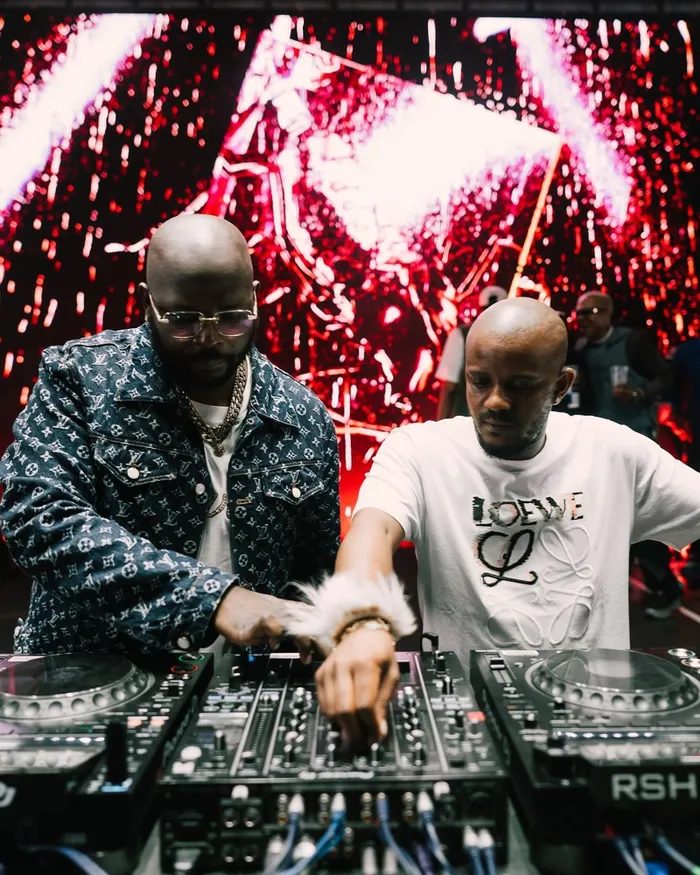
Kabza De Small, born Kabelo Petrus Motha, is the producer most often called the king of amapiano, and the description is about output as much as acclaim. His production credits run into the hundreds of tracks, and his albums, including I Am the King of Amapiano: Sweet and Dust, set the template for how an amapiano full-length is built. Maintaining consistency across that volume of work is an unusual achievement in any genre.
DJ Maphorisa, born Themba Sekowe, came to amapiano with a career already behind him, having produced for Nigerian and international artists before the genre existed, and he functions as its connector. He collaborates widely, produces for artists outside South Africa, and has done more than anyone to put amapiano in front of audiences that would not otherwise have found it, including through his work with Black Coffee’s Ibiza circles. Where Kabza is the architect of the sound, Maphorisa is the one who keeps taking it elsewhere.
The Wider Artist Ecosystem
Below that tier the roster is deep. Focalistic brought a rap cadence to the genre and his “Ke Star” with Vigro Deep became one of its first continental crossovers after a Davido remix. Tyler ICU produced “Mnike,” among the biggest amapiano records of 2023. Sha Sha, Zimbabwean-born and South Africa-based, was the first amapiano vocalist to win a BET award and is the figure most often credited with establishing a female vocal presence in the genre. Uncle Waffles, born in Eswatini, built a DJ career after a clip of her set went viral in 2021 and has since toured internationally and released her own music. Aymos, Mr JazziQ, Daliwonga, Vigro Deep, MFR Souls and Mas Musiq all hold substantial audiences of their own.

Then there is Tyla, whose “Water,” released in 2023, fused amapiano rhythm with R&B and pop and became a global hit, winning the Grammy for Best African Music Performance at the 2024 ceremony. Tyla is a pop artist who uses amapiano elements rather than an amapiano artist, which is a distinction worth keeping, but her success demonstrated that the rhythm could carry a record to the top of Western charts. That was the proof the genre had not previously had.