As part of our series on Nigerian FinTech start-ups, we bring you all you need to know about Flutterwave.
In a highly digitalised world, commerce is becoming increasingly electronic. This means that there is a greater demand now than ever for electronic means of buying and selling of goods and services, also known as e-commerce. One of the most important tools needed by every e-merchant is a payment gateway.
A payment gateway is a route through which payment is received and processed by a merchant on behalf of their customer. It allows the seller not only to display the services on offer but also provides a means for customers to electronically make purchases of goods and services.
In the past, people looking to sell products have had to come up with different ways to take payment from their customers. In addition to this, businesses that scaled up in value also had to worry about account reconciliation.
With payment gateways or channels, however, users can easily make purchases and the seller is guaranteed to receive his payment electronically. All payments are also made into a designated central account, meaning less hassle. This is usually done quite seamlessly-mostly by the integration of their APIs into your website or app.
What is an API?
API stands for Application Programming Interface. The term API (in the context of our discussion) is a set of functions, procedures, methods or classes used by computer programs to request services from other service providers or programs.
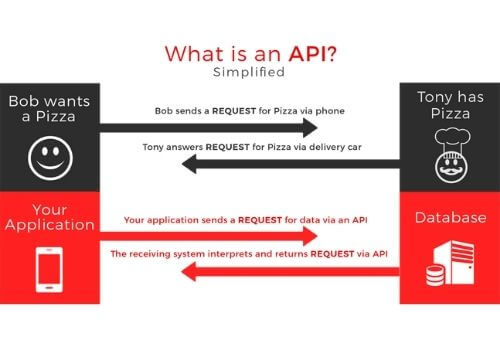
In simpler English, an API works by communicating with and exchanging data with other systems. It acts as a messenger between the user and the system. It helps to retrieve the necessary data the user is requesting from the system.
About Flutterwave
Nigerian entrepreneurs Olugbenga Agboola and Iyinoluwa Aboyeji co-founded Flutterwave in 2016. Before establishing Flutterwave, both men had acquired an extensive entrepreneurial experience.

Olugbenga contributed to the development of FinTech solutions at a number of tech companies and financial institutions such as PayPal, Standard Bank, among others. Iyinoluwa was one of the co-founders of Andela-a company that helps organise African software developers for global companies.
They designed the digital payment system to make it easier to do business across Africa. The idea for Flutterwave came when they identified the problem of online payments in Africa. This was one of the reasons why the API allows users to make international payments in their own currencies.
Flutterwave takes care of integrating banks and payment-service providers into its platform so businesses don’t have to take on the expense and burden.
The platform does much to aid intra-continental online transactions. Also, they make it easier for global companies to receive payments from Africans considering the relatively low usage of credit cards in the continent.
Flutterwave has two major branches - Rave, its payment gateway API and Barter, its international bill payment and transfer app.
Growth and funding
Flutterwave headquarters is located in San Francisco, California where it was founded. Today, the company has offices in 10 African countries including Nigeria, Kenya and South Africa.

They have strategically maintained San Francisco as their base to have easier access to funding. Aboyeji opined that many investors would be sceptical about funding an unknown startup out of Nigeria.
The startup graduated from Silicon Valley elite accelerator program Y Combinator counts. Social Capital and Omidyar Network are also among some of its investors.
The company is funded by 32 investors and has raised a total of $64.5M in funding over 11 rounds. Their latest funding was on 21 January 2020 from a Series B round. The total amount raised in that round alone was $35M. FIS and 9Yards Capital are among the most recent investors.
Flutterwave has a post-money valuation in the range of $100M to $500M as of 21 January 2020, according to PrivCo.
According to company data, in 2019, Flutterwave processed 107 million transactions worth $5.4 billion.
Partnerships
As Flutterwave’s reputation and reach has grown over time, their partnership with other brands has increased. Here are a number of some of its most notable partnerships.
Alibaba/Alipay
In July 2019, Flutterwave partnered with Alibaba’s payment system-Alipay. The agreement made Flutterwave the payment gateway that was the link between the $200billion China-Africa trade.
Visa
Flutterwave partnered with Visa in January 2019. This partnership led to the creation of a customer payment product called GetBarter. GetBarter facilitates personal and small merchant payments across Africa.
Existing Visa card users can send and receive funds at home while non-visa card users can create virtual cards. The product has been renamed Barter.
Flutterwave’s partnership with Visa also makes it possible for users of the platform to create virtual cards that can be used for transactional purposes.
BetWay
On 4 September 2020, Flutterwave signed a partnership with British Gaming Company Betway. The partnership makes it easier for African customers to fund their BetWay wallet.
In February 2020, Google announced a partnership with Flutterwave and the training of 5,000 merchants. The focus of the training is the digital skills the merchants need for their businesses to grow.
Paga
Also in February, Flutterwave made one of its most promising indigenous partnerships with Paga. This partnership opened Paga merchants and customers to Flutterwave’s merchant base of airlines, media outfits, hotels, ticketing companies, fashion retailers, etc.
Flywire
Flutterwave also has a partnership with Flywire Payments Corporation. They provide similar services of payment gateways for international transactions in local currency. However, Flutterwave is bridging the gap of the African market to them.
Worldpay
Again, in January 2020, Flutterwave partnered with global payment system, Worldpay. This partnership made Flutterwave its payment gateway of choice in Africa. This means that a predominantly European company can easily accept payments from Africa with “indigenous” cards.
How to register on Flutterwave
Signing up for a Flutterwave account is fast, easy and free. First, you go to Flutterwave signup page and fill the form accordingly.
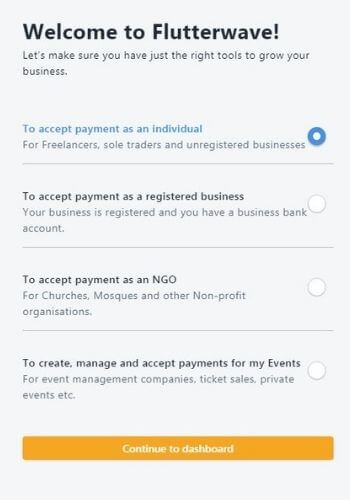
On the next screen, you select what kind of activities you want to run with Flutterwave. You can either signup as an individual, a registered business, an NGO or event management.
- Individual accounts are used for Freelancers, sole traders and unregistered businesses.
- Registered business accounts are for users who have a business bank account.
- NGO accounts are allocated for churches, mosques and other non-profit organisations.
- The event management account can be used to create, manage and accept payments for Events.
Next, you would need to verify your personal and business information.
- First, you would have to verify your phone number using a One-Time Password.
- Then, you would need to verify your company’s registration with valid details.
- You must ensure that the name on your CAC certificate corresponds with what you fill into all the forms for easy verification.
- You would also need to verify the account number into which your payments would be deposited.
- Finally, an authorised representative would need to be assigned to the account and this person must have a valid Bank Verification Number (BVN).
Features and services offered by Flutterwave
Checkout
One of the most basic services that Flutterwave offers is the Checkout option. This gives customers the option to make payments seamlessly on your website or mobile app.