


There are photographs in the archives of Italy’s war on Ethiopia that show Ethiopian women holding rifles, and the captions do not name them. They are anonymous in the way that history has a habit of rendering women anonymous, present in the frame but absent from the record. Maaza Mengiste has spoken often about that erasure, and about how long it stayed with her. Out of it came a novel that would land on the Booker Prize shortlist and force a reconsideration of who, exactly, fought the Italians when Mussolini’s army crossed into Ethiopia in October 1935. The whole of her career can be read as an argument with those photographs and the silence around them.
A Childhood in Flight
Maaza Mengiste was born in Addis Ababa and left Ethiopia as a small child, when her family fled the revolution that brought down Emperor Haile Selassie in 1974. Her family belonged to the educated class that the Derg, the Marxist military junta that seized power that year, came to regard with suspicion. When the violence of the Red Terror began, when neighbours disappeared and bodies appeared in the streets as warnings, the family left. They spent the rest of her childhood in Nigeria, then Kenya, before settling in the United States.
This is not a tidy immigrant arc, and Mengiste has resisted telling it as one. She moved through several African countries before she ever set foot in America, which means her sense of dislocation was layered rather than singular. She was a foreigner in Lagos and a foreigner in Nairobi before she became a foreigner in the American Midwest. That accumulated outsiderness, the experience of always arriving and never quite belonging, runs underneath all her fiction like a water table.
She came to writing through reading, and she read voraciously as a child trying to make sense of a country she had been pulled out of before she could understand it. She took a degree in English at the University of Michigan, later studied in Italy as a Fulbright scholar, and earned an MFA in creative writing from New York University. But the more important education, the one that shaped her sentences, came from the gap between the Ethiopia she half-remembered and the Ethiopia that existed in books, which was almost none at all. Western literature had very little to say about her homeland, and what it did say tended to flatten it into famine footage and imperial curiosity. She decided to write into that vacuum.
Beneath the Lion’s Gaze
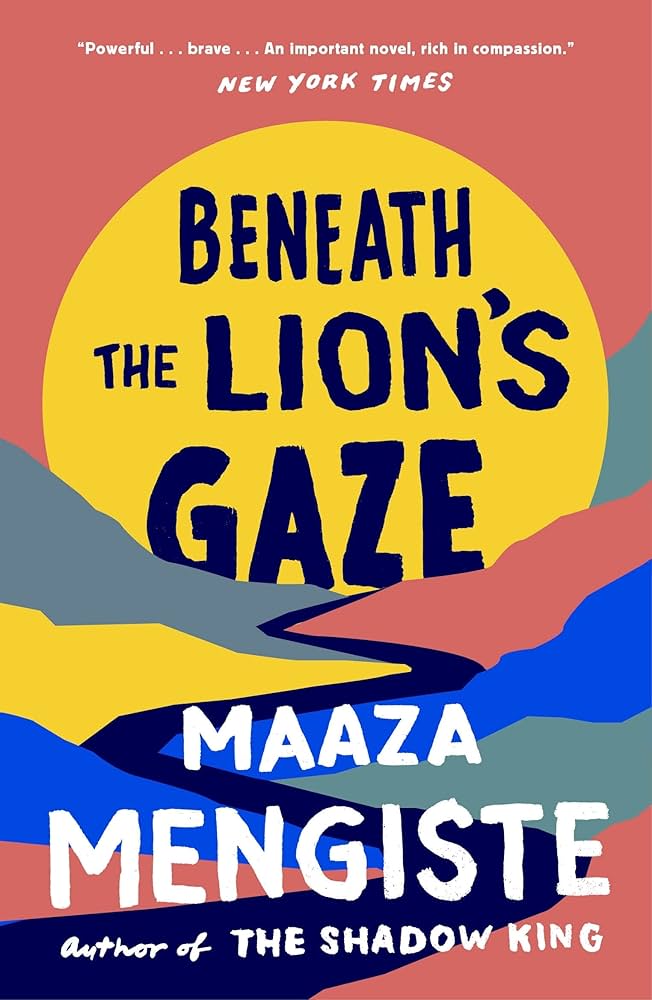
Her debut novel, published in 2010, sits squarely inside the period that drove her family into exile. Beneath the Lion’s Gaze follows a family in Addis Ababa as the 1974 revolution unfolds, as Haile Selassie is deposed and the Derg consolidates power through terror. The patriarch, Hailu, is a doctor. His two sons take opposite positions on the upheaval, one drawn toward the revolutionary fervour, the other recoiling from it. The novel watches a household get pulled apart by forces no single member can control.
What makes the book more than a competent political novel is Mengiste’s refusal to grant anyone the comfort of being purely a victim or purely a villain. The doctor faces an impossible choice when a tortured girl is brought to him to be kept alive only so she can be tortured further, and his decision becomes the moral hinge of the book. The prose is restrained where a lesser writer would reach for melodrama. The horror lands precisely because Mengiste refuses to amplify it.
The debut announced a writer interested in the texture of how ordinary people live inside extraordinary catastrophe. There is cooking, there is bickering, there is the small business of getting through a day, all of it continuing even as the state turns murderous. The novel was a runner-up for the Dayton Literary Peace Prize in fiction, a finalist for the Flaherty-Dunnan First Novel Prize, and later named by The Guardian among the ten best contemporary African books, and it established Mengiste as a serious chronicler of modern Ethiopian history rather than a memoirist mining her own family for material.
It is worth pausing on how rare this kind of book was when it appeared. The fall of Haile Selassie and the Derg’s reign of terror had been documented by historians and human rights groups, but it had scarcely entered English-language fiction. Mengiste was writing into near silence, giving a literary form to events that her own generation of Ethiopians knew mostly as inherited trauma. The body in the street, the disappeared neighbour, the child made to confess at gunpoint, these were not invented horrors but the lived material of a country she had been carried away from before she could fully grasp it. The novel does the work of remembering on behalf of people who could not, or dared not, speak.
The Shadow King
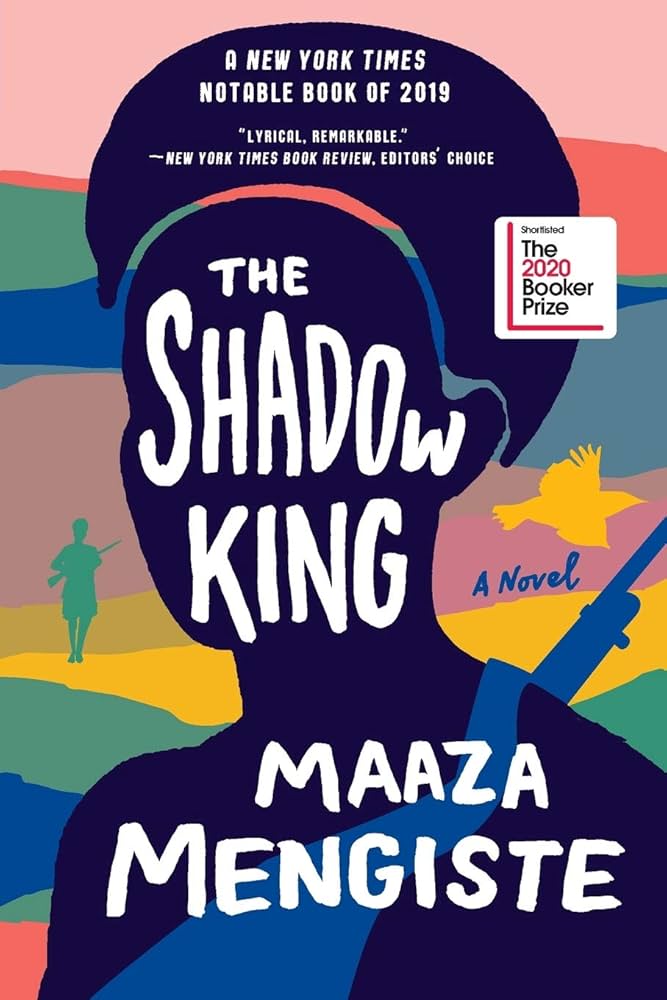
Nine years later came the novel that would define her reputation. The Shadow King, published in 2019 and shortlisted for the Booker Prize in 2020, returns to an earlier convulsion, the Italian invasion of 1935 under Mussolini. Its great subject is the women who fought, the cooks and servants and wives who picked up weapons when the men were dying, and whose participation in the resistance was scrubbed from the official histories.
At the centre is Hirut, an orphaned servant in the household of the resistance officer Kidane and his wife Aster. When Haile Selassie goes into exile in 1936, the resistance faces a collapse of morale, and its answer is theatrical: a peasant named Minim is dressed up as a decoy emperor to keep the troops believing their sovereign has not abandoned them. Hirut becomes his guard. The shadow king of the title is this stand-in, but the deeper shadows belong to the women whose courage went unrecorded. Mengiste structures the novel ambitiously, weaving in choral interludes, photographs described as if from an Italian soldier’s camera, and a frame that loops back to Hirut decades later carrying a box of images.
The book asks hard questions about looking, about who holds the camera and who is captured by it. Ettore Navarra, a Jewish soldier in the Italian army, photographs executed Ethiopians as trophies while understanding that the racial logic of fascism will shortly be turned on him. Mengiste makes the reader sit inside the discomfort of the gaze, then hands the power of looking back to the women themselves. It is a dense, demanding novel, and some readers find its lyricism overwhelms its pacing. But its ambition is undeniable, and its recovery of erased women from the historical margins is the achievement the Booker shortlist recognised.
The novel grew partly out of a private discovery. Mengiste has spoken about learning that her own great-grandmother had gone to war against the Italians, a fact that had been folded quietly into family lore rather than celebrated as the act of defiance it was. That personal thread runs beneath the larger historical recovery, and it explains the intensity of the book’s commitment to the women who fought. Mengiste was not constructing a thesis about gender and warfare from the outside. She was excavating a truth her own bloodline had half-buried, and the fictional Hirut becomes a vessel for all the unnamed women whose courage was treated as a footnote. The book insists, page after page, that the footnote is the story.
Beyond the Novels
Mengiste’s work extends past fiction into a sustained engagement with the image. She contributed a section to the 2013 documentary Girl Rising, on girls’ education around the world, alongside Edwidge Danticat and Mona Eltahawy, and her involvement reflects a career-long attention to the lives of women that official accounts overlook. Her preoccupation with photography and the archive is not a literary affectation. It is a method. She collects images, studies the captions and the silences in them, and treats the archive as a site of both violence and recovery.