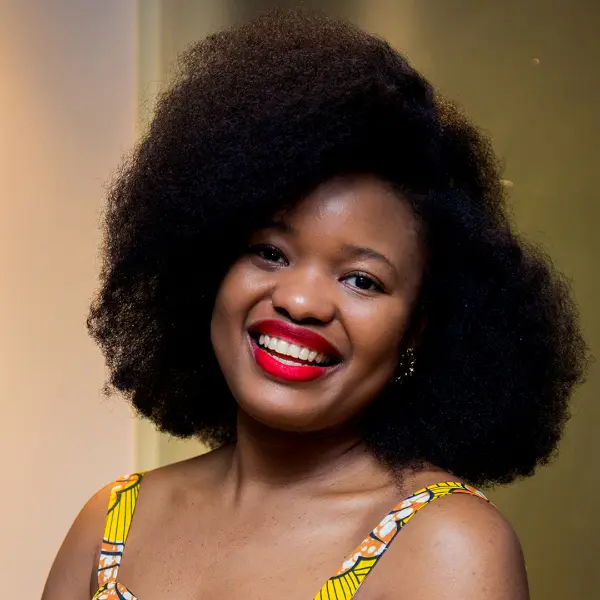

She was nineteen when Faber and Faber signed her, described at the time as the youngest female writer the storied British house had ever taken on, and she had begun the manuscript at seventeen. The story sounds like the kind of thing publishers invent for jacket copy, but it happened, and the book that resulted, The Spider King’s Daughter, was no novelty act. It was a sharp, double-voiced Lagos love story that announced a writer with an ear for the city and a refusal to flinch from its cruelties. Chibundu Onuzo has since proven that the prodigy was no fluke, building a body of work that runs from a teenage romance across the class divide to a novel about an African ruler and the daughter who never knew him, and on into children’s fiction. The throughline is Lagos, class, and the stubborn human need to belong somewhere.
Lagos, London, and a Faber Contract at Nineteen
Chibundu Onuzo was born Imachibundu Oluwadara Onuzo in 1991, the youngest of four children of two doctors, and grew up in Lagos. She moved to England at fourteen to sit her GCSEs at St Swithun’s in Winchester, as many children of the Nigerian professional class do, and at seventeen she began writing the novel that would change her life. The detail everyone repeats, and that is worth repeating carefully, is the sequence of ages. She started the book at seventeen, Faber signed it two years later, and it was published when she was twenty-one. It is the kind of beginning that can overshadow a career, the wunderkind label following the writer around long after the work has matured past it.
What is striking, looking back, is how little the early success warped her. She did not coast on the story of her own precocity. She took a first-class degree in history at King’s College London, then a master’s in public policy at University College London, and went on to doctoral research at King’s on the West African Students’ Union, the interwar London organisation of West African students that fed into anti-colonial politics. The historical training shows in her later, more ambitious fiction. She also kept up a second creative life as a singer-songwriter, performing and releasing her own music, including “Good Soil,” a song she wrote and released as a companion piece to Sankofa.
Onuzo belongs to the generation of Nigerian writers who came of age between Lagos and London, fluent in the codes of each. She writes Lagos with the intimacy of someone who grew up in it and the slight estrangement of someone who left at fourteen, and she writes Britain as a place that is hers and not hers at once. That doubleness, the perpetual question of where one truly belongs, runs through everything she has published. She was named in 2014 to the Hay Festival’s Africa39 list of African writers under forty, and in 2018 she was elected a Fellow of the Royal Society of Literature in its “40 Under 40” intake.
The Books, in Order
Onuzo is usually described as the author of three novels, which has stopped being accurate. Alongside the adult fiction she has written for children, and she has also worked in short fiction and on screen, so the shelf is wider than the standard three-book summary suggests. The table below separates the books from the adjacent work, because the two get conflated constantly: she is a musician as well as a novelist, and the songs are songs rather than albums of poetry or verse novels, which is the kind of slippage that turns a performer into a phantom bibliography.
| Title | Year | Form |
|---|---|---|
| The Spider King’s Daughter | 2012 | Novel, Faber and Faber; won a Betty Trask Award |
| Welcome to Lagos | 2017 | Novel, Faber in the UK; Catapult edition in the US in 2018 |
| “Sunita” | 2019 | Short story, in the anthology New Daughters of Africa |
| Sankofa | 2021 | Novel, Virago in the UK, Catapult in the US, Narrative Landscape in Nigeria |
| Mayowa and the Sea of Words | 2024 | Children’s novel, Bloomsbury |
| Mayowa and the Fire of Speech | 2026 | Children’s novel, Bloomsbury; second in the Mayowa sequence |
The Spider King’s Daughter
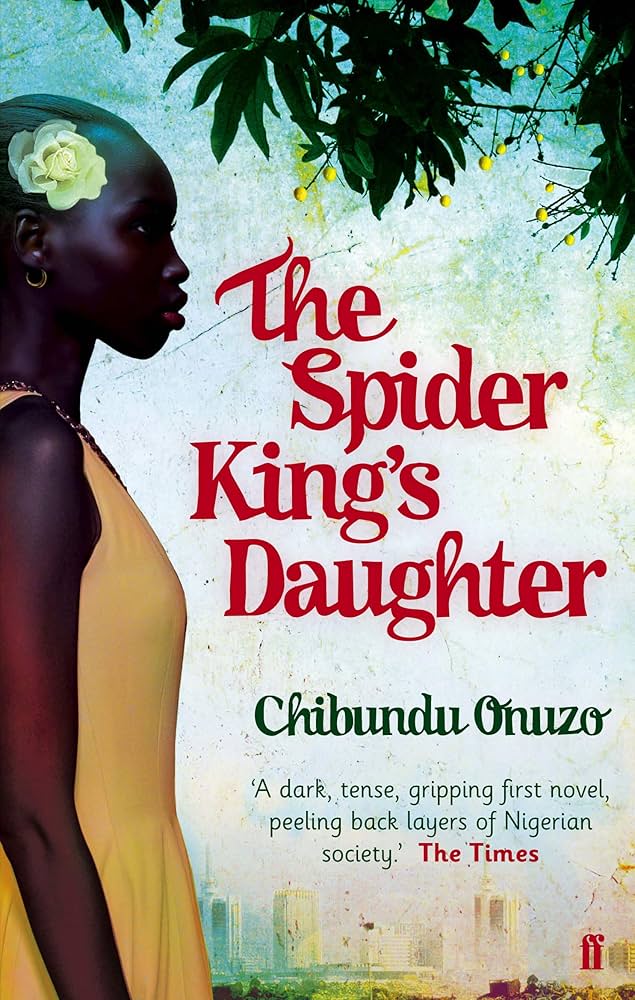
Her 2012 debut, the one she began as a teenager, is a Lagos love story told across an unbridgeable class divide. Abike Johnson is the daughter of a ruthless, fabulously wealthy businessman, the “Spider King” of the title, who has clawed his way to the top of the city and rules his family with the same iron control he uses on his empire. The unnamed boy she falls for is a street hawker, selling ice cream and cold water in the traffic to survive, his own family ruined by forces he is only beginning to understand. The novel alternates between their two voices, hers privileged and watchful, his proud and wounded, and the gap between their worlds is the engine of the story.
The romance is genuine and the writing has real charm, but Onuzo refuses to let it be a fairy tale. The class divide in Lagos is not a soft obstacle to be overcome by love. It is a hard, structural thing, tied to violence, corruption and the buried history of how the rich got rich. As the boy uncovers the truth about the Spider King and his own family’s fate, the love story curdles into something darker, and the ending refuses the comfort the reader has been led to expect.
The book’s prize record is worth getting right, because it is routinely inflated. It won a Betty Trask Award in 2013, an award for first novels by writers under thirty-five. It was shortlisted, but did not win, the Dylan Thomas Prize and the Commonwealth Book Prize, and it was longlisted for both the Desmond Elliott Prize and the inaugural Etisalat Prize for Literature. What the book announced was Onuzo’s central gift, the ability to write Lagos as a living, stratified organism, beautiful and brutal, where the distance between the tinted-window Mercedes and the boy tapping on its glass is the whole story of the city.
Welcome to Lagos
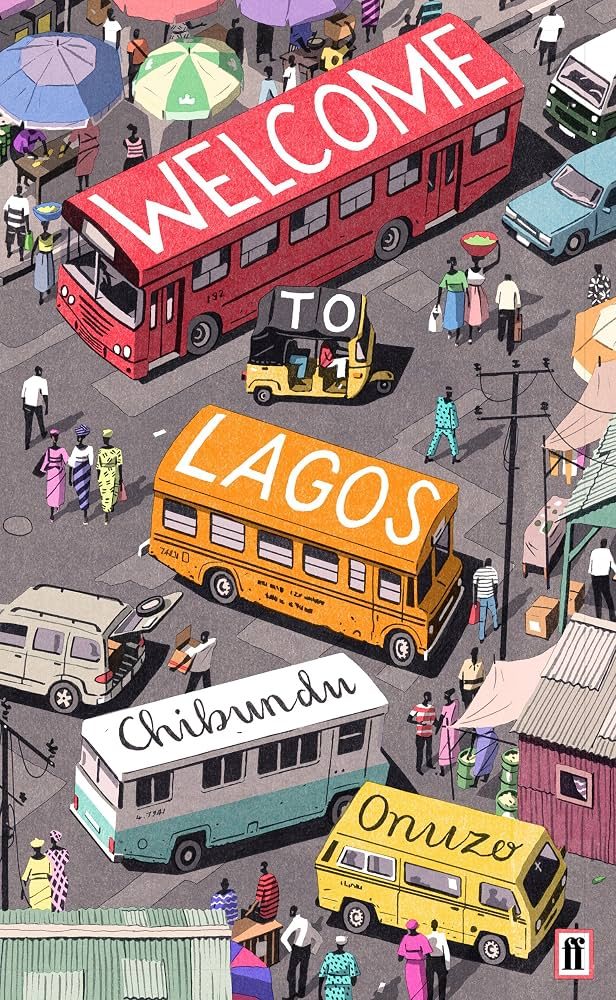
Her second novel, published by Faber in January 2017 and issued in the United States by Catapult the following year, is broader, funnier and more generous, a portrait of the city through a band of unlikely strangers who fall in together. Chike Ameobi, an army officer, deserts in the Niger Delta rather than carry out an order against a village, and his junior, Yemi, walks away with him. On the road they collect Fineboy, a young ex-militant with an affected American accent and a dream of becoming a radio presenter, then Isoken, a sixteen-year-old who has escaped a rebel group, and finally Oma, who is leaving an abusive husband. They reach Lagos with nothing and squat in an apparently abandoned house, which turns out to belong to Chief Sandayo, the Minister of Education, who has absconded with millions meant for the schools.
Welcome to Lagos is a comic novel with serious bones. It is about corruption, the rot at the top of Nigerian public life, but it tells that story from the bottom up, through people the system has chewed and spat out. Onuzo’s affection for her characters is the book’s warmth, and her satire of the political class is its bite. A second strand follows Ahmed Bakare, a wealthy, London-educated newspaper editor chasing the Sandayo story, which lets her show the city from many angles at once, the bridge and the ministry, the newsroom and the street. The title, deadpan and welcoming, is an irony that opens into genuine love for the place.
The novel confirmed that Onuzo was not a one-book prodigy but a serious chronicler of Lagos, with a widening canvas and a sure comic touch. It was shortlisted for the Royal Society of Literature’s Encore Award, which recognises second novels. It is the book where her voice fully relaxes into itself.
Sankofa
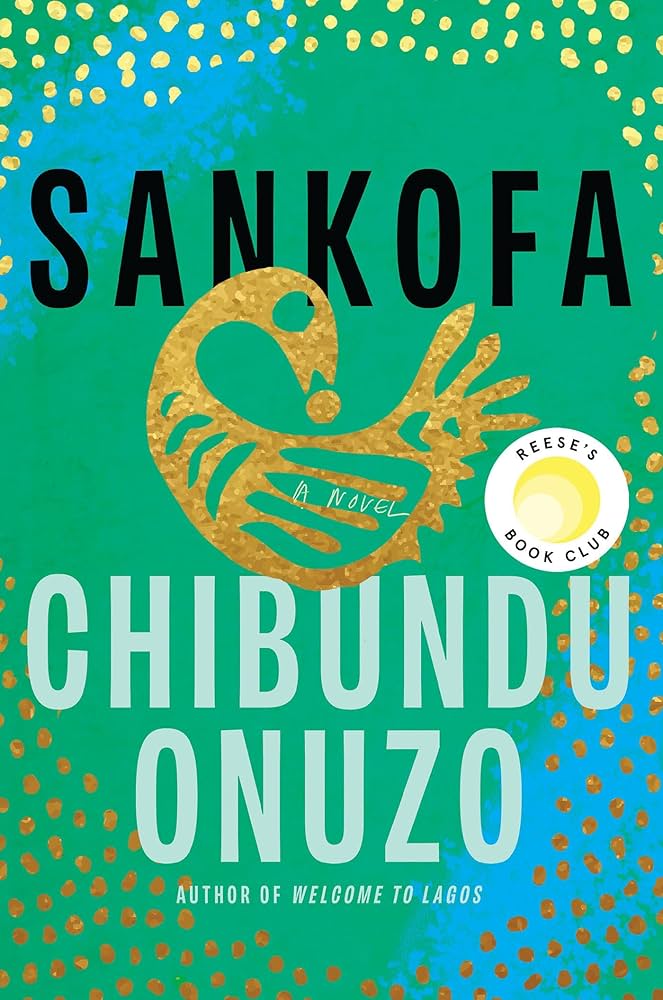
Her 2021 third novel makes the boldest leap. Sankofa follows Anna, a middle-aged mixed-race British woman whose marriage is failing and whose mother has just died, who discovers among her mother’s papers that the West African father she never knew was no ordinary student. He went home to become the president, and by many accounts the dictator, of a small invented African country. Anna travels there to find him still alive, elderly and complicated, and to discover what it means to be the daughter of someone other people remember as a tyrant.
The title comes from the Akan concept of Sankofa, the idea of returning to retrieve what was left behind, often pictured as a bird looking backward. The novel is a meditation on roots and return, on the mixed-race child’s lifelong question of belonging, and on the gap between the public monster and the private parent. Onuzo refuses the easy version in which the dictator is simply evil or simply misunderstood. Anna’s father is charming and ruthless, loving and indefensible, and the novel makes the reader sit with the impossibility of reconciling the two.
Sankofa extends Onuzo’s preoccupation with belonging into diaspora identity and postcolonial politics, and it found a notably wide readership, picked up by Reese Witherspoon’s book club and by the BBC’s Between the Covers. It is her most thematically ambitious book, and it pulls the question that has always driven her, where do I belong, into its sharpest and most personal form.