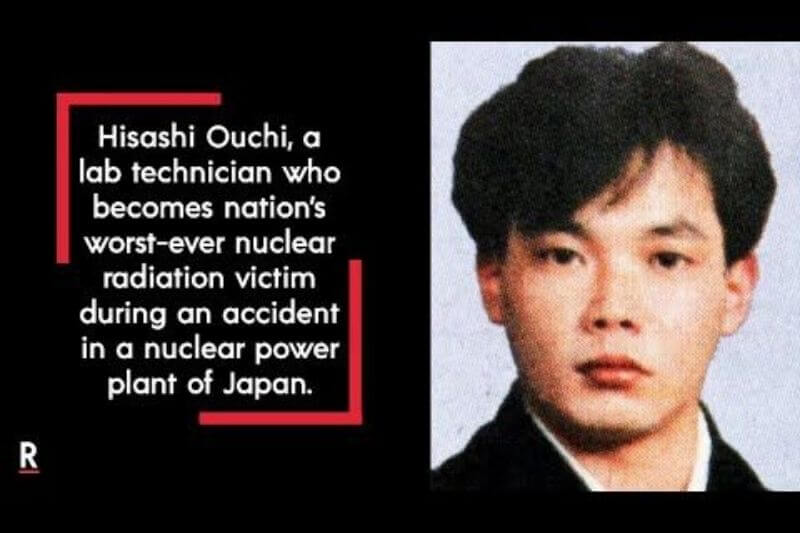
The saying that every job comes with its hazard couldn’t have been truer for Hisashi Ouchi. On September 30, 1999, Hisashi was exposed to the highest amount of radiation any human has ever been exposed to in documented history.
Effect of radiation on the human body.
Hisashi Ouchi was a 35-year-old technician who worked at a nuclear facility owned by the Japanese Nuclear Fuel Conversion Company known as Tokaimura. And he would go on to become the most radioactive man ever recorded to date. The level of radiation Ouchi was exposed was said to be almost the same as at the blast centers in the 1945 nuclear bombings of Hiroshima and Nagasaki. It was also reported to be at about 17,000 times the maximum annual permissible exposure in Japan.
Nuclear power has become an integral energy alternative for natural-resource starved Japan to limit dependence on imported energy. Tokaimura’s location and available land space made it an ideal investment for nuclear power production. Nuclear power provides approximately 30% of Japan’s electricity today.
In this article, we would rewind the hands of time to learn in detail, the unfortunate series of events that led to the disaster, its impact on humans, the environment and lessons learned from it.
How much radiation was Hisashi Ouchi exposed to?
Hisashi Ouchi was exposed to about 17 Sieverts of radiation, according to the Science and Technology Agency’s National Institute of Radiological Sciences in Chiba, near Tokyo.
How many Sieverts (the unit measurement of radiation) is lethal?
One Sievert, the unit measurement for a dose of radiation, will cause illness if absorbed all at once, and 8 Sieverts will result in death, even with treatment.
How nuclear plants operate
Nuclear power stations rely on fission, a process that involves splitting large heavy uranium atoms (U235) into smaller atoms. When they split, the atoms release large amounts of energy which is captured as heat, used to power boilers and steam turbines to generate electricity.
Large amounts of fuel are then loaded into a nuclear reactor as the fission reaction is allowed to get underway. The U235 is split by a particle called a neutron, and each time a U235 atom splits it releases energy and another neutron. This particle is then free to split another atom and there follows a growing cascade of splitting atoms called a chain reaction.
The reaction is controlled in the reactor to help keep the energy release under moderate proportions. Unimpeded, the chain reaction occurs almost instantaneously in an atomic explosion very much like the A-bombs exploded over Japan at the height of the Second World War.
JCO’s Function
JCO’s role was to provide the uranium fuel used by these stations. Ordinary uranium does not have enough uranium 235 (U235), a particular isotope that splits easily under the right conditions.
The company, and others like it, take more and enrich it, raising the level of U235 to between 2 and 4 percent of the total fuel weight. This is “rich” enough to make the power stations work and drive the turbines.
Does radiation melt skin?
Radiation is just energy being deposited in your body. However, a radiation dose high enough to melt your skin is going to cause unconsciousness well before that happens and acute death as well. It won’t really melt, but a high radiation dose can cause severe burns.
Nuclear power production process at Tokaimura
Tokaimura is an average-sized town in the Ibaraki prefecture (county), which sits on a crossroads of the Japanese nuclear energy industry. The region is populated with nuclear facilities, including power plants, fuel manufacturing facilities and service companies, all committed to the maintenance of the nuclear ethic.
Handling nuclear materials imposes extreme risks to technicians; it requires precision and seasoned employees to safely conduct procedures. The process of combining nuclear products involves a fission process with the potential to produce radiation and explosive energy.
In order to produce the necessary uranium fuel, a purified chemical procedure with three crucial steps is required:
- Feeding of small batches of uranium oxide powder into a designated dissolving tank in order to produce uranyl nitrate using nitric acid.
- Next, the mixture is carefully transported to a specially-crafted buffer tank. The buffer tank containing the combined ingredients is specially designed to prevent fission activity from reaching criticality. In a precipitation tank, ammonia is added forming a solid product. This tank is meant to capture any remaining nuclear waste contaminants.
- In the final process, uranium oxide is placed in the dissolving tanks until purified, without enriching the isotopes, in a wet-process technology specialized by Japan.
The JCO uranium processing plant disaster
It’s also important to state that Tokaimura was the site of Japan’s first nuclear plant, completed in 1966, and is home to no fewer than 17 nuclear facilities. It has also previously experienced a nuclear accident in March 1997 when a plutonium reprocessing plant suddenly caught fire, leaving 37 people exposed to radiation.
How does radiation kill?
Radiation damages your stomach and intestines, blood vessels, and bone marrow, which makes blood cells. Damage to bone marrow lowers the number of disease-fighting white blood cells in your body. As such, most people who die from radiation sickness are killed by infections or internal bleeding.
Chronology of events leading to nuclear criticality
Hisashi Ouchi and Masato Shinohara weren’t involved in ordinary fuel production at the JCO plant. They were formulating super-enriched fuel, which experts now believe was destined for an experimental new nuclear reactor. They were enriching the uranium to 19-20 percent. And as such, they worked in a “conversion experiment building”, one of the many large buildings on the JCO complex.
The production of uranium fuel pellets process involves relatively conventional industrial chemistry, but the risks involved were most certainly higher since the men were working with radioactive materials. Hisashi Ouchi and Masato Shinohara most likely resumed work much the same as they had the day before without any inkling of the disaster ahead of them.
30 September 1999
In an attempt to speed up the last few stages of the fuel-conversion process to meet shipping requirements, JCO facility technicians Hisashi Ouchi, Masato Shinohara, and Yutaka Yokokawa mixed the chemicals in stainless-steel buckets. The workers followed JCO operating manual guidance in this process but were unaware it was not approved by the STA. Under standard STA operating procedure, uranyl nitrate should be stored inside a buffer tank and gradually pumped into the precipitation tank in 2.4 kg increments.
With the workers manually transferring the solution, they had no way of measuring how much solution had been transferred and at around 10:35 am, the precipitation tank reached critical mass when its fill level, containing about 16 kilograms (35 pounds) of uranium, reached criticality in the tall and narrow buffer tank.
The hazardous level was reached after the technicians added a seventh bucket containing aqueous uranyl nitrate, enriched to 18.8% U235 to the tank. The solution added to the tank was more than seven times the legal mass limit specified by the STA.
The nuclear fuel conversion standards specified in the 1996 JCO Operating Manual outlined the proper procedures regarding the dissolution of uranium oxide powder in a designated dissolution tank. The buffer tank’s tall, narrow geometry was designed to hold the solution safely and to prevent criticality.
The workers bypassed the buffer tanks entirely, opting to pour the uranyl nitrate directly into the precipitation tank. Uncontrolled nuclear fission began immediately. The resulting nuclear fission chain became self-sustaining emitting intense gamma and neutron radiation in the nuclear facility.
At the time of the event, Hisashi Ouchi had his body over the tank while Shinohara stood on a platform to assist in pouring the solution. Yokokawa was sitting at a desk four meters away. All three technicians observed a blue flame which is believed to be Cherenkov radiation.
Hisashi Ouchi been transported to the hospital after suffering massive radiation exposure.
Technicians Ouchi and Shinohara immediately experienced pain, nausea, and difficulty breathing. Hisashi Ouchi received the largest radiation exposure resulting in problems with mobility, coherence and loss of consciousness. Upon the point of critical mass, large amounts of high-level gamma radiation set off alarms in the building triggering evacuation.
Evacuation
By mid-afternoon, the plant workers and surrounding residents were asked to evacuate. Five hours after the start of the criticality, evacuation of about 161 people from 39 households within a 350-meter radius from the conversion building commenced.
Twelve hours after the incident, 300,000 surrounding residents of the nuclear facility were told to stay indoors and cease all agricultural production. This restriction was lifted the following afternoon. Almost 15 days later, the facility instituted protection methods with sandbags and other shielding to protect from residual gamma radiation.
Containment
The lack of concrete and steel shielding around the building was considered a factor that helped the spread of radiation quickly. It was hitherto thought of as unnecessary because this type of accident was not supposed to be possible. Over the next several hours the fission reaction produced continuous chain reactions.
The next morning, workers ended the nuclear chain reaction by draining water from the surrounding cooling jacket installed on the precipitation tank. The water served as a neutron reflector. A boric acid solution was added to the precipitation tank to reduce all contents to sub-critical levels.