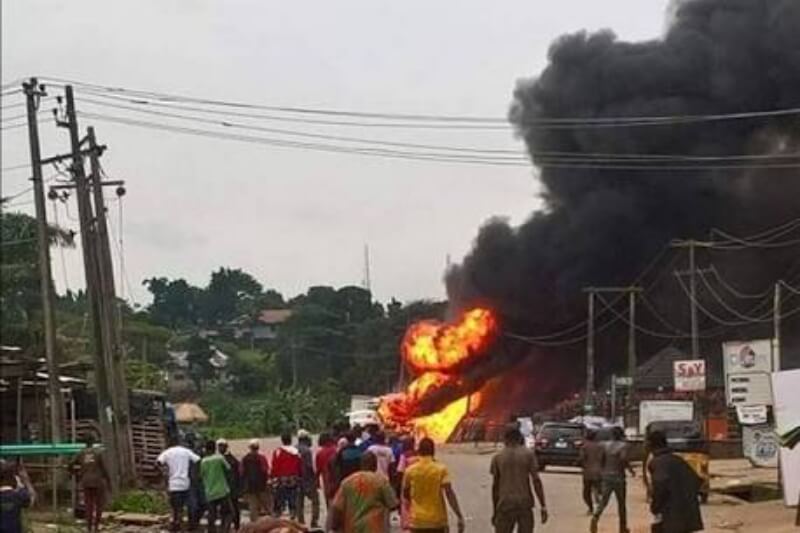
Over the years, there have been several explosions in Lagos state, which have led to losses of lives, properties and sources of livelihood. For some of the explosion, the cause could not be explicitly identified while for others they occurred out of negligence, sheer carelessness, lack of proper and adequate information and enlightenment - that is ignorance - on the part of those involved.
Known as the Center of Excellence and the commercial capital of Nigeria, Lagos is the hub for all forms of business activities. With a population of approximately 20 million, it is not just home for creativity and entertainment, unfortunately, it is also a hub for vices and tragedy. The latter is particularly notable.
The residents of Lagos have been hit badly by various explosions in the state, which claimed numerous lives.
Below are details of all the most recent explosions in Lagos state and their attributed causes.
All recent Lagos explosions and their known causes
1. Jesse pipeline explosion (1998)
In a small community called Jesse, which is located in Lagos, there occurred an explosion of a pipeline on the 18th day of October 1998. The death toll attributed to the explosion was reported to be 1,082. Just by looking at the number of casualties, you can see why the Jesse pipeline blast has been labelled by many as the most horrific of pipeline blasts in Lagos and maybe even Nigeria.
The primary cause of the blast was a ruptured pipeline. However, there have been two reports debating what had caused the pipeline to rupture. On the one hand, the Nigerian government attributed the cause to the work of vandals, who they say intentionally broke the pipeline thereby igniting the fire. On the other hand, off the record, some people have said that the rupture of the pipeline was caused due to neglect and lack of proper maintenance. The spark, which ignited the blast was initiated by a cigarette.
The pipeline, owned by the Nigerian National Petroleum Corporation (NNPC) continued burning uncontrollably until it was put out by a US-owned firefighting company. The then President Abdulsalami Abubakar visited the next day promising support, solutions and futuristic preventive measures.
2. Lagos Armory explosion (2002)
Popularly identified as the Ikeja Cantonment Bomb Blast, the Lagos armoury explosion was reported to have been caused by an accidental triggering of high-level explosives, which were stored at the Ikeja Cantonment, a military facility situated in the city.
This unfortunate happening occurred on 27th January 2002. The explosion created a large amount of debris, which caused fires around the northern part of Lagos city burning different sections of the area and causing great panic among residents and Lagosians in nearby areas.
The major tragedy was that the explosion alone wasn’t the direct cause of most deaths attributed to it, but the uncertainty and fear it created. Sadly, on hearing the explosions and seeing the flames, many who fled in panic fell and drowned in a concealed nearby canal.
It is believed that the explosion and its effect caused the death of at least 1,100 persons and displaced more than 20,000 others. Additionally, several thousand more were injured or left homeless.
An inquiry pointed the finger at the Nigerian Army for not decommissioning the base when directed back in 2001. A lack of maintenance was also figured as another reason for the explosion.
A fire that had broken out at a nearby street market spread to the base’s primary munition store detonating the explosives and causing a humongous blast, killing many of the staff and families in the base. Streets nearby were destroyed, and fires were ignited in other areas due to the debris sent flying by the blast.
The tremors shook down buildings and trapped people in the ruins. Windows 15km were reportedly shattered while 50km inland could feel the tremors of the blast. This sent thousands running for safety; those who fell in the stampede were trampled upon to death. Others were reported to have jumped from high rise buildings to drop to their death in the fight to live.
This horrific and devastating effect was too much for the emergency services to handle as their woeful inadequacy of water points or personnel was control. The hospitals in the suburb were overwhelmed as the explosion continually boiled out of the consumed armoury into the afternoon of January 28.
By the eve of the 28th January, things seemed to be under control but families were in utter bewilderment as they sought their loved ones and children including those of the military personnel who had lost a large number of their Lagos-based staff.
Read Also: Buhari commiserates with Ghanaian President over Accra explosions
3. Abule Egba pipeline explosion (2006)
The Abule Egba pipeline explosion was one of the explosions in Lagos State where hundreds of people died. The blast happened on Boxing Day, 26th December 2006.
The disaster was reported to have taken place in the densely populated area of Lagos when an elevated pipeline, which was a passage for petroleum products, was targeted by vandals. It was not totally clear if the pipeline was punctured as a divergence strategy or otherwise. However, the result was the same as the pipeline was vandalised and punctured at about midnight local time.
This was noticed by some and alerted others. Soon, hundreds of individuals gathered around to scavenge fuel using different sorts of containers, thereby leaving puddles and trails of fuel on the ground where the siphoning was taking place.
These droplets of fuel were ignited and there was an explosion. There was no specifically stated cause of the fire, which set off the explosion that rocked Abule Egba. However, some who claimed to be witnesses, stated that the pipes were struck before it went off.
It was initially reported that there were around 500 deaths, but later reports put the loss at a relatively smaller number. Then secretary-general of the Nigerian Red Cross (NRC), Abiodun Orebiyi gave an estimate of at least 200 dead, adding that 60 persons were affected with serious burns. Houses, mosques and churches were also destroyed.
4. Atlas Creek pipeline explosion (2006)
In 2006, vandals drilled holes into a pressurised pipeline at Insanki Island, popularly known as Atlas Creek, near Lagos Nigeria, leading to a massive explosion that killed hundreds of people.
On the 12th of May 2006, a petroleum pipeline was ruptured by vandals to siphon fuel. This action attracted locals too, who joined the vandals to scoop fuel with their jerry cans. It was in this hullabaloo that the explosion occurred. It could not be ascertained as to whether it was a spark against the pipes or maybe a flame that led to the explosion.
After the incident, the Nigerian Red Cross was reported to have found about 500 jerry cans at the scene of the explosion. The disaster at Atlas Creek claimed 150 lives, and all consumed within 20 metres of the explosion.
Then-President Olusegun Obasanjo ordered a full-scale investigation into the incident. The remains of the corpse had to be buried in a nearby area creating a massive graveyard.