
Dry humor, or deadpan humor, is the art of maintaining a neutral emotion while talking about a ridiculous or absurd subject. It is a form of comedy that is common among several forms of entertainment. Ranging from stand-up comedy, films, writing, and so on, dry humor is as old as time.
It is also called dry-wit humor because it sometimes requires a common level of intellect, or at least knowledge, to be enjoyed. Unlike regular comedy, where the buildup to the punch line already prepares the audience for the funny part, it is delivered in a blunt manner. Usually, the contrasting emotion of the deliverer and the subject makes the joke even funnier.
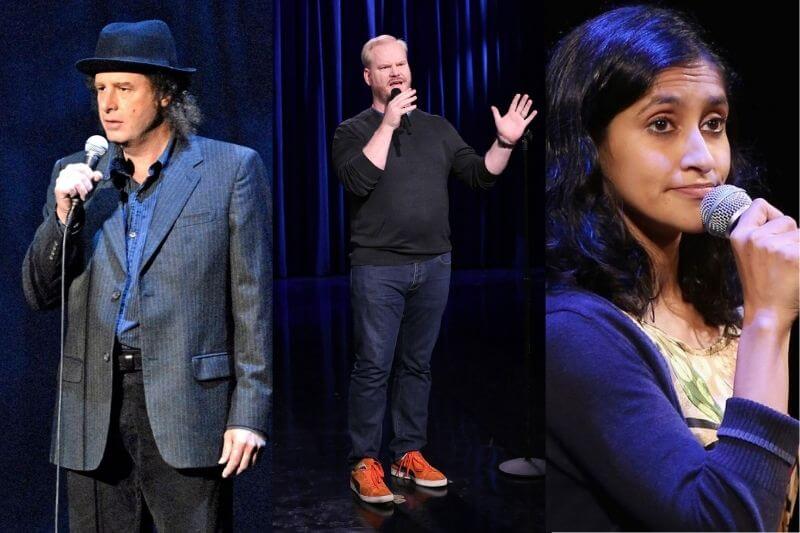
From Steven Wright to Jim Gaffigan and Aparna Nancherla, dry humor has been one of stand-up comedians’ most natural forte. Before we go into more details, here are 10 important facts you should know about this form of comedy.
Top 10 facts about Dry Humor
- Dry humor, or deadpan humor, is the art of maintaining a neutral emotion while talking about a ridiculous or absurd subject.
- It is the same as minimisation and requires the audience to a certain level of nuance, wit and knowledge, to enjoy the joke,
- The New York Times invented the word “deadpan” in 1928, and it was originally just a compound word ‘dead’ and ‘pan’.
- Dead, in the context of deadpan means, ‘without animation’ while pan is a common slang for ‘the face,’ and it was later translated to mean ‘playing a role with expressionless face’.
- Comedian and actor Buster Keaton is credited as one of the first performers to master a deadpan expression, using it widely in the early 1900s.
- The 1928 classic short film “The Beau Brummels” was entirely performed in deadpan, and it is the first film on record to do this.
- Steven Alexander Wright, an American dry humor stand-up comedian has won the Academy Award for Best Live Action Short Film and earned two Primetime Emmy Awards.
- Jim Gaffigan, another deadpan comedian was among the top ten grossing comics in the US in 2012 and was the most popular comic on Pandora.com with over 647 million spins in 2016.
- American comedian and actress Aparna Nancherla and “Army of the Dead” actress Tig Notaro are two deadpan and dry humor female comedians in the US.
- Rowan Atkinson (Mr. Bean) used to be a deadpan comedian in the 2000s and made his name in one such films, “Blackadder”.
Related: Websites to watch Asian drama and movies in English for free
History of dry humor and deadpan comedy
According to the Oxford English Dictionary, The New York Times invented the word “deadpan” in 1928. In its original form and usage, it was a compound word containing two words, ‘dead’ and ‘pan’. Dead, in this usage meant ‘without animation’ while pan is common slang for ‘the face’. Thus, deadpan was supposed to mean a face without animation, and a later concise definition says ‘playing a role with expressionless face’.
Comedian and actor Buster Keaton is credited as one of the first performers to master a deadpan expression. Before his career in film, Keaton had been a stage comedian in the 1900s, and he quickly realised that expressing no emotion while telling jokes made people laugh more than when he smiled. With this realisation, Keaton also employed the tactic in his acting. He eventually got the nickname “The Great Stone Face” for this.
The 1928 classic short film “The Beau Brummels” was entirely performed in deadpan, and so was the 1980 film “Airplane!”. In 1934, a character in the film “The Gay Bride” used the line ‘give it a dead pan’, in one of the earliest use of the term as a verb.
Over the years, the American and British entertainment industry have taken to deadpan humour. From John Cleese’s “Fawlty Towers” to Rowan Atkinson’s “Blackadder” and the 2000s “Curb Your Enthusiasm,” this form of comedy has always captivated audiences.
Dry humor is not so easy to understand as it has more to do with contradiction, delivery and context. While deadpan is just the use of an expressionless face when delivering a joke. To enjoy dry humor, the audience needs to be on the same page with the person in terms of nuance, wit and knowledge otherwise, they will miss the joke. See some of the most famous users of dry humor.
Steven Wright
Steven Alexander Wright is an American stand-up comedian in his late 60s, who made a name for himself using dry humor and deadpan delivery. He also has a signature lethargic voice going for him, which makes him sound funnier.
Wright is an example of a comedian who has mastered the art of wit and wordplay. He is also famous for his one-liners and surreal humor. Rolling Stone listed him as the 17th Greatest Comedian in a 2017 article. He has won the Academy Award for Best Live Action Short Film and earned two Primetime Emmy Awards.
Influenced by comic George Carlin and director Woody Allen, Wright began his career as a stand-up comedian in 1979 after he graduated from Emerson College, Boston, Massachusetts. He first performed at Comedy Connection in Boston before Peter Lassally discovered him and brought him on the “The Tonight Show” in 1982.
On his first appearance, Wright stole the show and everyone, from host Jonny Carson to the studio audience, wanted him to come back. He returned a week later. But he did not get a job on the show, instead, he went on to make a comedy album in 1985 titled “I Have a Pony”. The album got a Grammy Award for Best Comedy Album nomination, and HBO snatched him up.
Here is a collection of Steve Wright Deadpan, dry humor, and one-liner jokes:
https://youtu.be/tiGag5emLJg
His show became one of the most requested comedy specials on HBO, and he won an Academy Award in 1989 for the short film, “The Appointments of Dennis Jennings”. Wright’s style of laid-back dry humor and deadpan delivery got him cult-like followership in the media.
The popular meme about famous dead people not saying or writing many of the things attributed to them online was inspired by Steven Wright. He had said it when many jokes linked to him circulated on the internet. “Someone showed me a site, and half of it that said I wrote it, I didn’t write,” Wright said.
He was the first inductee into the Boston Comedy Hall of Fame in 2008, and was named in the top 50 comedy acts according to a 2005 poll to find The Comedian’s Comedian.