Copyright for Content Creators: How to Protect Your Work Online
Legal

Copyright for Content Creators: How to Protect Your Work Online

David Jituboh|
Ad SpaceArticle Top - 728x90
Advertisement

Copyright is the legal right that gives creators exclusive control over how their original works are used, distributed, and reproduced. If you understand copyright for content creators, you understand the foundation of your legal rights as someone who makes things and publishes them online. Copyright applies the moment you create an original work and fix it in a tangible form – recording a video, writing a blog post, composing a song, or taking a photograph all trigger automatic copyright protection.

Copyright protects the specific expression of ideas, not the ideas themselves. This is a critical distinction. If you make a YouTube video explaining five tips for better photography, your specific script, your visual presentation, your editing, and your voiceover are all protected by copyright. But the underlying ideas – the five tips themselves – are not. Someone else can create their own video covering the same five photography tips using their own words and images without infringing your copyright. They cannot, however, copy your script verbatim, re-upload your video, or use your footage without permission.

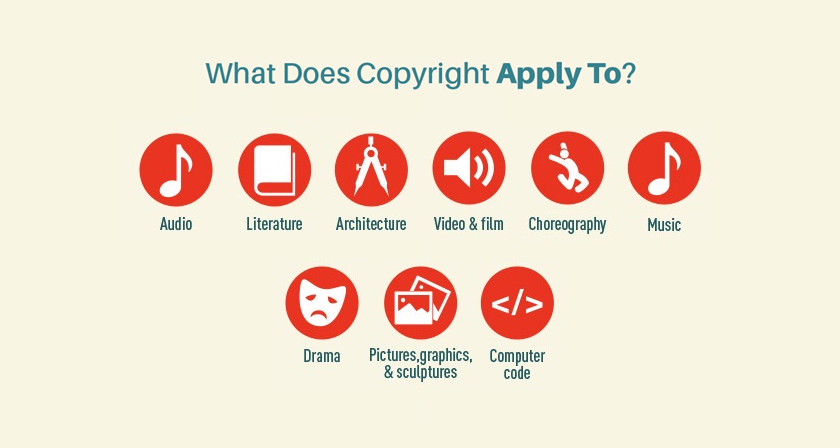
Here is what copyright does protect: literary works (blog posts, articles, scripts, books, social media captions), musical works (compositions, lyrics, and sound recordings), visual works (photographs, illustrations, graphic designs, thumbnails), audiovisual works (YouTube videos, TikTok videos, films, animations), and software (apps, code, games). Copyright protection lasts for the life of the creator plus 70 years under U.S. law.

Here is what copyright does not protect: facts, data, and information (you cannot copyright a historical date or a statistical figure), ideas, concepts, and methods (you cannot copyright the concept of a “day in the life” vlog), titles and short phrases (you generally cannot copyright a video title or a hashtag – though they may qualify for trademark protection), and works in the public domain (creative works whose copyright has expired, which are free for anyone to use).

Automatic Copyright vs Registered Copyright

One of the most common misconceptions about copyright for content creators is that you need to do something special to “get” a copyright. In the United States and most countries that have signed the Berne Convention (virtually every country in the world), copyright protection is automatic. The moment you create an original work and fix it in a tangible medium – writing it down, recording it, saving a file – you have copyright over that work. You do not need to register it, publish it, or put a copyright notice on it.

So why bother registering? Because registered copyright provides significantly stronger legal protections than automatic copyright. Here are the key benefits of registration with the U.S. Copyright Office.

Statutory damages. If your registered work is infringed, you can sue for statutory damages of $750-30,000 per work (or up to $150,000 per work for willful infringement) without having to prove actual financial losses. Without registration, you can only recover actual damages – meaning you would need to prove exactly how much money you lost because of the infringement, which is often difficult or impossible.

Attorney’s fees. If your registered work is infringed and you win the lawsuit, the court can order the infringer to pay your attorney’s fees. Given that copyright litigation can cost $50,000-500,000+ in legal fees, this provision is enormously important. Without registration, you pay your own legal fees regardless of whether you win.
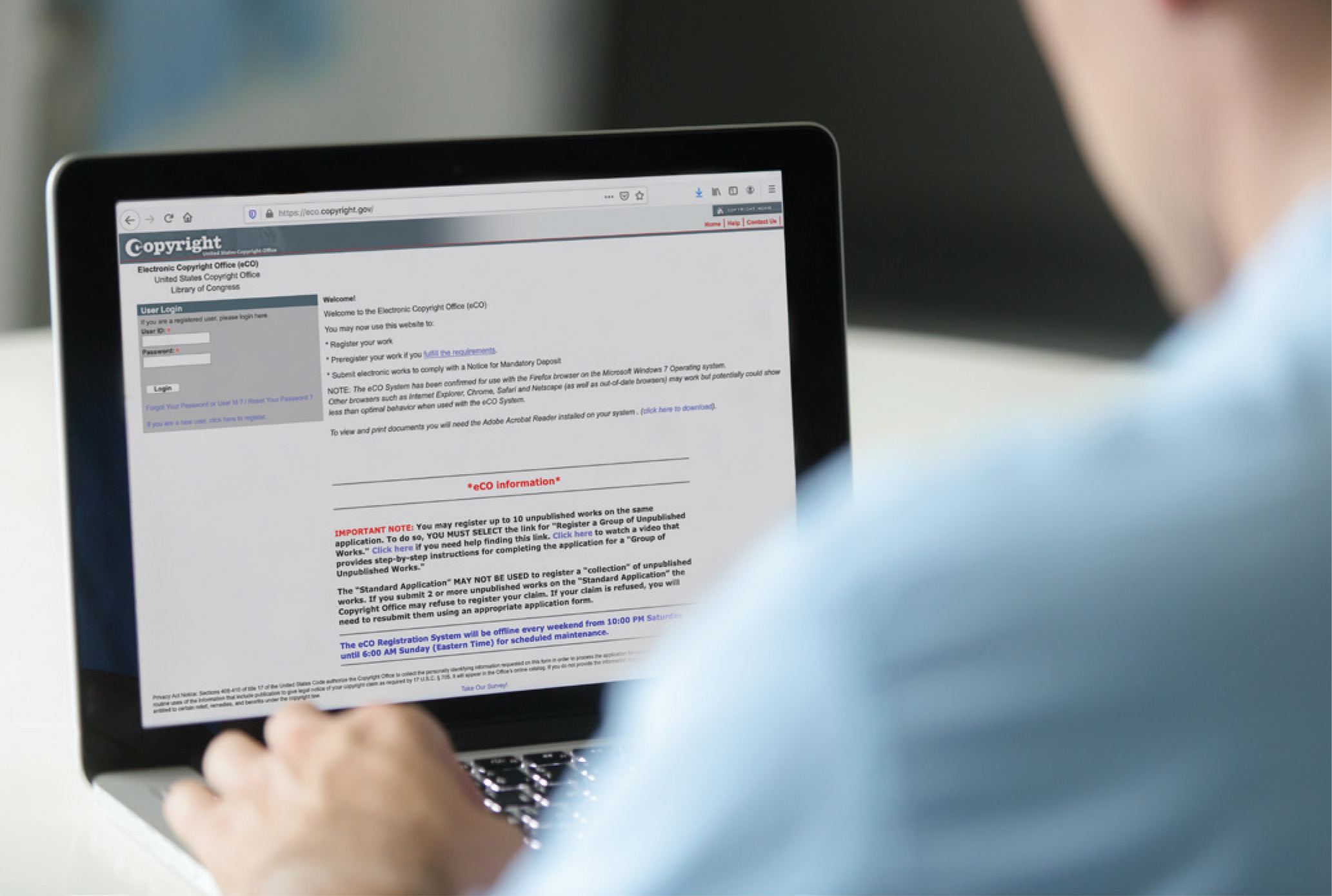
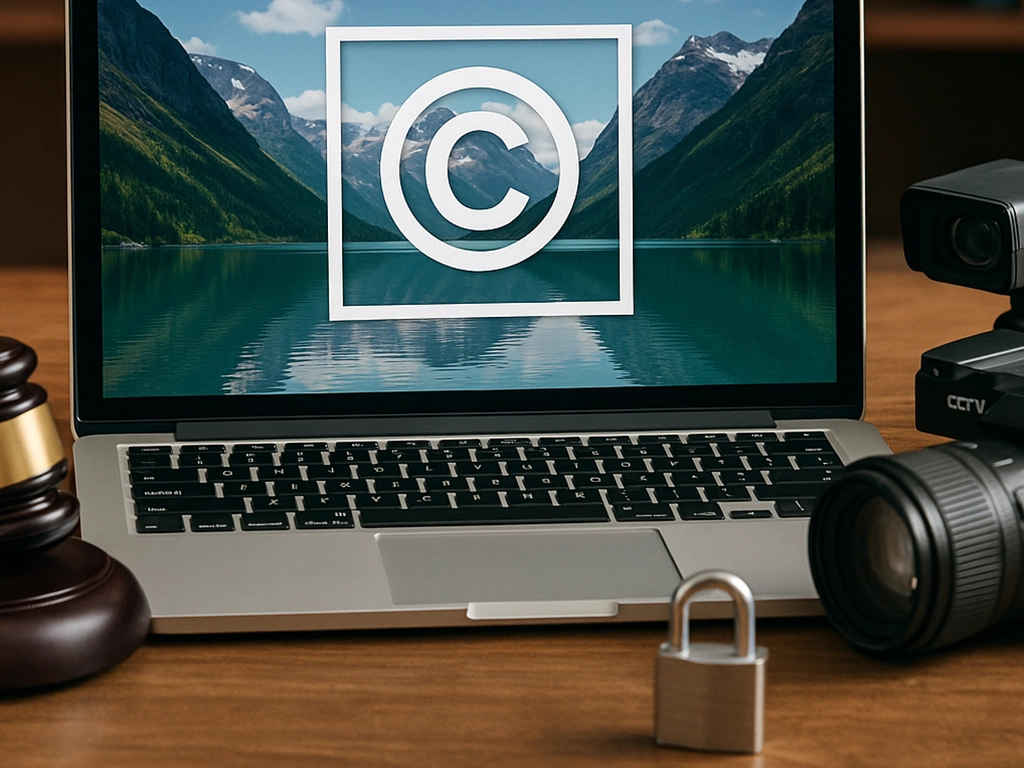
Copyright registration documents and certificates on desk with registration portal on laptop
Image: Copyright

Public record. Registration creates a public record of your copyright claim, which can serve as evidence of ownership in disputes. If someone claims they created the work first, your registration certificate with its filing date provides strong evidence to the contrary.

Prerequisite for lawsuits. You must register your copyright before you can file a copyright infringement lawsuit in federal court. You can register after infringement occurs, but you will only be eligible for statutory damages and attorney’s fees if you registered before the infringement began (or within three months of publication).

Registering a copyright is straightforward and relatively inexpensive. For a single work (one video, one song, one article), the filing fee through the U.S. Copyright Office’s online system is $65 as of 2026. For a group of published photographs or unpublished works, you can register multiple works in a single application. The process involves filling out an online form, paying the fee, and uploading a copy of your work. Processing takes 2-8 months, though your registration is effective from the date of filing.

For most content creators, it is not practical to register every single piece of content you create. A YouTube creator publishing weekly would spend over $3,000 per year on registration fees alone. A more strategic approach is to register your most valuable or most-likely-to-be-copied works: your best-performing videos, your original music, your signature series content, and any work that generates significant revenue.

Fair Use Explained: The Four Factors
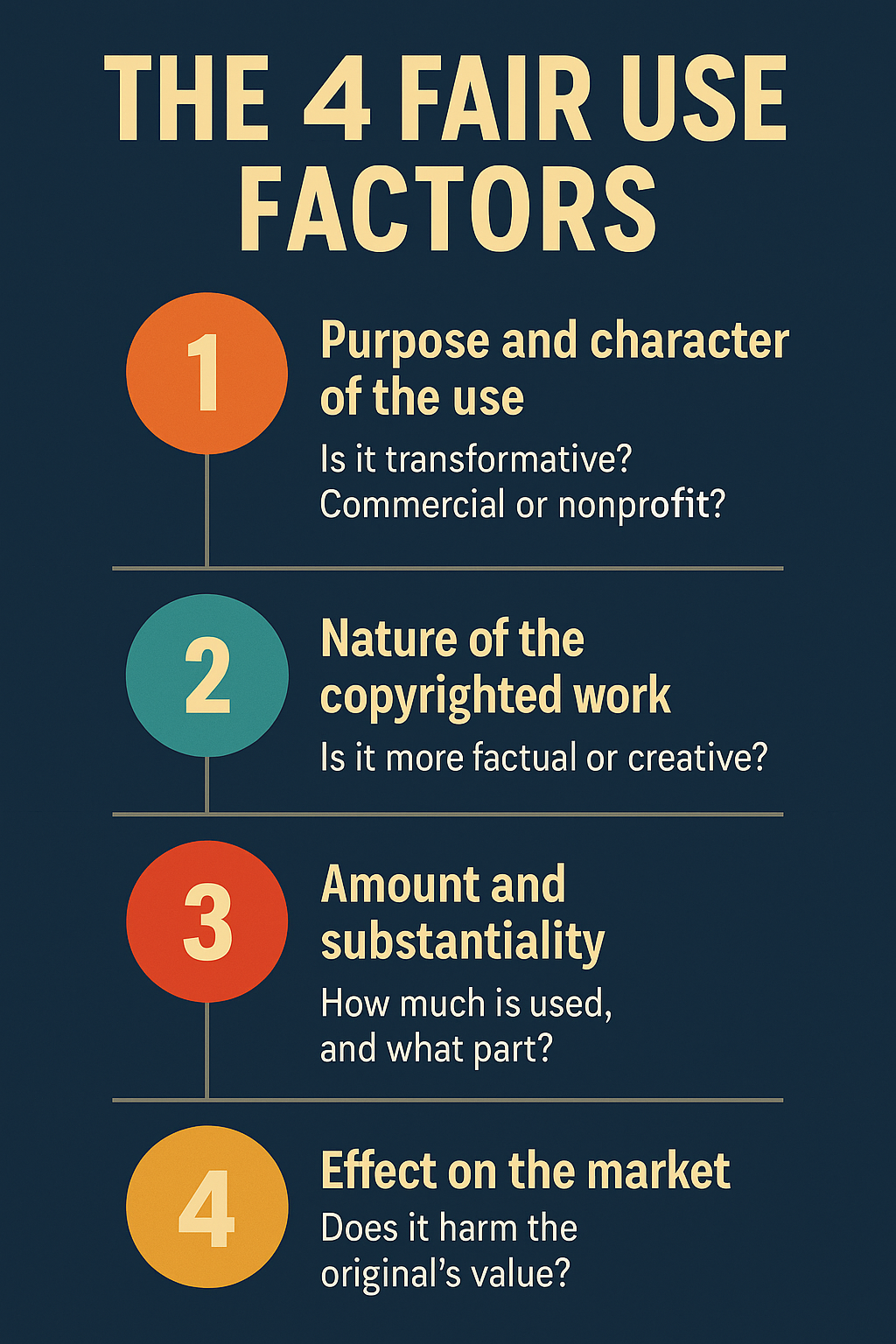
Fair use is the most misunderstood concept in copyright for content creators. It is a legal doctrine that allows limited use of copyrighted material without the copyright holder’s permission for purposes like commentary, criticism, education, news reporting, and parody. Fair use is why a movie reviewer can show clips from a film while reviewing it, and why a professor can photocopy a book chapter for classroom use.

Fair use is not a simple on-off switch. There is no rule that says “you can use 30 seconds of a song” or “you can use 10% of a written work.” Instead, fair use is determined by analyzing four factors, and courts weigh all four together to reach a conclusion.

Factor 1: The purpose and character of the use. Is your use “transformative” – meaning you are using the copyrighted material to create something new with a different purpose or meaning? Commentary, criticism, education, and parody are generally considered transformative. Simply re-uploading someone else’s video with no commentary is not. Commercial use weighs against fair use, while nonprofit educational use weighs in its favor. This factor is often considered the most important.

Factor 2: The nature of the copyrighted work. Using factual or informational content (like a news report) is more likely to be fair use than using highly creative content (like a song or a movie). Published works are more susceptible to fair use claims than unpublished works, because the creator’s right to control first publication is strongly protected.

Factor 3: The amount and substantiality of the portion used. Using a small portion of a copyrighted work is more likely to be fair use than using the entire work. But “amount” is not just quantitative – it is also qualitative. Using the “heart” of a work (the most distinctive or memorable part) can weigh against fair use even if the quantitative amount is small. For example, using a 30-second clip of a song that includes the chorus might not be fair use even though 30 seconds seems like a small portion.

Factor 4: The effect on the market for the original. If your use of the copyrighted material serves as a substitute for the original – meaning someone might watch your video instead of the original – that weighs heavily against fair use. If your use does not compete with the original’s market (for example, a critical review that uses clips to discuss the film’s flaws), it is more likely to be considered fair.

The practical reality for content creators is that fair use is a legal defense, not a permission. You assert fair use after being accused of infringement, and a court decides whether it applies. This means there is always some legal risk in relying on fair use, and the outcome is never guaranteed until a judge rules. Many creators over-rely on fair use claims that would not hold up in court, while others avoid perfectly legitimate fair uses out of excessive caution.

DMCA Takedowns: Filing and Responding

The Digital Millennium Copyright Act (DMCA) created the notice-and-takedown system that governs how copyright infringement is handled on digital platforms. Understanding DMCA procedures is essential copyright knowledge for content creators, whether you need to protect your own work or respond to a claim against you.

Filing a DMCA Takedown Notice

If someone has copied your content and uploaded it to a platform without your permission, you can file a DMCA takedown notice. The process varies slightly by platform but generally involves these steps.

First, locate the infringing content and gather evidence: the URL of the infringing content, the URL of your original content, and any evidence showing that you are the original creator (timestamps, original files, registration certificates). Second, use the platform’s copyright reporting tool. YouTube has a Copyright Takedown Request form, Instagram and TikTok have in-app reporting features, and most major platforms have dedicated DMCA pages. Third, submit the required information: your contact details, identification of the copyrighted work, identification of the infringing material, a statement that you believe the use is unauthorized, and a statement that the information in your notice is accurate under penalty of perjury.

Once the platform receives a valid DMCA notice, it is required by law to “expeditiously” remove or disable access to the infringing material. In practice, this typically takes 24-72 hours. The platform must also notify the person who posted the infringing content that it has been removed.

Responding to a DMCA Takedown (Counter-Notice)

If your content is removed due to a DMCA takedown notice and you believe the claim is incorrect – for example, because your use qualifies as fair use or because the claimant does not actually own the copyright – you can file a counter-notice. A counter-notice must include your contact information, identification of the removed content, a statement under penalty of perjury that you believe the material was removed by mistake or misidentification, and your consent to the jurisdiction of federal court.

After receiving a valid counter-notice, the platform must restore your content within 10-14 business days unless the copyright holder files a lawsuit in that time. Filing a false DMCA takedown notice or a false counter-notice carries legal penalties, as both are made under penalty of perjury. Abuse of the DMCA system – filing takedowns to silence criticism, harass competitors, or remove content you simply do not like – is both unethical and potentially illegal.

YouTube’s Content ID System

YouTube operates a proprietary system called Content ID that goes beyond standard DMCA procedures. Copyright holders upload reference files (audio or video) to Content ID, and the system automatically scans every video uploaded to YouTube for matches. When a match is detected, the copyright holder can choose to block the video, track the video’s analytics, or monetize the video (running ads and collecting the revenue). Content ID claims are not the same as DMCA takedowns – they do not result in copyright strikes against your channel – but they can demonetize your videos or block them in certain countries.

Creative Commons Licenses Explained
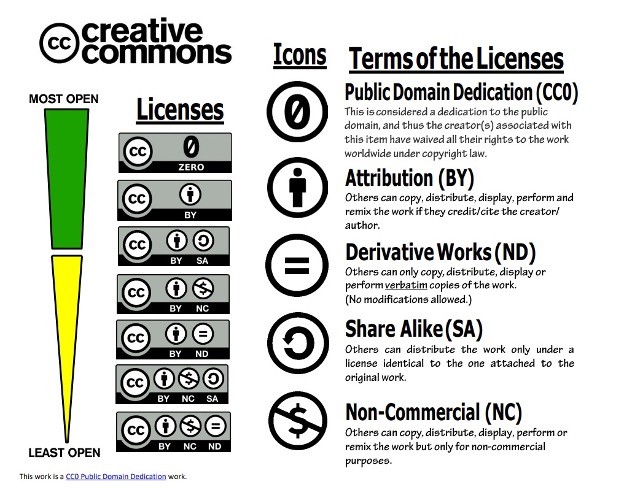
Creative Commons (CC) licenses are standardized copyright licenses that allow creators to grant specific permissions for how their work can be used. Instead of the default “all rights reserved” that comes with standard copyright, CC licenses offer a spectrum of permissions that range from very permissive to relatively restrictive. Understanding Creative Commons is important copyright knowledge for content creators both as users and as licensors of creative works.

CC BY (Attribution): The most permissive license. Others can copy, distribute, display, perform, and modify your work – even commercially – as long as they give you credit. This is commonly used for educational materials, research, and content that creators want to spread as widely as possible.

CC BY-SA (Attribution-ShareAlike): Same as CC BY, but anyone who modifies your work must distribute their derivative work under the same license. This “copyleft” provision ensures that derivative works remain freely available. Wikipedia uses this license.

CC BY-NC (Attribution-NonCommercial): Others can use and modify your work, but only for noncommercial purposes, and they must give you credit. This is popular among creators who want their work shared freely but do not want others profiting from it.

CC BY-ND (Attribution-NoDerivs): Others can copy and distribute your work in its original form, with credit, but they cannot modify it. This is useful when you want your work shared but not altered.

CC BY-NC-SA and CC BY-NC-ND: These combine the above restrictions. CC BY-NC-SA allows noncommercial modifications with the same license; CC BY-NC-ND is the most restrictive CC license, allowing only noncommercial sharing of the unmodified original.

CC0 (Public Domain Dedication): The creator waives all copyright and places the work in the public domain, allowing anyone to use it for any purpose without any restrictions. Pexels, Unsplash, and many stock photo sites use CC0 or similar licenses.

As a content creator, CC-licensed material can be incredibly useful for finding free music, images, and footage for your projects. Websites like the Free Music Archive, Wikimedia Commons, and Flickr allow you to search for CC-licensed content. Always check the specific license terms and provide proper attribution when required. Getting the attribution wrong or violating the license terms can still constitute copyright infringement.

Protecting Your YouTube Videos and Channel

YouTube is both the largest platform for video content creators and one of the most common places where content theft occurs. Here are specific strategies for protecting your YouTube content.

Register with Content ID (if eligible). YouTube’s Content ID system is the most powerful copyright protection tool on the platform, but it is only available to copyright holders who meet specific criteria – generally, they must own a significant catalog of original content. Third-party services like IdentifyY, Collab, and Vydia can help independent creators access Content ID through their existing partnerships.
Watermark your videos. YouTube offers a built-in channel watermark feature that places your logo or channel name on every video. While watermarks can be cropped out, they deter casual theft and make it easier to prove ownership if your content is copied.

Monitor for re-uploads. Services like YouTube’s Copyright Match Tool (available to channels in the YouTube Partner Program) automatically scan the platform for videos that match yours and notify you when potential copies are found. You can then review the matches and file takedown requests directly from the tool.

Include clear ownership information. In your video descriptions, include a copyright notice (e.g., “Copyright 2026 [Your Name]. All rights reserved.”) and a clear statement about permitted use. While this does not change your legal rights, it removes any ambiguity about whether others have permission to use your content.

Protecting Your Music Online

Musicians face unique copyright challenges because music has two separate copyrights: the composition (melody, lyrics, and arrangement, typically controlled by a music publisher) and the sound recording (the specific recorded performance, typically controlled by a record label or the artist). Understanding both copyrights is essential for musicians navigating copyright for content creators.

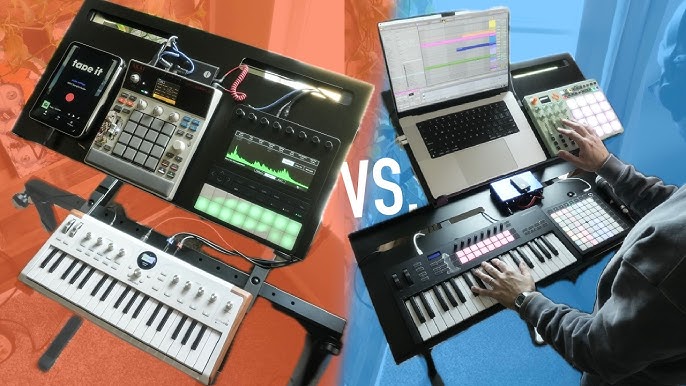
Music production setup with DAW, MIDI keyboard, and copyright registration documents
Image: YouTube

Register your songs with the Copyright Office. Register both the composition (using Form PA for performing arts) and the sound recording (using Form SR). You can register multiple unpublished songs as a collection in a single application to save on filing fees.

Register with a performing rights organization (PRO). BMI, ASCAP, and SESAC collect performance royalties on behalf of songwriters and publishers. When your music is played on radio, in venues, on streaming services, or in any public performance, your PRO collects royalties and distributes them to you. Registration is free with BMI and ASCAP.

Distribute through a reputable distributor. Services like DistroKid ($22.99/year), TuneCore ($14.99/year per single), and CD Baby ($9.95 per single) deliver your music to Spotify, Apple Music, Amazon Music, and other platforms while ensuring your content is properly registered and fingerprinted for automated copyright detection.

Use split sheets for collaborations. Every time you create music with another person, complete a split sheet documenting each person’s percentage of ownership for both the composition and the master recording. Sign it before leaving the studio. More copyright disputes in music come from unclear splits than from any other cause.

Protecting Your Writing and Blog Content

Written content – blog posts, articles, newsletters, social media posts, and books – is frequently copied online, often by content farms that scrape and republish articles without permission. Here are strategies for protecting your written work.

Publish first and establish timestamps. Your publication date serves as evidence of when your work was created. Use platforms that create clear, verifiable timestamps – WordPress post dates, email newsletter send dates, and social media post timestamps all serve this purpose. The earlier you can prove your work existed, the stronger your ownership claim.

Set up Google Alerts. Create Google Alerts for unique phrases from your most important articles. When those exact phrases appear elsewhere on the internet, you will receive a notification. This is a free, automated way to monitor for content theft across the web.

Use Copyscape. Copyscape ($0.03 per search) checks the entire web for copies of your content. The premium version can monitor your pages automatically and alert you when duplicates appear. For bloggers who publish regularly, this is a worthwhile investment in content protection.

Include clear terms of use. Add a copyright notice and terms of use page to your website that specifies whether and how others can quote, reference, or republish your content. Standard practice is to allow brief quotations with attribution and a link back to the original, while prohibiting full reproduction without written permission.

What to Do When Someone Steals Your Content

Despite your best preventive efforts, content theft is common online. Here is a step-by-step process for responding when you discover someone has copied your work without permission.

Step 1: Document everything. Take screenshots of the infringing content, save the URL, note the date you discovered it, and download a copy if possible. Also document your original work with timestamps proving you created it first. This evidence is essential if the situation escalates to legal action.

Step 2: Assess the situation. Is this a clear case of copying, or could it be coincidental similarity? Is the infringing content generating significant views or revenue, or is it on a small account with minimal reach? Is the infringer likely to respond to a polite request, or will you need to use formal legal mechanisms? Your response should be proportional to the severity of the infringement.

Step 3: Contact the infringer directly. Sometimes content theft is unintentional – someone may have shared your content thinking it was free to use, or a content team may have scraped it without realizing it was copyrighted. A polite, direct message explaining that the content is yours and requesting removal resolves many cases without the need for formal legal action. Provide a specific deadline (7-14 days is reasonable) for removal.

Step 4: File a DMCA takedown notice. If direct contact does not resolve the issue, file a DMCA takedown notice with the platform hosting the infringing content. As described above, this requires the platform to remove the content expeditiously. File notices with every platform where the infringing content appears.

Step 5: Contact the web host. If the infringing content is on a website (not a social media platform), you can file a DMCA notice with the website’s hosting provider. Most web hosts have abuse departments that handle copyright complaints and will remove infringing content or suspend the infringing website.

Step 6: Consult a lawyer. If the infringement is significant – generating substantial revenue, damaging your reputation, or continuing despite takedown notices – consult an entertainment or intellectual property lawyer about further legal options, including cease-and-desist letters and potential litigation.

International Copyright Considerations

Copyright law is territorial – each country has its own copyright laws, and your rights can differ depending on where the infringement occurs. However, international treaties provide a framework of minimum protections that apply in most countries.

The Berne Convention (1886, with many subsequent revisions) is the most important international copyright treaty, with 181 member countries. Under the Berne Convention, copyright protection is automatic (no registration required), member countries must provide a minimum term of protection (life of the author plus 50 years, though many countries exceed this), and works created in one member country receive the same copyright protection in all other member countries as that country provides to its own citizens.

The WIPO Copyright Treaty (1996) updated international copyright law for the digital age, requiring member countries to provide legal protections against circumvention of technological protection measures (like DRM) and against removal of copyright management information.

In practical terms, if you are a U.S. content creator and someone in Germany copies your video, your copyright is protected in Germany under the Berne Convention. You can file a DMCA-equivalent takedown in Germany (Germany has its own implementation of the EU Copyright Directive), and you could potentially pursue legal action in German courts under German copyright law. However, cross-border enforcement is complex and expensive, which is why most international copyright disputes are resolved through platform-based mechanisms (like DMCA takedowns) rather than litigation.

One important difference between countries: fair use is a specifically American doctrine. Other countries have similar but different concepts – the UK and Australia use “fair dealing,” which is more restrictive and limited to specific enumerated purposes. The EU has its own exceptions and limitations. Content that qualifies as fair use in the United States might not be legal in other jurisdictions, and vice versa.

Real Examples of Copyright Disputes in Content Creation

These real cases illustrate how copyright issues play out in the content creation world.

H3H3 Productions v. Matt Hoss (2017). YouTuber Matt Hosseinzadeh sued Ethan and Hila Klein (H3H3 Productions) for copyright infringement over a reaction video that used portions of his original video with commentary. The court ruled in H3H3’s favor, finding that their reaction video was transformative fair use. This case was significant because it was one of the first federal court rulings specifically addressing fair use in the context of YouTube reaction videos, establishing important precedent for commentary and criticism content.

Musician copyright strikes on Twitch. In 2020-2021, a massive wave of DMCA takedown notices hit Twitch streamers who had used copyrighted music in their streams – even as background music. Many streamers received multiple copyright strikes and had their accounts threatened with suspension. The incident highlighted how copyright law applies to live streaming and prompted Twitch to develop tools for removing copyrighted audio from recorded streams. It also spurred the growth of royalty-free music services specifically designed for streamers.

FreakingFrames Instagram dispute. Photographer and content creator FreakingFrames documented a case where a large brand used one of their Instagram photographs in marketing materials without permission or payment. After direct outreach failed, a DMCA notice and a lawyer’s cease-and-desist letter resulted in a settlement that included both compensation and a public acknowledgment. The case illustrated that even individual creators have legal recourse against well-resourced companies that use their work without permission.

AI training data controversies (2023-2026). Numerous content creators have discovered that their published works – blog posts, images, videos, and music – were used to train AI systems without their knowledge or consent. Several class-action lawsuits (including Getty Images v. Stability AI and Andersen v. Stability AI) are testing whether using copyrighted works to train AI constitutes infringement. As of 2026, court decisions are still emerging, but the issue has prompted many creators to add explicit AI training opt-out notices to their content and use robots.txt directives to block AI crawlers from scraping their websites.

Key Takeaways

  • Copyright protection is automatic the moment you create and fix an original work – but registering with the Copyright Office ($65 per work) unlocks statutory damages and attorney’s fees in lawsuits.
  • Copyright protects the expression of ideas, not the ideas themselves – someone can cover the same topic as you, but they cannot copy your specific content.
  • Fair use is determined by four factors (purpose, nature, amount, market effect) weighed together – there is no simple “X seconds is okay” rule.
  • DMCA takedown notices are your primary tool for removing infringing content from digital platforms, and most platforms process them within 24-72 hours.
  • Creative Commons licenses let you grant specific permissions for how others can use your work, from fully open (CC0) to restrictive (CC BY-NC-ND).
  • Use split sheets for any music collaboration, document everything with timestamps, and set up monitoring tools like Google Alerts and Copyscape.
  • International copyright protection exists through the Berne Convention (181 countries), but enforcement across borders is complex.
  • When someone steals your content, follow the escalation path: document, contact directly, file DMCA, contact web host, consult a lawyer.

Frequently Asked Questions

Do I need to register my copyright to be protected?

No – copyright protection is automatic the moment you create an original work and fix it in a tangible form. However, registering with the U.S. Copyright Office provides critical additional protections that make enforcement much more practical: the ability to sue for statutory damages ($750-150,000 per work), the ability to recover attorney’s fees if you win, and the creation of a public record of your ownership. Registration costs $65 per work and is strongly recommended for your most valuable content.

Can I use copyrighted music in my YouTube videos or TikTok posts?

Generally, no – not without a license. Using copyrighted music without permission can result in your video being blocked, demonetized, or taken down. TikTok and Instagram provide libraries of licensed music that creators can use freely within those platforms, but this license typically does not extend to other platforms. YouTube offers the Audio Library with royalty-free tracks. For any other use, you need either a synchronization license from the publisher and a master use license from the label, or you should use royalty-free music from services like Epidemic Sound, Artlist, or Musicbed.

What qualifies as fair use for content creators?

Fair use is most likely to apply when your use is transformative – meaning you are using copyrighted material to create something new with a different purpose or meaning. Commentary, criticism, education, news reporting, and parody are the most common fair use purposes. Using a brief clip from a movie while providing detailed analysis and criticism is more likely to be fair use than using the same clip purely for entertainment. There is no fixed amount (like “30 seconds”) that automatically qualifies as fair use – courts weigh all four factors (purpose, nature, amount, and market effect) together.

What should I do if I get a copyright strike on YouTube?

First, carefully review the claim to determine whether it is legitimate. If you believe the claim is incorrect – because you have a license, the content is yours, or your use qualifies as fair use – you can file a counter-notification through YouTube’s Copyright section. Be aware that filing a counter-notification is a legal statement made under penalty of perjury, so only file one if you genuinely believe the claim is wrong. If the claim is legitimate, remove the infringing content and avoid using the same material in future videos. Three active copyright strikes result in channel termination.

How do I protect my content from being used to train AI?

As of 2026, legal protections against AI training use are still developing. Practical steps you can take include adding a robots.txt directive to your website that blocks known AI crawlers (like GPTBot and CCBot), including explicit language in your website’s terms of use prohibiting the use of your content for AI training, registering your most important works with the Copyright Office, and supporting industry organizations advocating for stronger AI-related copyright protections. Several pending lawsuits may establish clearer legal precedents, but for now, prevention through technical and legal notices is the most practical approach.

Ad SpaceIn-Article - 300x250
Advertisement
Share
Copyright for Content Creators: How to Protect Your Work Online - Sidomex Entertainment